

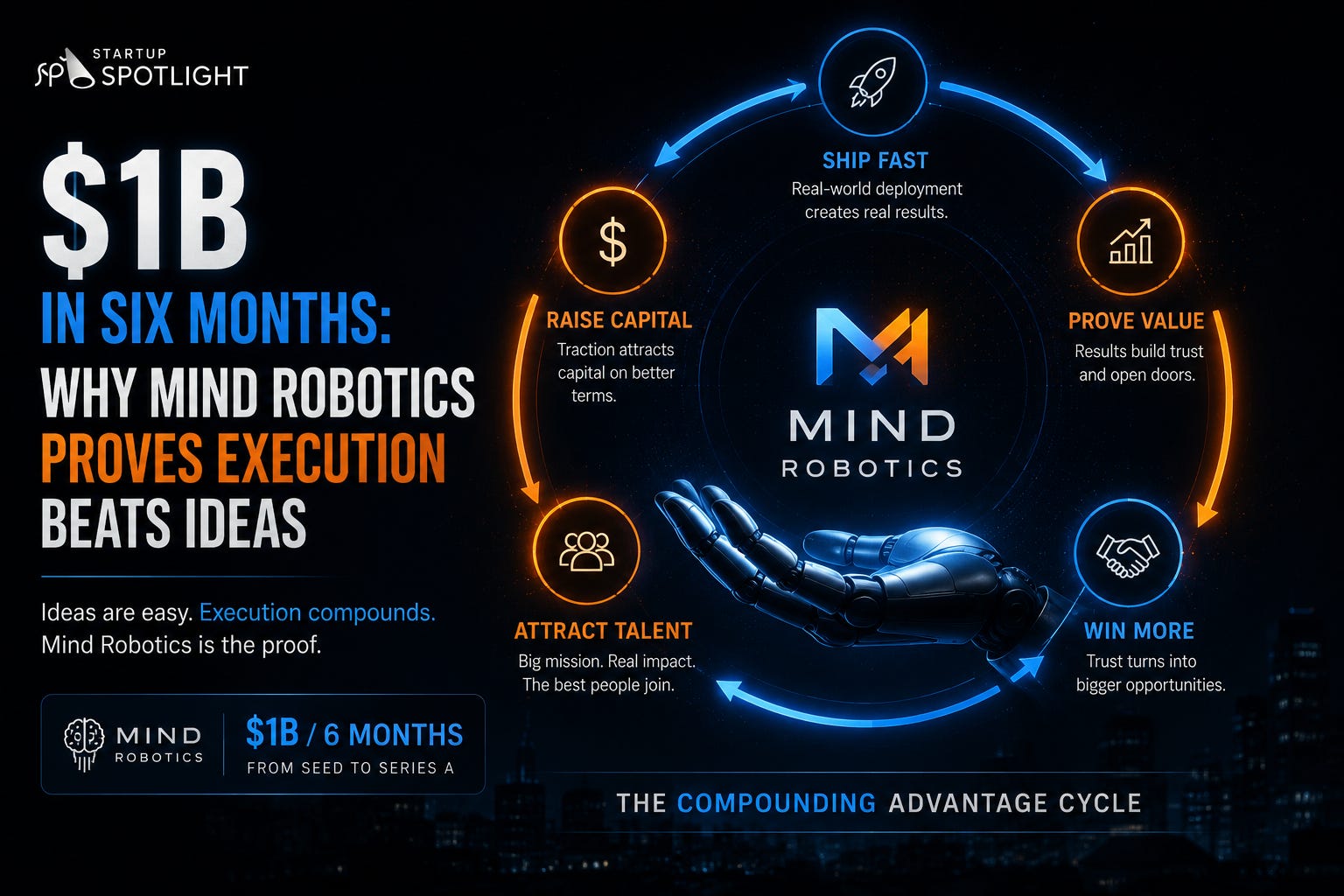
$1.015 billion. From nothing to a $3.4 billion valuation in less than six months. That’s not a victory lap. That’s a signal flare about how venture capital works in 2026.
Mind Robotics just announced a $400 million Series B led by Kleiner Perkins, bringing total investment to more than $1 billion. Six months prior, the company raised $115 million in seed funding in late 2025 and a $500 million Series A round in March 2026. That’s $115M, then $500M, then $400M in quick succession. Most founders would kill for that trajectory. The real story here is why it happened.
Mind Robotics, the industrial robotics spinoff created by Rivian CEO RJ Scaringe, raised another $400 million just two months after securing a separate $500 million funding round. But speed alone doesn’t move Kleiner Perkins. What moves Kleiner Perkins is this: Mind Robotics is building the world’s leading industrial robotics platform, combining foundation models, robust hardware, and deployment infrastructure to automate dexterous, reasoning-intensive manufacturing tasks at scale. Translation: they’ve got a live customer, real data, working hardware, and an actual problem to solve.
How Mind Robotics Built an Unfair Advantage Before Pitching VCs
Scaringe had access to Rivian’s factories. Not hypothetically. Actually. He could train models on real assembly lines, iterate with thousands of parts, and prove the thing works before asking VCs for the next check. That’s not luck. That’s the Flywheel Model: an unfair advantage that compounds.
Here’s how it works. You start with one asset nobody else has. In Mind Robotics’ case, it’s Rivian’s manufacturing footprint. You use that asset to generate exclusive data. They’re feeding foundation models with factory-floor realities. That data becomes harder to replicate than code. Competitors can’t just hire the same engineers. They don’t have the same hardware feedback loops. So you raise at a premium because you’ve already proven the thing works at scale. Then you raise again because the data advantage gets stronger. The flywheel turns. Capital follows proof, not slides.
This is the opposite of how most startups pitch. They build features. Mind Robotics built infrastructure. They built unfair advantages. The Palo Alto, Calif.-based company said it is building a “full-stack platform of foundation models, purpose-built robotics, and deployment infrastructure to automate industrial and manufacturing tasks at scale”. Every component of that stack is locked in because only they have the manufacturing access to test it.
Why’s this relevant to founders? Because it proves capital is done paying for narrative. VCs aren’t interested in what you say you’ll build. They’re interested in what you’ve already built. Mind Robotics raised $900M in the first two rounds not because Scaringe’s a good storyteller. He raised because he had deployed robots working in a live factory. Flywheel advantage. Unfair odds. Proof.
The Mental Model: Asymmetric Access Beats Patents
The mental model here is critical: Moats built through asymmetric access beat moats built through intellectual property. If you’ve got exclusive data, exclusive customers, or exclusive environments, you can raise faster, grow stronger, and make it harder for anyone else to catch up. Patents are breakable. Data flywheels are structural.
At /mkt, we’re building athlete tokenization in regulated markets. Our moat isn’t a patent. It’s that we’re already executing in Reg A+ offerings and tZERO infrastructure. That execution generates the data, the relationships, and the regulatory know-how that matter. Every trade teaches us something about investor behavior, liquidity, and market structure. That’s what capital actually wants to see.
The Real Startup Playbook: Build the Flywheel First, Then Raise
Mind Robotics just spent $900 million buying proof. The takeaway for builders isn’t “raise faster.” The takeaway is: if you can get in front of a real problem with real hardware before asking for scale capital, you’ll raise at better terms, faster, with less dilution. Build the flywheel first. Then ask for capital to turn it faster.
Most startups have this backward.
If this was useful, share it with someone who builds things. And if you want the full toolkit of 50 mental models, my book is coming soon.