


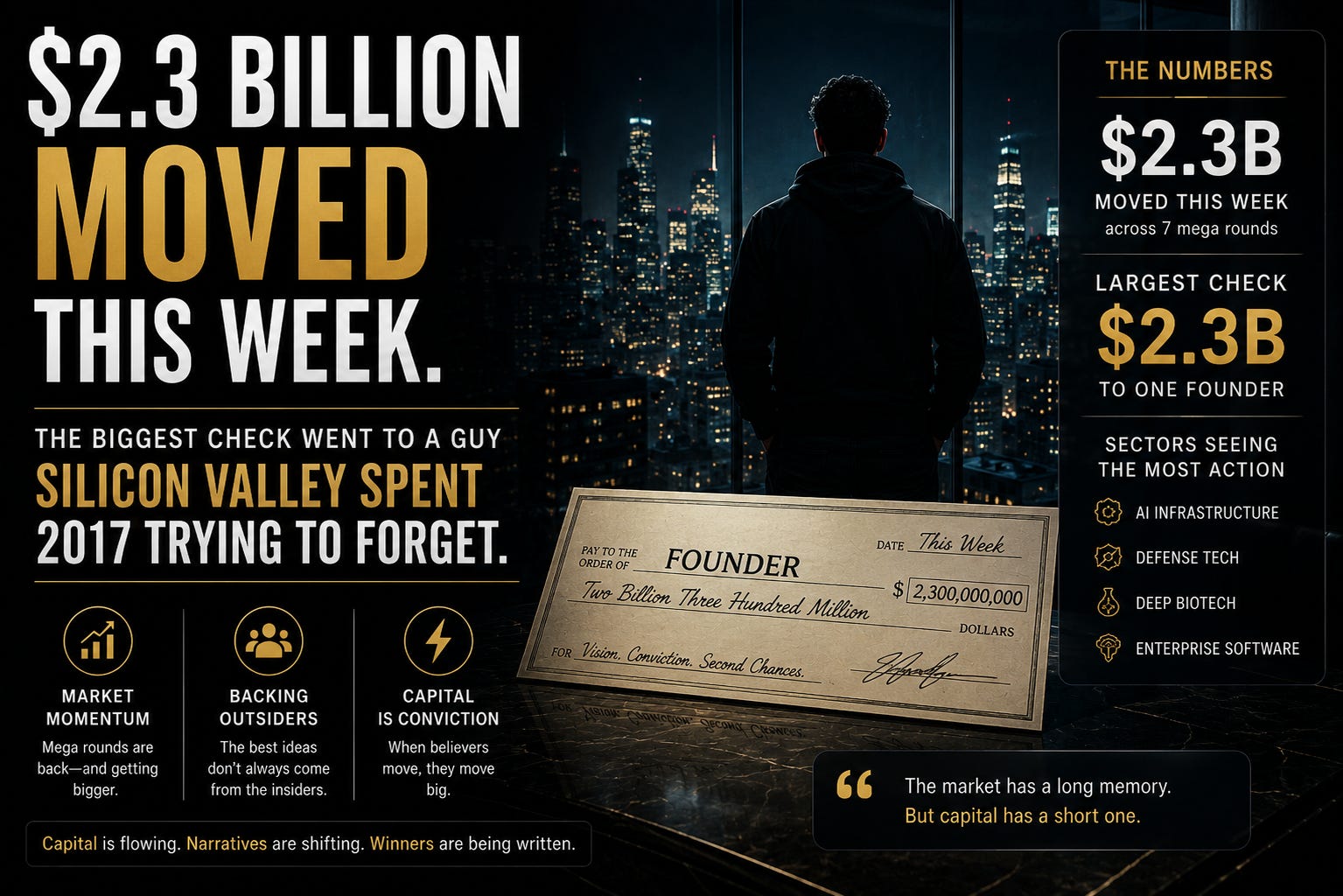
Four disclosed rounds this week added up to roughly $2.34 billion. Three of them funded physical infrastructure, regulated infrastructure, or classified work. Almost none of it was pure software. Here's what mattered, in order.
1. Travis Kalanick’s Atoms raised $1.7 billion, and Uber wrote a check TechCrunch reported on July 22 that Atoms, Kalanick’s industrial robotics holding company, closed $1.7 billion in equity led by Andreessen Horowitz, with Ben Horowitz joining the board. Bain Capital, Fifth Wall, K5 Global, SV Angel and Uber participated. Atoms sits on top of CloudKitchens and Pronto and now runs three divisions: Food, Mining and Transport. The company hasn’t disclosed a post-money valuation, a debt facility size, or commercial traction figures for any of those divisions.
Spence’s hot take: When the company that pushed you out becomes an investor, that isn’t forgiveness. That’s a supply chain decision.
The model: Asymmetric Information Asymmetric information means one side of a transaction knows things the other side doesn’t, and the price gets set by the informed side, not by you. a16z, Bain and Uber saw a data room before they wired $1.7 billion. The rest of us saw a founder’s post on X and a vision letter. Pay attention to what got disclosed here (round size, lead investor, board seat) versus what didn’t (valuation, revenue, units deployed). Companies release the numbers that help them raise the next round. The silence is data too.
For sector context: Crunchbase reported in late June that robotics startups had raised $18.8 billion globally in 2026, already ahead of the $15 billion raised across all of 2025.
2. OpenAI added two bank CEOs to its board CNBC reported that OpenAI appointed Nubank founder and CEO David Vélez and BNY CEO Robin Vince to its nonprofit and for-profit boards on July 21. Vince spent more than 25 years at Goldman Sachs before taking over BNY in 2022, and reporting indicates he’ll chair the audit committee. OpenAI, valued at more than $850 billion according to CNBC, filed its prospectus confidentially with the SEC in June and hasn’t announced a listing timeline.
Spence’s hot take: Nobody recruits an audit committee chair out of Goldman because they’re curious about accounting.
3. Four DOGE alumni raised $160 million for a stealth military cyber startup Reuters reported on July 22, citing three people familiar with the matter, that Cathedral closed $160 million at a $1.4 billion valuation co-led by a16z and Sequoia, with both firms taking board seats. Founders Gavin Kliger, Luke Farritor, Marko Elez and Jack Stein are building AI tooling for offensive and defensive military cyber work. Cathedral declined to comment, and no customers, contracts or revenue figures have been publicly disclosed. Treat that valuation as unconfirmed reporting from unnamed sources, not a company statement.
Spence’s hot take: A $1.4 billion price tag before a public product is a bet on access, not on code.
4. Augustus raised $180 million at a $1 billion valuation to build a “Global Dollar Bank” Per the company’s July 21 release, Tiger Global led the Series B with Hummingbird, QED, and founders from Nubank, Ramp, Circle and Deel participating. Augustus says it has raised $210 million to date and already processes volume for customers including Kraken. The pitch is clearing infrastructure that runs across Swift, ACH, SEPA and stablecoin rails instead of issuing its own token. Worth flagging a discrepancy: the company describes itself as a federally chartered bank, while Decrypt reported the OCC charter is conditional. Those aren’t the same thing.
Spence’s hot take: The winners here won’t be the fastest teams. They’ll be the ones who can survive an exam. That’s the same reason we build on regulated rails at /mkt: slower to stand up, much harder to copy.
5. Sila raised $300 million for silicon anodes while the EV market wobbles Sila announced on July 21 via BusinessWire that Atreides Management and Sutter Hill Ventures led a $300 million private round, joined by 8VC, Bessemer Venture Partners, Matrix Partners and funds advised by T. Rowe Price. The capital funds Phase 2 at the company’s 160-acre Moses Lake, Washington plant. Sila says its Titan Silicon material delivers 20 to 40 percent higher energy density than graphite, and TechCrunch reported the expansion targets enough anode material for more than 100,000 EVs.
Spence’s hot take: Sila quietly stopped leading with the EV story and started selling to drones, satellites, robotics and AI hardware. Same material, better customer.
Next week’s Startup Spotlight deep-dive: the charter race. What actually happens when stablecoin rails collide with federally regulated banking, why the boring compliance work is the moat, and which side of that collision the capital is picking.
If this was useful, share it with someone who builds things. And if you want the full toolkit of 50 mental models, you can grab my book, Mental Models: How to Think, Act, and Win, on Amazon right now.
Next week on Startup Spotlight
Every company above made noise this week. Next Wednesday’s paid deep-dive goes the other direction: the biggest AI infrastructure bet of the moment might be the one that never touches the cloud. I’m breaking down the on-prem AI shift, who’s quietly winning it, and why “private by default” is about to matter far more than it sounds. Paid subscribers get the full teardown.
——————————————————————————————————————
If this was useful, share it with someone who builds things. And if you want the full toolkit of 50 mental models, you can grab my book, Mental Models: How to Think, Act, and Win, right now.


——————————————————————————————————————
Next week’s deep-dive:
Next Wednesday’s paid deep-dive goes the other direction: the biggest AI infrastructure bet of the moment might be the one that never touches the cloud. I’m breaking down the on-prem AI shift, who’s quietly winning it, and why “private by default” is about to matter far more than it sounds. Paid subscribers get the full teardown.

——————————————————————————————————————