

Thirteen people. One drug. One trial that either works or it doesn’t. And Goldman Sachs just helped hand them $152 million.
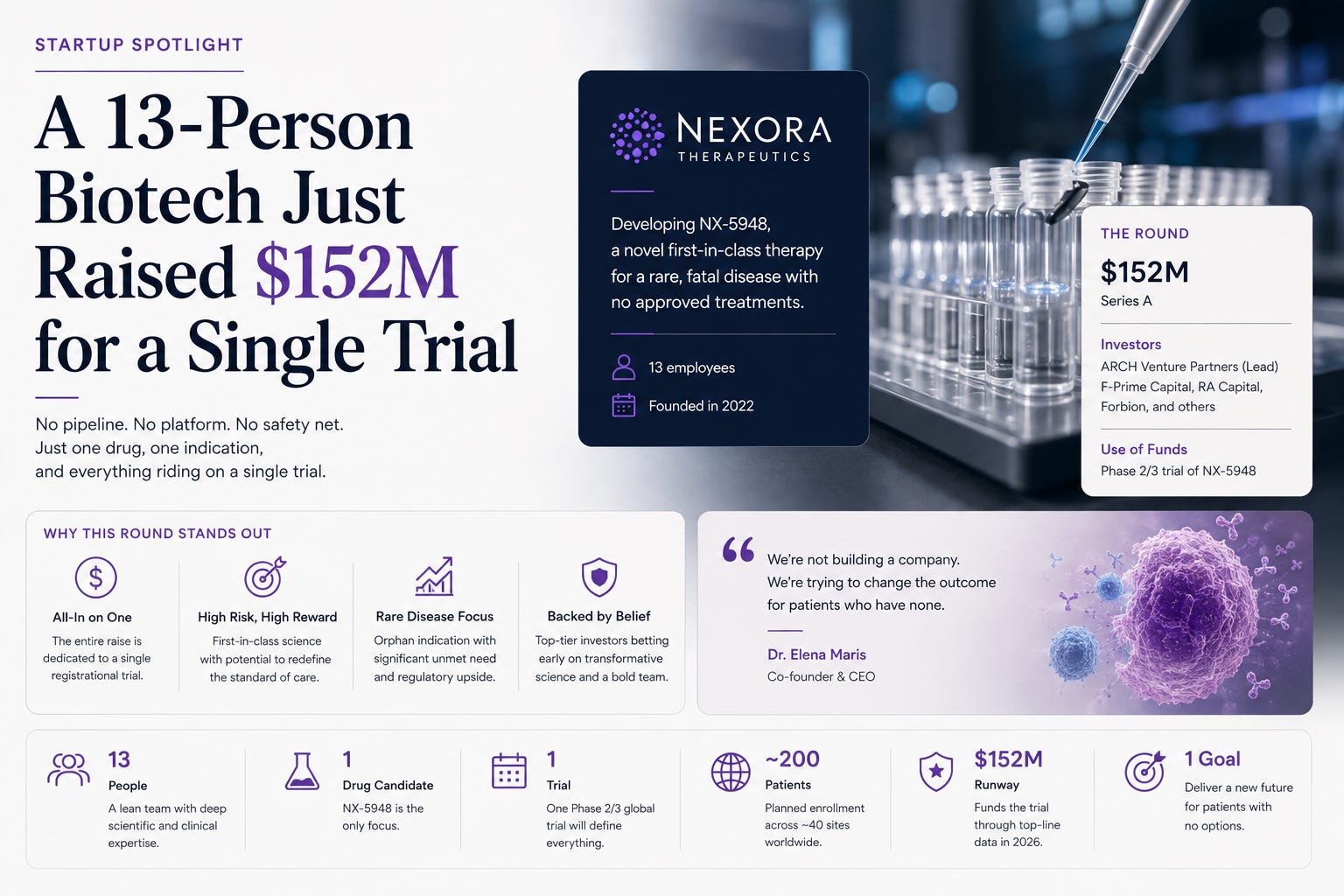
On August 11, Vaderis Therapeutics, a clinical-stage biotech split between Basel and suburban Chicago, closed an oversubscribed $152.5 million Series B. Life Sciences at Goldman Sachs Alternatives and TCGX co-led it, with Omega Funds, EQT Life Sciences, Perceptive, and others piling in. The cash funds one thing: a global Phase 3 study of engasertib, a drug first built to fight cancer that Vaderis is repurposing for hereditary hemorrhagic telangiectasia, a rare inherited disorder that makes blood vessels form wrong and bleed. The company says the round carries it all the way through a potential U.S. approval, which means it wouldn’t have to sell the drug off cheap partway through to keep the lights on.
To most people, this looks insane. A tiny team betting everything on one late-stage trial, in a disease most have never heard of, with a molecule borrowed from cancer research. But that reaction confuses “unlikely” with “bad,” and that’s the trap.
Here’s the model from my book: expected value. You don’t judge a bet by whether it’ll probably work. You judge it by the payoff times the odds. A coin flip that pays 10 to 1 is a great bet even though you lose more than half the time. Specialist investors don’t ask “will this work?” They ask “if it works, how big is it, and are the real odds better than the price implies?”
Run Vaderis through that lens and the “reckless” story falls apart. HHT has no approved targeted therapy today, so a first-in-class win would own the category. The science isn’t pulled from nowhere either. The New England Journal of Medicine published proof-of-concept results on engasertib last December, which tilts the odds off zero. And the raise is sized to reach the finish line, so any payoff wouldn’t get diluted away across a dozen desperate bridge rounds. Big asymmetric upside, odds better than a naive guess, structured so the winners keep the winnings. That’s not a lottery ticket. That’s a priced bet.
None of that guarantees the trial works. Phase 3 studies fail all the time, and this one might. That’s the point. The pros aren’t claiming certainty. They’re claiming the math.
Spence’s take: “Risky” is the laziest word in investing. Most people use it to mean “might fail,” then walk away. Sharp money uses it to mean “mispriced,” then leans in. The crowd sees 13 people and one trial and calls it a gamble. The investors who actually ran the numbers saw a bet where the upside dwarfed the odds against it. Same facts, opposite conclusion. The whole difference is whether you bother to do the multiplication.
If this was useful, share it with someone who builds things. And if you want the full toolkit of 50 mental models, you can grab my book, Mental Models: How to Think, Act, and Win, on Amazon right now.
Disclaimer: This newsletter is for informational and educational purposes only. It is not investment, financial, legal, tax, or medical advice, and nothing here is a recommendation or solicitation to buy, sell, or hold any security or to participate in any investment strategy. Funding amounts and financial figures reflect information reported by the company as of the publication date and are point-in-time figures that may change. Forward-looking statements, including the initiation and outcome of the Phase 3 HEROIC study, the potential for regulatory approval, the expected use of proceeds, and any future commercialization of engasertib, are attributed to the company and are not statements of fact. Clinical-stage drug development carries substantial risk, and trials frequently fail. Private company figures are difficult to verify independently. Do your own research and consult a licensed professional before making any financial decision. The author may hold positions in companies or sectors mentioned and receives no compensation from any company covered here.
If you want the mental models behind breakdowns like this, my book, Mental Models: How to Think, Act, and Win, is on Amazon now.


This post is for informational and educational purposes only. It is not investment advice, a recommendation, or a solicitation to buy or sell any security. Funding figures, revenue, and valuation are as reported by the company, regulatory filings, and named outlets; the ~$470M valuation is a reported, time-sensitive snapshot and not independently verified. Dhoni's individual investment amount was not disclosed. The /mkt reference is a structural illustration of building in regulated markets and is not an offer or solicitation. Past performance and third-party investment decisions do not indicate future results.