

A company that’s roughly two months old, with an API still in preview and no shipped product, just raised $1.1 billion. Read that again. Not a typo.
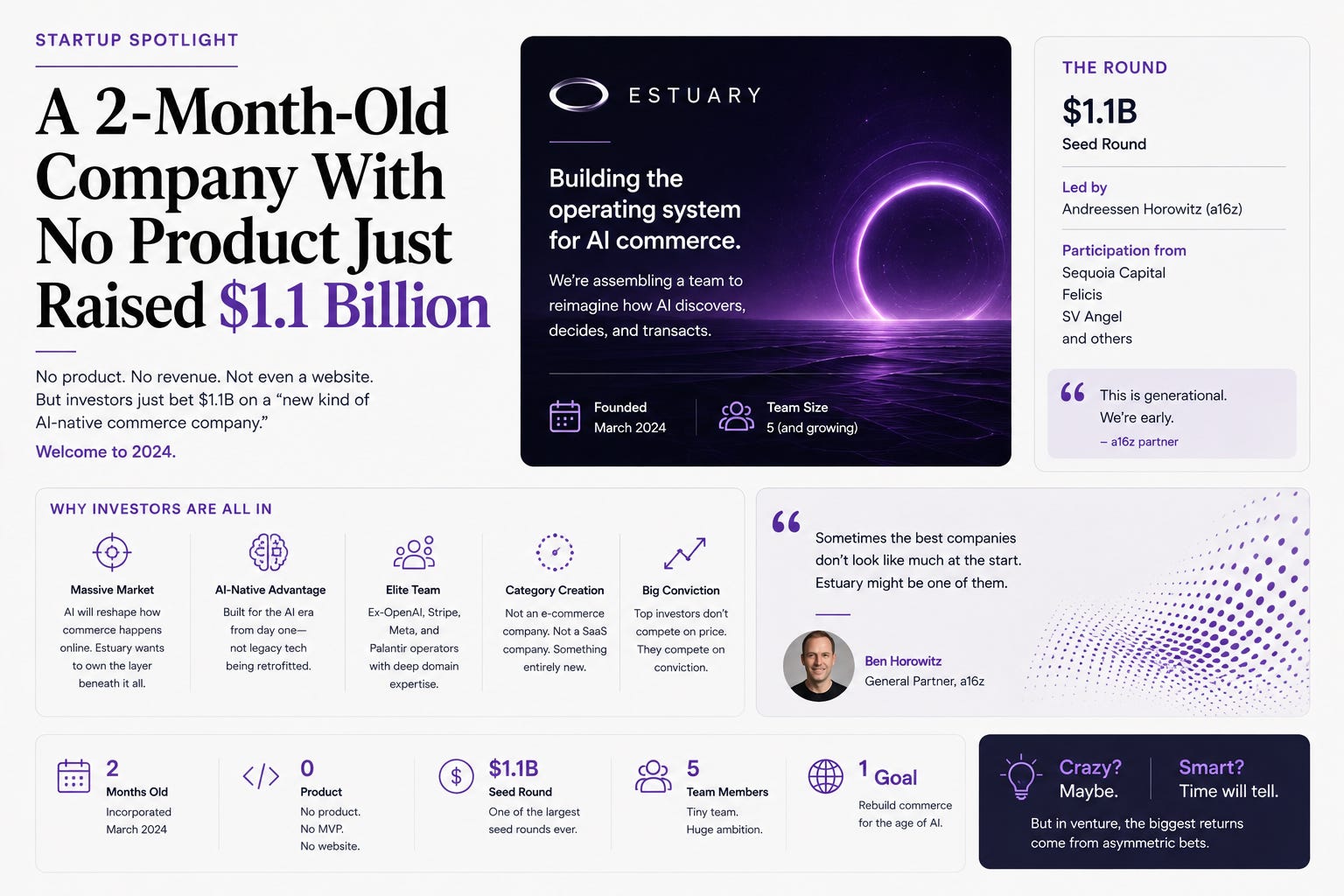
On August 11, River AI announced $1.1 billion across its seed and Series A, co-led by General Catalyst and AMP PBC, with strategic checks from Nvidia and AMD Ventures and participation from Y Combinator and Temasek. The company came out of stealth on June 10. Its founder is Igor Babuschkin, who co-founded xAI and did earlier stints at DeepMind and OpenAI. What River sells today is an API for fine-tuning open-weight models. What it’s selling investors is a plan to rebuild the entire AI stack, from training to hardware, so that AI aligns to individual people instead of billions of users at once. There’s no revenue story here yet. There’s a founder and a thesis.
By any normal measure, paying $1.1 billion for that is nuts. And by any normal measure, it is. But venture capital doesn’t run on normal measures.
Here’s the model from my book: the power law. Startup outcomes aren’t spread evenly around some sensible average. They’re wildly lopsided. A tiny handful of companies return more than an entire fund, and almost everything else returns little or nothing. Once that clicks, the whole game flips. The mistake that kills a venture fund isn’t overpaying for a deal that fails, because you can only lose what you put in, once. The mistake that kills a fund is missing the one deal that becomes the giant. So the rational move isn’t to dodge the crazy-looking bet. It’s to make sure you’re holding a piece of anything that could plausibly be the outlier.
I spent years building derivatives, so here’s how I actually read this round: it’s a call option. The premium is $1.1 billion. The downside is capped at that premium. The upside, if River becomes a foundational layer of AI, is a number with a lot more zeroes. Nvidia and General Catalyst aren’t claiming River will probably work. They’re pricing how big the tail gets if it does, then deciding they can’t afford to not own the option.
That’s why “no product” doesn’t rattle them the way it rattles you. They’re not underwriting today. There is no today worth underwriting. They’re underwriting a distribution, and betting that a proven builder plus a big idea plus a mountain of capital gives that distribution a fat enough right tail to matter.
Spence’s take: Every time one of these rounds lands, the timeline fills with people calling it dumb money. Sometimes it is. But most of the “that’s insane” takes are just bell-curve brains staring at a power-law game. The pros aren’t betting River works. They’re betting they can’t afford to be out if it does. In venture, the only unforgivable error is being right about the risk and absent from the winner.
If this was useful, share it with someone who builds things. And if you want the full toolkit of 50 mental models, you can grab my book, Mental Models: How to Think, Act, and Win, on Amazon right now.
Disclaimer: This newsletter is for informational and educational purposes only. It is not investment, financial, legal, or tax advice, and nothing here is a recommendation or solicitation to buy, sell, or hold any security, option, or other instrument, or to participate in any investment strategy. The references to options pricing and power-law returns describe how venture investors approach risk and are illustrative, not trading or investment guidance. Funding amounts reflect information reported by the company as of the publication date and are point-in-time figures that may change. Forward-looking statements, including plans to rebuild the AI stack and build personal AI, are attributed to the company and its founder and are not statements of fact. Early-stage companies carry a high risk of failure. Private company figures are difficult to verify independently. Do your own research and consult a licensed professional before making any financial decision. The author may hold positions in companies or sectors mentioned and receives no compensation from any company covered here.
If you want the mental models behind breakdowns like this, my book, Mental Models: How to Think, Act, and Win, is on Amazon now.


This post is for informational and educational purposes only. It is not investment advice, a recommendation, or a solicitation to buy or sell any security. Funding figures, revenue, and valuation are as reported by the company, regulatory filings, and named outlets; the ~$470M valuation is a reported, time-sensitive snapshot and not independently verified. Dhoni's individual investment amount was not disclosed. The /mkt reference is a structural illustration of building in regulated markets and is not an offer or solicitation. Past performance and third-party investment decisions do not indicate future results.