



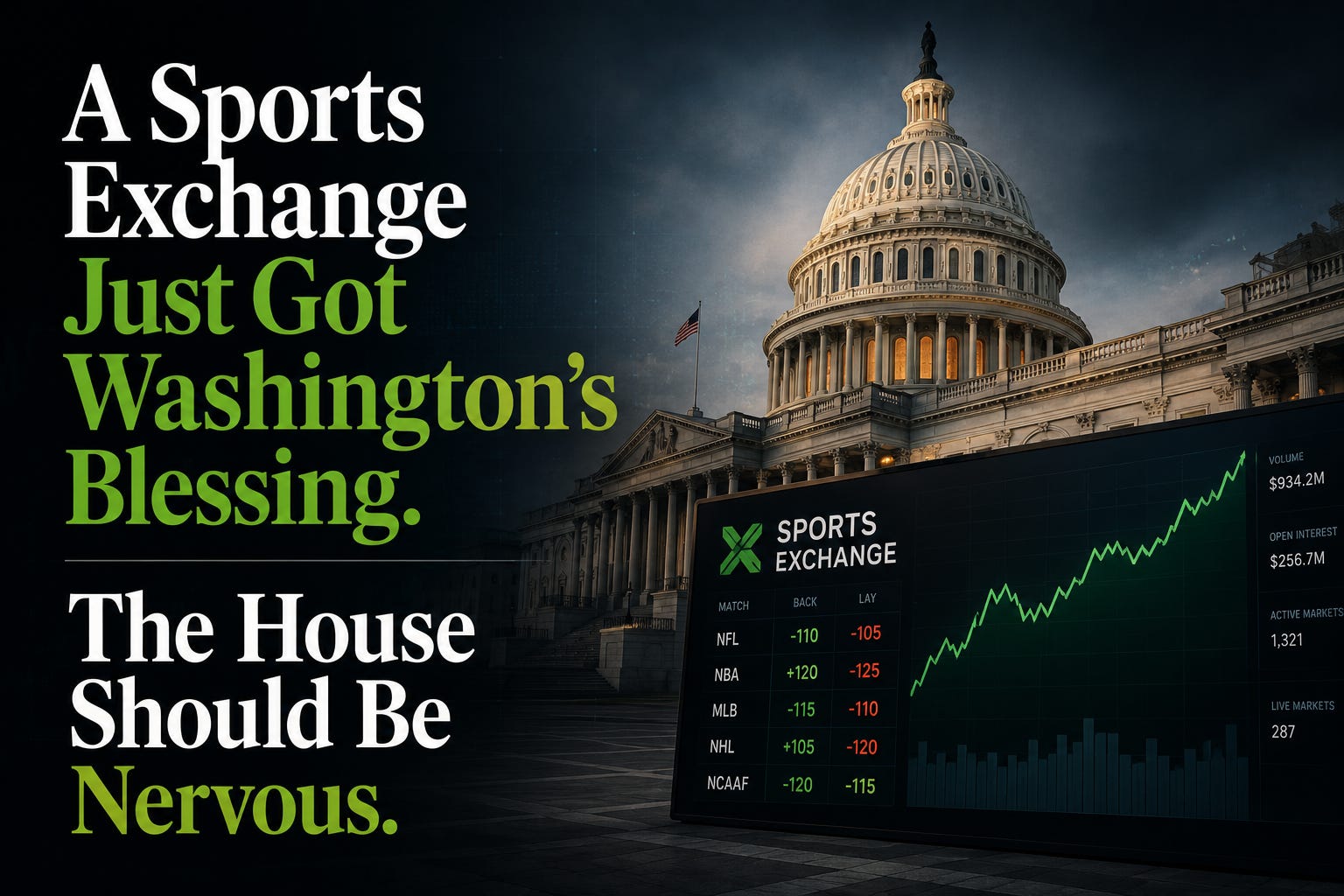
For a century, the house always won because the house wrote the rules. A startup out of New York just got Washington to change them.
The Commodity Futures Trading Commission granted Novig approval to operate as a federally regulated Designated Contract Market, which is the formal term for an exchange. In plain English, Novig now has a path to offer sports trading in all 50 states, not as a sportsbook, but as a venue where people trade contracts against each other. A competitor, ProphetX, cleared the same bar about a week earlier. The race to be the regulated sports exchange is officially on.
Quick context on the company. Novig was founded in late 2024 by Jacob Fortinsky and Kelechi Ukah. It runs a commission-free, peer-to-peer exchange with an order book, meaning there’s no house taking the other side of your trade. Back in February it raised a $75 million Series B led by Pantera Capital, pushing total funding past $105 million at a reported valuation around $500 million. The company says its annualized trading volume has run into the billions after roughly 10x growth in 2025. It also claims a far higher share of profitable users than traditional sportsbooks. Treat that as a company figure, because it is one.
The model from my book that cuts to the heart of this is Follow the Incentives.
A traditional sportsbook is your counterparty. When you win, it loses. So its incentives are exactly what you’d expect: shade the odds, limit the sharp players, discourage anyone who wins too often. That isn’t a bug in a few bad operators. It’s the structure. As Charlie Munger liked to say, show me the incentive and I’ll show you the outcome.
An exchange flips that. It doesn’t take the other side of your trade. It makes money on volume and fees regardless of who wins, so its incentive is a deep, active, trusted market with lots of participants. Align the incentives, and you get better pricing and a platform that doesn’t punish you for being good. That structural alignment, not the app design, is the real threat to the incumbents.
I’ve watched this movie before from the building side. At Robinhood I worked on prediction markets and derivatives, and at /mkt we build on regulated trading infrastructure. The pattern repeats: take a market run by a middleman, financialize it, and move it onto a regulated exchange. It happened to stock brokers. It’s now happening to the sportsbook.
Here’s my contrarian take, and I’ll keep it conservative. A license is not a victory. It’s a permission slip. Novig is walking into a brutal field where Kalshi already dominates and Robinhood, DraftKings, and FanDuel have enormous distribution. The exchange model is structurally better, but better structure loses to better distribution all the time. And there’s a real societal question underneath all of this: turning every game into a 24/7 tradable asset is exactly why some states are pushing back. The incentives that make this a great business are the same ones worth watching closely.
If this was useful, share it with someone who builds things. And if you want the full toolkit of 50 mental models, you can grab my book, Mental Models: How to Think, Act, and Win, right now.


Startup Spotlight is for informational and educational purposes only. It is not investment advice, an offer, or a solicitation to buy or sell any security. Company metrics are self-reported, and funding details are drawn from public reporting and company statements. Figures may change.