

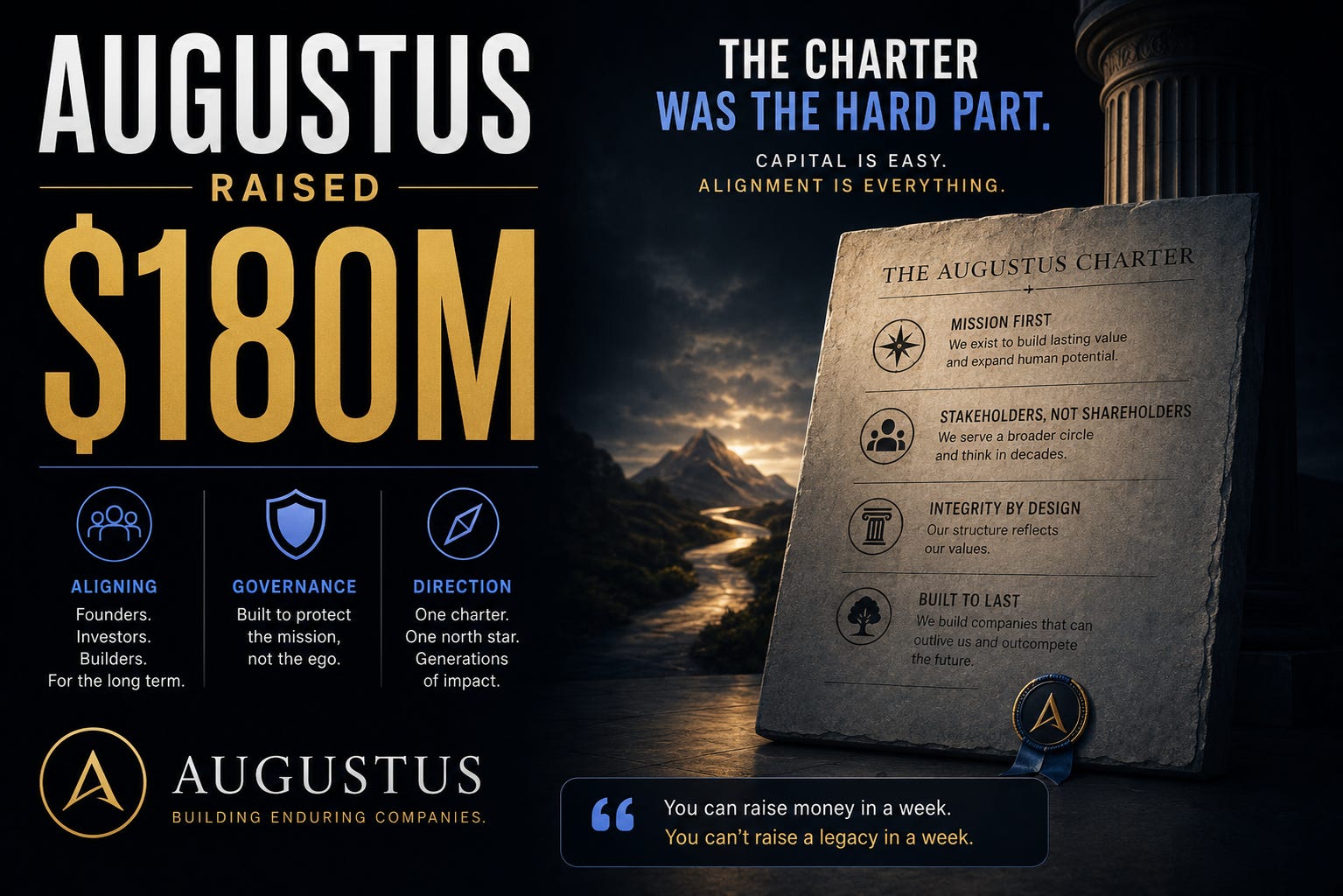
There have been thousands of fintech funding rounds since 2010. Over that same stretch, the OCC has handed out eight conditional approvals for a national bank charter. Augustus has one of them.
The New York company announced a $180 million Series B on Tuesday at a $1 billion valuation, led by Tiger Global, with Hummingbird, QED, and a long list of operator angels including founders and executives from Nubank, Ramp, Circle, Deel, Revolut, and Coinbase. That brings total funding to $210 million for a company founded in 2022. It says it’s already processing billions for customers including Kraken.
What it does is unglamorous and enormous. If a fintech in Brazil or Nigeria wants to move dollars to a US client, it doesn’t just send dollars. It routes through a chain of correspondent banks, paying a toll and waiting at every handoff. Augustus wants to be the direct line instead: an API-first clearing bank offering operating and FBO accounts, moving money over Swift, ACH, SEPA, and stablecoin rails. CEO Ferdinand Dabitz puts the thesis bluntly, saying the dollar is the world’s greatest product but its distribution is broken.
The mental model here is Path Dependence. Systems get locked into their history, not their optimum. Correspondent banking isn’t slow and expensive because someone designed it that way. It’s slow and expensive because it accreted over decades, every participant built on top of it, and the cost of coordinating everyone onto something better has always exceeded any single player’s incentive to try. The path you started on constrains where you can go, long after the original reason has stopped making sense.
Most fintechs respond by optimizing within the path. They build middleware, they shave a basis point, they wrap a nicer API around the same chain of intermediaries. Augustus is trying to step off the path entirely, and the only door out of a path-dependent system that’s this heavily regulated is a charter. That’s why the sequencing matters. They got conditional approval in May and the money in July. Hard thing first, easy thing second. QED’s Nigel Morris frames correspondent banking as the last part of the bank stack fintechs haven’t really challenged, and it stayed unchallenged precisely because you couldn’t get at it without the permission almost nobody gets.
Here’s the contrarian part, though. Path dependence cuts both ways. The same lock-in that makes correspondent banking bad also makes it sticky. Every compliance team, every settlement process, every ops runbook at those international banks was built around the existing chain. Being better isn’t enough. Augustus has to be worth the rewiring, one risk committee at a time. And “conditional” is doing real work in that sentence: conditional approval is not final approval, and the conditions are where these things get slow.
We run into the same reality at /mkt. Building athlete offerings under Reg A+ with tZERO as trading infrastructure means the permission layer takes longer than the product layer, every time. That’s frustrating right up until you realize it’s the entire barrier to entry.
So don’t watch the valuation on this one. Watch whether the conditional approval converts, and who signs on after it does.
If this was useful, share it with someone who builds things. And if you want the full toolkit of 50 mental models, you can grab my book, Mental Models: How to Think, Act, and Win, on Amazon right now.
If you want the mental models behind breakdowns like this, my book, Mental Models: How to Think, Act, and Win, is on Amazon now.


This post is for informational and educational purposes only. It is not investment advice, a recommendation, or a solicitation to buy or sell any security. Funding figures, revenue, and valuation are as reported by the company, regulatory filings, and named outlets; the ~$470M valuation is a reported, time-sensitive snapshot and not independently verified. Dhoni's individual investment amount was not disclosed. The /mkt reference is a structural illustration of building in regulated markets and is not an offer or solicitation. Past performance and third-party investment decisions do not indicate future results.