


Here’s what investors won’t tell you directly: regulatory risk isn’t a yes/no gate anymore. It’s a valuation multiplier.
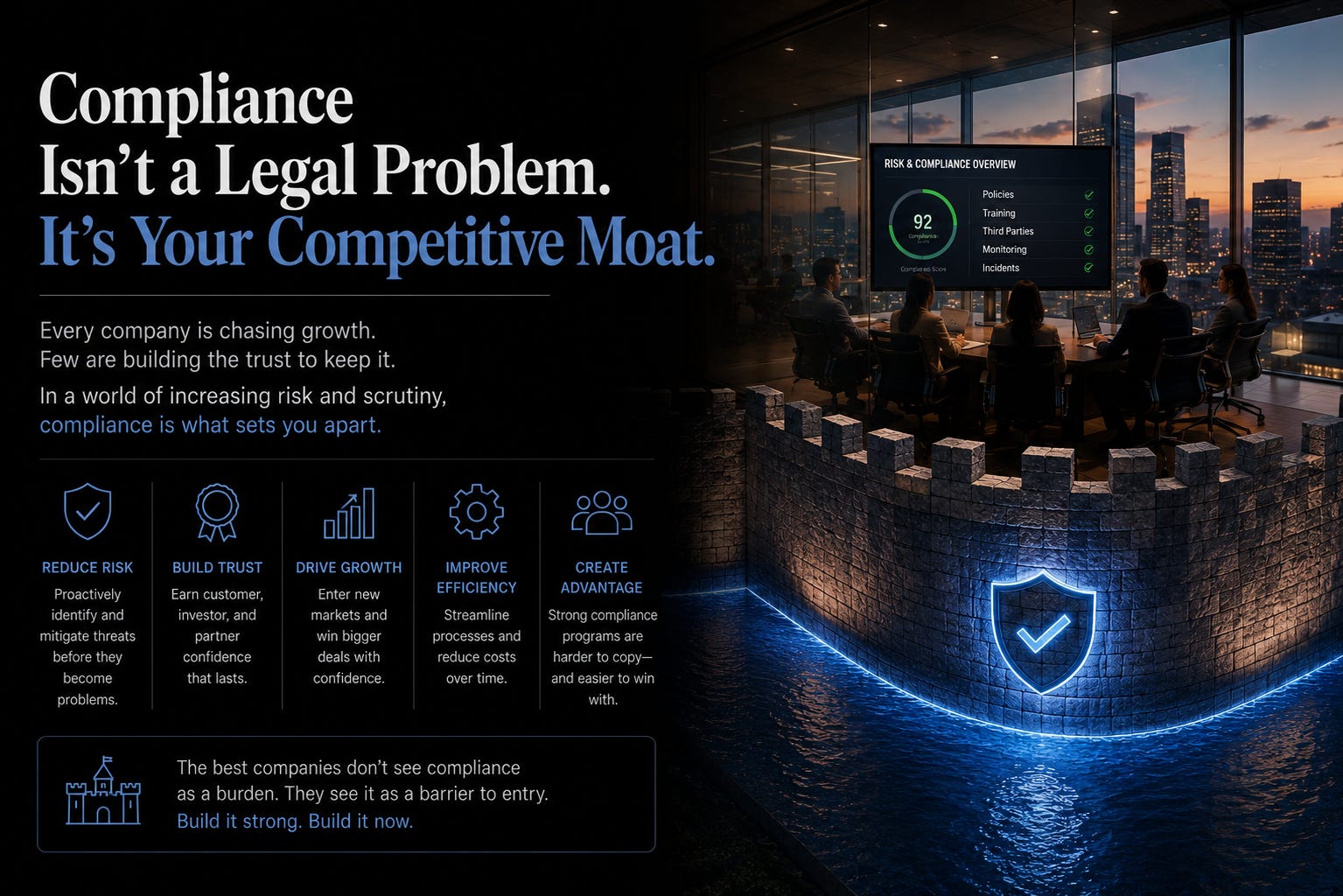
A founder with sloppy compliance gets a discount. A founder with compliance baked into product design gets a premium. The difference isn’t 10%. It’s often 20% to 40% on funding terms, and that’s before you count the enterprise customers who won’t buy from you without it.
The “compliance premium” is real. At seed stage, founders now face 15 to 20% higher legal expenses just to get the infrastructure in place. That’s not a bug. That’s the market’s way of pricing in regulatory risk. But here’s what makes 2026 different from 2020: it’s not just about legal defense anymore. It’s about competitive advantage.
Let me show you why.
The procurement revolution is happening right now.
Enterprise security teams and procurement departments are asking AI startups three questions before they even look at product features: How was your model trained? What data goes into your prompts? Who checks the outputs, and how can we challenge bad results?
Those questions used to come from compliance lawyers. Now they come from CISOs, CFOs, and procurement directors who are already spending $500K to $2M on AI vendors. They’re not buying demos. They’re buying defensibility.
The EU AI Act is a formal, risk-based regime that ties obligations to use case, model category, and role in the system. The US is a patchwork of state laws, federal guidance, and agency enforcement. The UK is principle-led, which sounds looser until you realize it means you’re responsible for interpreting the principles yourself. China maintains state control.
For most founders, this sounds like chaos. In reality, it’s clarity. The chaos was 2020 to 2023, when you could build anything and apologize later. That era is dead.
Now here’s the part that matters for your startup: the founder who understands these regimes doesn’t see them as constraints. They see them as a moat.
Why? Because 90% of competing startups will ignore compliance until fundraising breaks down or a customer refuses to sign. At that point, you’re scrambling to retrofit governance into a product that wasn’t designed for it. You’re 6 months behind. Your valuation discount is permanent.
But the 10% of founders who treat compliance as a product constraint from day one end up with:
First, a cleaner product. When you design for governance, data handling, and auditability from the start, you end up with fewer exploits, clearer workflows, and easier customer onboarding. You’re not adding compliance to something fragile. You’re building something resilient.
Second, a competitive edge in sales. Your customer procurement process becomes your strongest sales tool. While competitors are hiring lawyers to defend their infrastructure, you’re showing audits, certifications, and transparent decision logs. You close deals faster and on better terms.
Third, a stronger fundraising position. When a VC asks about compliance risk in 2026, the founder who says “we have ISO 42001 certification and we’ve mapped our training data and we’ve designed for audit” doesn’t sound cautious. They sound smart. The founder who says “we’re thinking about that” sounds naive.
Here’s how I think about it, and how we build at /mkt.
We’re operating in a regulated market (Reg A+ offerings with tZERO trading infrastructure). Our competitors might say that’s a constraint. We treat it as an asymmetric advantage. Because we had to build compliance into the core from the beginning, we ended up with a cleaner infrastructure, better data governance, and a product that enterprise partners actually trust.
The result? Regulators don’t see us as a risk. They see us as a partner. Customers trust us faster. And when a competitor tries to copy our product, they can’t copy the compliance scaffolding. That’s the moat.
The mental model here is “First-Principles Thinking.”
Most founders start with a product idea and retrofit compliance later. First-principles thinking means starting with “what’s the regulatory reality?” and designing product around it. It’s harder upfront. It’s slower at the beginning. But it’s the only way to build something that survives contact with enterprise customers, regulators, and serious capital.
My contrarian take: compliance-first founders aren’t being cautious. They’re being aggressive.
They’re building a moat that’s expensive for competitors to copy. They’re capturing customer trust at a time when trust is the scarcest resource. They’re moving into markets where compliance is the barrier to entry, not the barrier to profit.
The founders complaining about “regulatory burden” in 2026 are losing. The founders building regulatory resilience into product are winning.
If you’re raising capital for an AI startup right now, the single best question to get asked in a board meeting isn’t “how fast can you grow?” It’s “how did you design for compliance?” If you can answer that clearly, you’ve just signaled something most founders can’t: that you think like a builder, not a hustler.
The era of move-fast-and-break-things in regulated markets is over. The era of move-thoughtfully-and-build-trust has started. The founders who recognize that shift first are the ones building the defensible companies.
If this was useful, share it with someone who builds things. And if you want the full toolkit of 50 mental models, my book is coming soon.