

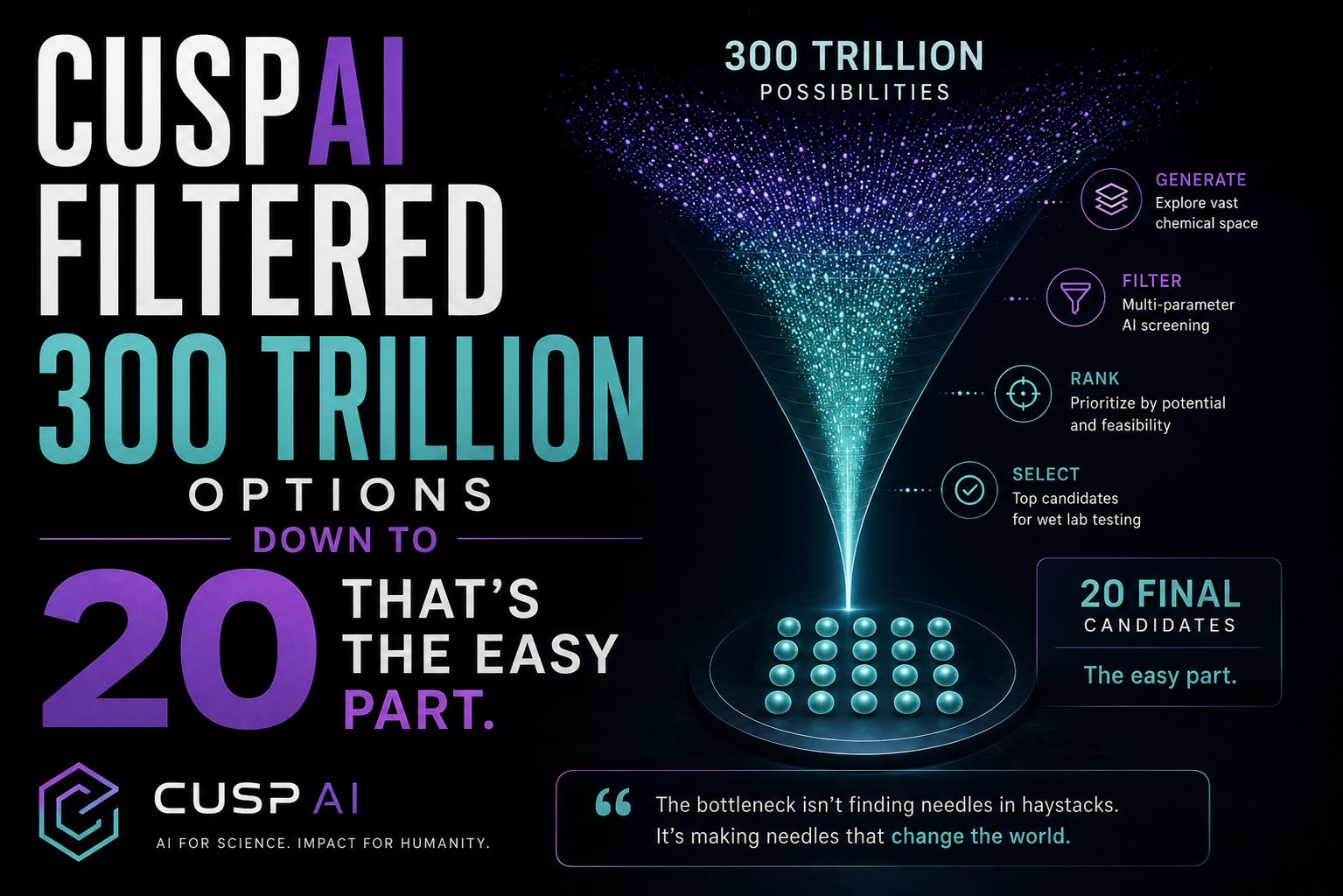
CuspAI just filtered roughly 300 trillion possibilities down to about 20 worth testing. Investors decided that trick is worth $2.6 billion. The trick is real. The price tag is a bet on everything that happens after the filtering stops.
Here’s the news. On Monday, the two-year-old Cambridge company raised a $450 million Series B at a $2.6 billion valuation. Ten months ago it was worth about $520 million, per Bloomberg, so that’s roughly a 5x markup in under a year. Kleiner Perkins and NEA led, with a significant check from Jeff Bezos’s Bezos Expeditions and names like AMD Ventures, Lux Capital, and John Doerr in the mix. CuspAI also launched the AI Materials Foundry, a coalition of 45-plus members including Nvidia, Samsung, and Meta.
What it actually does: its model, MIRA, searches the near-infinite space of possible materials and narrows it to a short list worth putting in a lab. In one project with chemicals maker Kemira, it sifted about 300 trillion candidate structures for PFAS-removal materials, generated over 5,000 designs, and cut down to roughly 20 priorities. Semiconductors will absorb 80% of its research this year, including hunting for substitutes to supply-constrained metals like ruthenium and iridium.
The mental model here is Local vs. Global Optimum.
Traditional R&D is hill-climbing. You start from a material you already know, tweak it, keep whatever tests a little better, and repeat. The trap is that you get stuck on the nearest peak. There might be a much taller mountain across the valley, but you’d have to climb down and cross empty ground to reach it, so you never do. CuspAI’s pitch is that its search sees the whole range at once and points straight at the highest summit, skipping the local traps that trial-and-error can’t escape.
That’s a genuine edge, and it’s why the check is this big. But here’s the part the valuation glosses over. Spotting a taller peak is not the same as building a road to the top of it. A promising candidate still has to survive physical synthesis, durability testing, manufacturing at a cost that works, and in many of these markets, regulators. CuspAI’s own best public result, the Kemira work, is still about 20 candidates “moving into further development,” not a product on a shelf.
So here’s the contrarian read.
The bull case is that AI collapses the search from years to months. Fair, and probably true. The bear case is quieter: search was never the only bottleneck. The distance between “we found it” and “we built it, it works, and it’s cheap” is where the real time and money live, and no model has shortened that stretch yet. A 5x markup prices the search as if it were the summit. It’s the trailhead.
We think about this exact gap at /mkt. A number that looks perfect in a simulation still has to survive contact with the real world and the rules that govern it. Structuring value under something like Reg A+ means you don’t get to stop at “the math works.” It has to hold up when someone actually stands behind it.
So watch CuspAI’s labs, not its valuation. The search is solved. The climb hasn’t started.
If this was useful, share it with someone who builds things. And if you want the full toolkit of 50 mental models, you can grab my book, Mental Models: How to Think, Act, and Win, on Amazon right now.
If you want the mental models behind breakdowns like this, my book, Mental Models: How to Think, Act, and Win, is on Amazon now.


This post is for informational and educational purposes only. It is not investment advice, a recommendation, or a solicitation to buy or sell any security. Funding figures, revenue, and valuation are as reported by the company, regulatory filings, and named outlets; the ~$470M valuation is a reported, time-sensitive snapshot and not independently verified. Dhoni's individual investment amount was not disclosed. The /mkt reference is a structural illustration of building in regulated markets and is not an offer or solicitation. Past performance and third-party investment decisions do not indicate future results.