

Most founders would crawl over glass for a term sheet. Databricks just got handed one and gave most of it back.
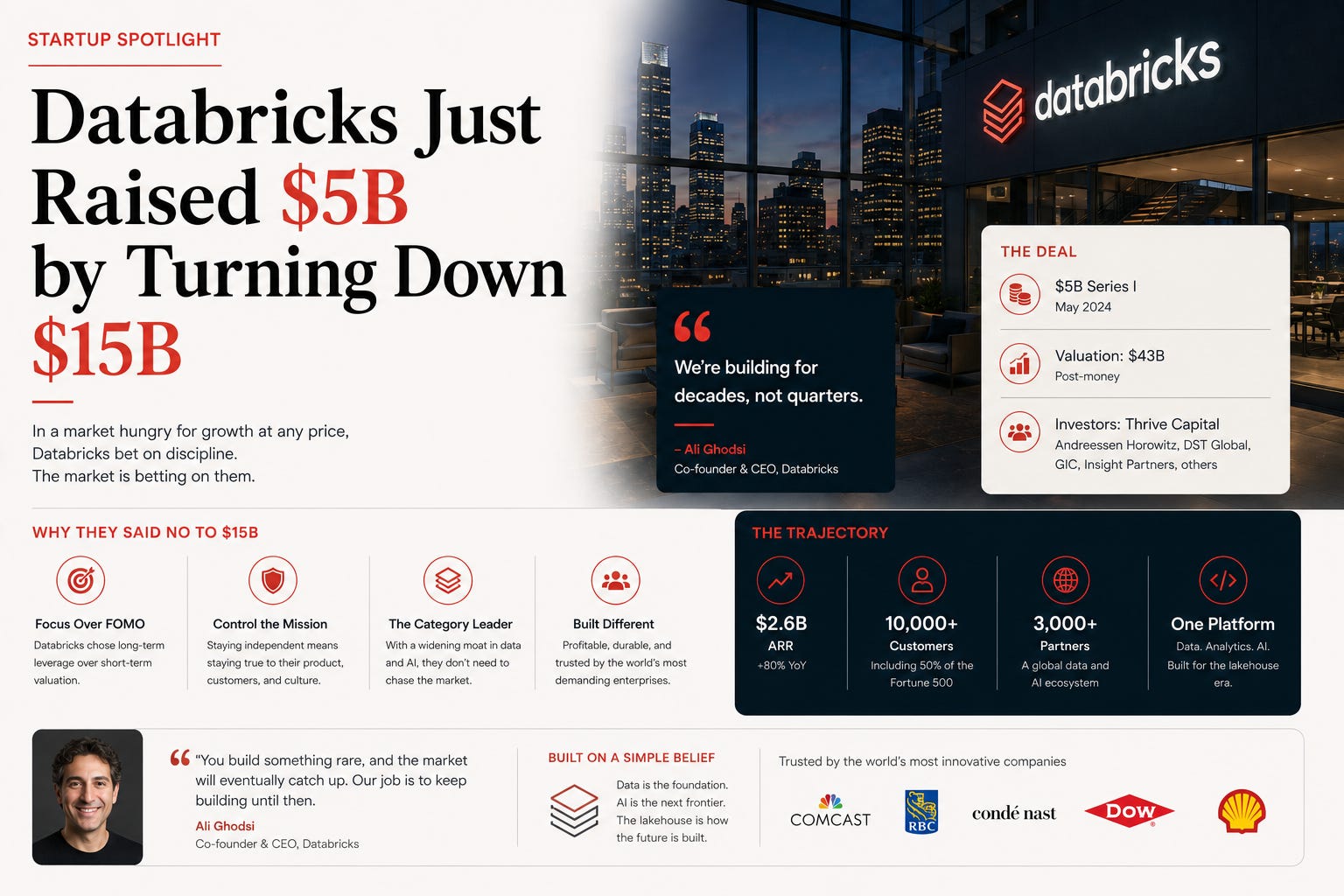
On August 13, the data and AI company closed a $5 billion strategic round at a $190 billion valuation, led by Coatue with Blackstone, MGX, T. Rowe Price, and new investor Sixth Street Growth. Per TechCrunch’s reporting, the striking part isn’t the number it took. It’s the number it didn’t. The company reportedly went in looking for around $1 billion, investors pushed to put in $15 billion, and Databricks settled on $5 billion. Then it made clear it’s staying private for now, even though it’s long been treated as an IPO-in-waiting.
The business can afford to be picky. Databricks says it crossed a $7 billion revenue run rate, growing more than 80% year over year last quarter, and that it’s kept adjusted cash flow positive for twelve straight months. Six months ago the company was valued around $134 billion, so its reported valuation climbed roughly 42% while it was busy printing cash.
Here’s the model from my book worth pulling out: opportunity cost. Most people file it under money, but it’s really about hidden trade-offs. Every yes quietly kills the options you could’ve said yes to instead. A dollar raised isn’t free. It carries dilution, a higher bar to clear next time, and investor expectations that harden into a leash. An IPO isn’t free either. CEO Ali Ghodsi said the quiet part out loud, framing today’s public markets as a distraction the company doesn’t need right now.
So run the math the way Databricks apparently did. The extra billions it passed on wouldn’t have changed the roadmap. They’d have changed the cap table, the pressure, and the focus. When you’re already cash-flow positive and growing 80%, capital isn’t the constraint. Attention is. Taking the bigger check would’ve cost the exact thing that got them here.
Spence’s take: In a bull market, everyone grades a founder on how much they can raise. The better grade is how much they’re willing to walk away from. Cheap capital is the easiest yes in the world, which is precisely why refusing it is the tell. Databricks didn’t take $5 billion because it couldn’t get more. It took $5 billion because it did the subtraction most founders skip.
If this was useful, share it with someone who builds things. And if you want the full toolkit of 50 mental models, you can grab my book, Mental Models: How to Think, Act, and Win, on Amazon right now.
Disclaimer: This newsletter is for informational and educational purposes only. It is not investment, financial, legal, or tax advice, and nothing here is a recommendation or solicitation to buy, sell, or hold any security or to participate in any investment strategy. Funding amounts, valuations, and financial figures reflect information reported by the company or by third-party news sources as of the publication date and are point-in-time figures that may change. The $190 billion valuation is company-reported. Details of the round’s size and negotiation, including the reported $1 billion sought and $15 billion offered, come from press reporting (TechCrunch) and have not been independently confirmed by the company. Forward-looking statements, including plans to remain private or eventually go public, are attributed to the company and its executives and are not statements of fact. Private company figures are difficult to verify independently. Do your own research and consult a licensed professional before making any financial decision. The author may hold positions in companies or sectors mentioned and receives no compensation from any company covered here.
If you want the mental models behind breakdowns like this, my book, Mental Models: How to Think, Act, and Win, is on Amazon now.


This post is for informational and educational purposes only. It is not investment advice, a recommendation, or a solicitation to buy or sell any security. Funding figures, revenue, and valuation are as reported by the company, regulatory filings, and named outlets; the ~$470M valuation is a reported, time-sensitive snapshot and not independently verified. Dhoni's individual investment amount was not disclosed. The /mkt reference is a structural illustration of building in regulated markets and is not an offer or solicitation. Past performance and third-party investment decisions do not indicate future results.