

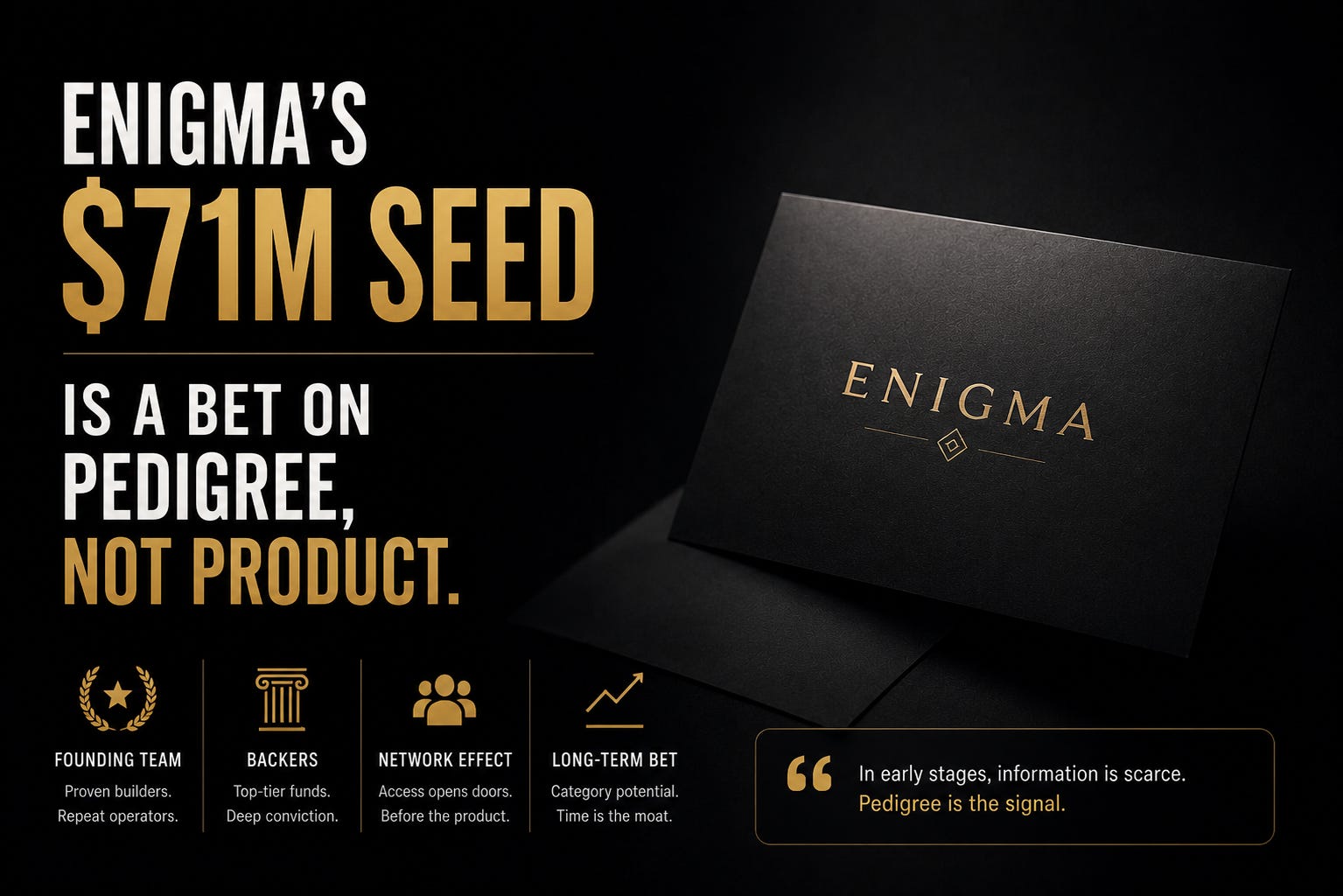
Seventy-one million dollars is a big seed round. It’s a wild one for a company that’s less than a year old and put its first public product online the same afternoon it announced the raise.
On July 27, physical AI startup Enigma came out of stealth with a $71 million seed led by Index Ventures and Ribbit Capital. Conviction Partners’ Sarah Guo joined, along with individual leaders from OpenAI, Anthropic, Google DeepMind, xAI, Cognition, and Wiz. The company builds foundation AI models meant to make any robot, on any hardware, intelligent, plus the interface layer to make controlling one feel as easy as turning up the volume on your phone.
The founders are the pitch as much as the product. CEO Jonathan Jacobi was reportedly Microsoft’s youngest-ever employee at 17. He and cofounder Gal Niv met in hacking competitions as teenagers and served together in Israel’s Unit 8200. Neither is a roboticist, which Index frames as a feature, not a bug.
For proof of life, Enigma launched Robots.online, where anyone can remotely pilot more than 100 of its robots in real time from hangars in Israel and California. They draw with a paintbrush, run simple chemistry experiments, and sword-fight each other. It’s a demo. It’s also, functionally, a data pipeline for training the models on how normal people actually try to talk to machines.
The mental model: Preferential Attachment, also called the Matthew Effect.
In networks, new connections don’t form at random. They attach to the nodes that already have the most connections. The rich get richer, not because they earned this particular link, but because they already had the last one. Capital and elite talent behave the same way. A team with the right logos, the right unit, and the right first employer becomes a magnet, and the money shows up before the product does, precisely because the pedigree lowers the perceived risk of writing the check.
That’s what a $71 million seed with an all-star angel roster actually signals. Not that the robots work at scale. It’s that the market has already decided this team is the kind of node other advantages should attach to. The founding story isn’t a footnote to the round. For a company this young, it’s a big part of the collateral.
Spence’s take: Preferential attachment is real, and it’s a trap for everyone watching from the cheap seats. The pedigree that pulls in the capital is not the same thing as the moat. Enigma’s actual bet, an interface layer sitting on top of other people’s robots, is either the most valuable position in the stack or one product cycle away from being a feature somebody else ships for free. The angel list doesn’t settle that question. It just raises the stakes on it. So don’t anchor on the $71 million. Watch how fast real enterprise deployments show up, because that’s the clock that starts the moment the pedigree premium begins to wear off.
If this was useful, share it with someone who builds things. And if you want the full toolkit of 50 mental models, you can grab my book, Mental Models: How to Think, Act, and Win, on Amazon right now.
If you want the mental models behind breakdowns like this, my book, Mental Models: How to Think, Act, and Win, is on Amazon now.


This post is for informational and educational purposes only. It is not investment advice, a recommendation, or a solicitation to buy or sell any security. Funding figures, revenue, and valuation are as reported by the company, regulatory filings, and named outlets; the ~$470M valuation is a reported, time-sensitive snapshot and not independently verified. Dhoni's individual investment amount was not disclosed. The /mkt reference is a structural illustration of building in regulated markets and is not an offer or solicitation. Past performance and third-party investment decisions do not indicate future results.