


A roughly 150-person company with basically no product just raised $12 billion. First reaction: that’s insane. Hold that thought
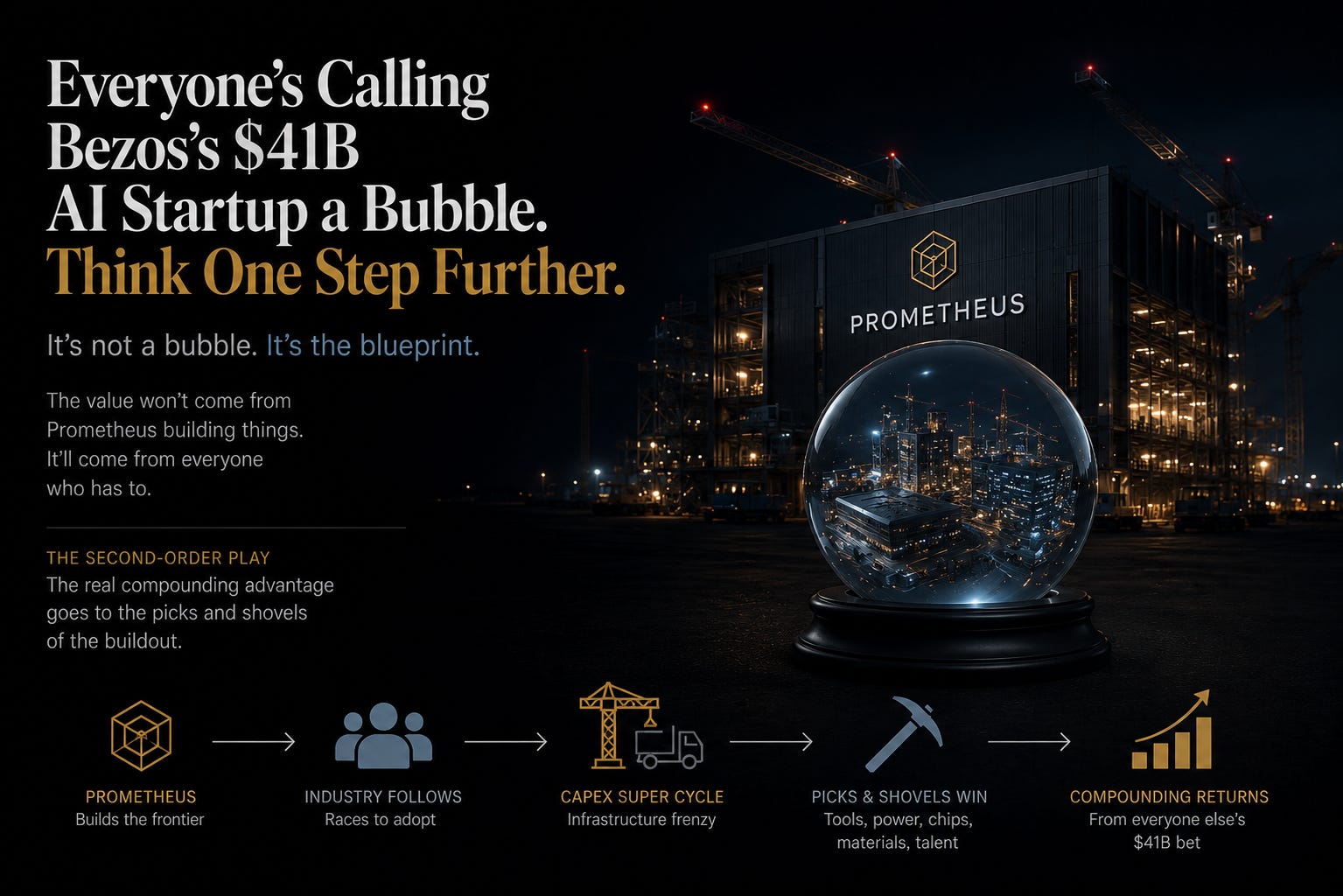
The company is Prometheus, the industrial-AI startup co-led by Jeff Bezos and Vik Bajaj, former co-founder of Alphabet’s Verily. It announced a $12 billion Series B at about a $41 billion valuation, backed by JPMorgan, Goldman Sachs, BlackRock, DST Global, Arch Venture Partners, and Bezos himself. It launched in November 2025 with $6.2 billion, so total funding sits north of $18 billion in roughly seven months. The team is spread across San Francisco, London, and Zurich. It’s Bezos’s first operating role since he left the Amazon CEO seat in 2021.
What it’s building isn’t a chatbot. It’s what the founders call an “artificial general engineer,” AI meant to design and help manufacture complex physical products, from jet engines to drug compounds. Bezos’s framing to Axios: ask a jet-engine maker for the same engine with 10% more thrust and you might be staring at a ten-year program, not because anyone’s lazy, but because the physical world is brutally hard.
The model: Second-Order Thinking
First-order thinking stops at the obvious, immediate consequence. Second-order thinking asks the harder question: and then what? What do the consequences cause?
First-order on this news is easy and loud. $41 billion for 150 people and no revenue? Bubble. AI hype. The emperor has no thrust. But run it second-order. The bet isn’t on what Prometheus sells today, which is close to nothing. It’s on one thesis: the slowest, most expensive step in the entire physical economy is the engineering design loop, and software is about to bolt a flywheel onto it. And then what? Compress that loop and small teams attempt projects that used to need thousands of engineers and a decade. Whoever owns that tool sits upstream of trillions in industrial output. The banks and Bezos aren’t pricing a product. They’re pricing a position.
There’s a second-order tell most coverage skipped. Bezos has reportedly explored a roughly $100 billion fund to buy manufacturers outright and run them on this AI. First-order, that’s a side rumor. Second-order, it might be the whole plan: own the tool and the factories it runs.
My take
Here’s where I’d push back on the bulls and the bears.
The bears’ “it’s a bubble” reflex misses the upstream position. But the bulls have a second-order crack that physics won’t forgive. Software iterates because you can ship, break, and patch in a day. Jet engines can’t. You can’t A/B test a drug compound or hot-fire your way past certification (Bezos knows the cost; Blue Origin just lost a New Glenn in a test).
So the question that decides whether $41 billion is genius or fantasy: does an artificial general engineer collapse the whole design loop, or just the cheap front half, while the expensive, regulated back half (testing, certification, tooling, supply chain) stays exactly as slow? Compress the front, leave the back, and you’ve sped up the part that was never the real bottleneck.
That’s the bet under the bet, and it’s why I’d watch the regulated back half closest. I see the same truth at /mkt, building in a heavily regulated market: software speeds the front of the loop, but the durable moat is mastering the slow, regulated part nobody gets to skip.
If this was useful, share it with someone who builds things. And if you want the full toolkit of 50 mental models, my book is coming soon.
This newsletter is for informational and educational purposes only. It isn’t investment advice, nor an offer or solicitation to buy or sell any security. References to companies, including /mkt, are illustrative and not recommendations. Figures cited are drawn from public disclosures and reporting, and the reported manufacturing-fund plan is unconfirmed. Do your own research and consult a licensed professional before making any financial decision.