


Most stablecoin companies are racing to make money move faster. Fasset spent six years making it legal. That’s the bet, and last month a syndicate of serious institutions put $51 million behind it.
Section 1: Company Overview
Fasset is a banking and investment platform built for emerging markets. In plain English: it’s an online bank for people in places like Indonesia, Pakistan, Malaysia, and Turkey, except the money moving underneath runs on stablecoins instead of the slow, expensive correspondent-banking system. Customers get multi-currency accounts, cards, and access to digital and tokenized real-world assets. Businesses get cross-border settlement that clears in seconds instead of days.
The company closed a $51 million Series B on May 14, 2026, which Dealroom data cited by the company flags as the largest payments Series B announced globally this year. SBI Group, one of Japan’s largest financial conglomerates, anchored the round, with Bahrain’s Investcorp, Turkey’s Arz Portföy, and a group of Gulf and Southeast Asian family offices joining. Per public disclosures, that brings Fasset’s total raised to roughly $78 million, building on a $22 million Series A in 2022.
The founding team is the tell. CEO Mohammad Raafi Hossain and co-founder Daniel Ahmed started Fasset in 2019 while both worked inside the UAE Prime Minister’s Office, Hossain advising on policy and innovation, Ahmed on emerging-tech strategy. Hossain also founded Finocracy, a financial-inclusion outfit that has partnered with the UN, the Global Fund, and the Islamic Development Bank. This is not a team of crypto-natives who discovered regulation as an afterthought. They came out of government, and they built the company regulation-first. That sequencing matters more than it sounds, and I’ll come back to it.
Section 2: The Market
The number that frames everything: FXC Intelligence pegs the total addressable market for stablecoin cross-border payments at $16.5 trillion, with the heaviest-potential corridors running into and between emerging markets. Global remittances alone hit roughly $905 billion in 2024 and are tracking toward $1 trillion by 2030.
The shift is already underway. Actual stablecoin payment volume, stripping out trading, reached about $390 billion in 2025, more than double the prior year, with B2B payments growing 733% year over year on McKinsey and Artemis figures. Industry forecasts have stablecoins handling 5 to 10% of all cross-border payments by 2030, which pencils out to $2.1 to $4.2 trillion in annual value. The total fiat-backed stablecoin supply now sits above $273 billion.
Why now, and why emerging markets? Two reasons. First, regulation finally caught up. The GENIUS Act in the U.S., MiCA in Europe, and Singapore’s MAS framework removed the legal ambiguity that kept institutional treasuries on the sidelines. Second, the unit economics are brutal in exactly the corridors Fasset serves. Mature corridors like U.S.-Mexico have seen fees compress under 50 basis points. The exotic-currency corridors, the ones running through South Asia and Africa, still carry all-in fees of 5 to 8%. That’s where the fat is, and it’s where legacy players have the least incentive to compete because the volumes are fragmented and the compliance is painful. Fasset is leaning directly into the painful, profitable part of the market.
It’s already at meaningful scale. The platform reports over $32 billion in annualized transaction volume, more than 2 million wallets across 125 countries, and over 1,000 SME clients.
Section 3: Business Model and Moat
Fasset makes money the way a bank does, layered on rails that cost almost nothing to run. Revenue comes from transaction and FX spreads on cross-border flows, account and card fees, and a growing stack of higher-margin products in development: SME lending, trade finance, and invoice factoring. Those lending products are the real margin story, because spread on a payment is thin and one-time, while a loan book compounds.
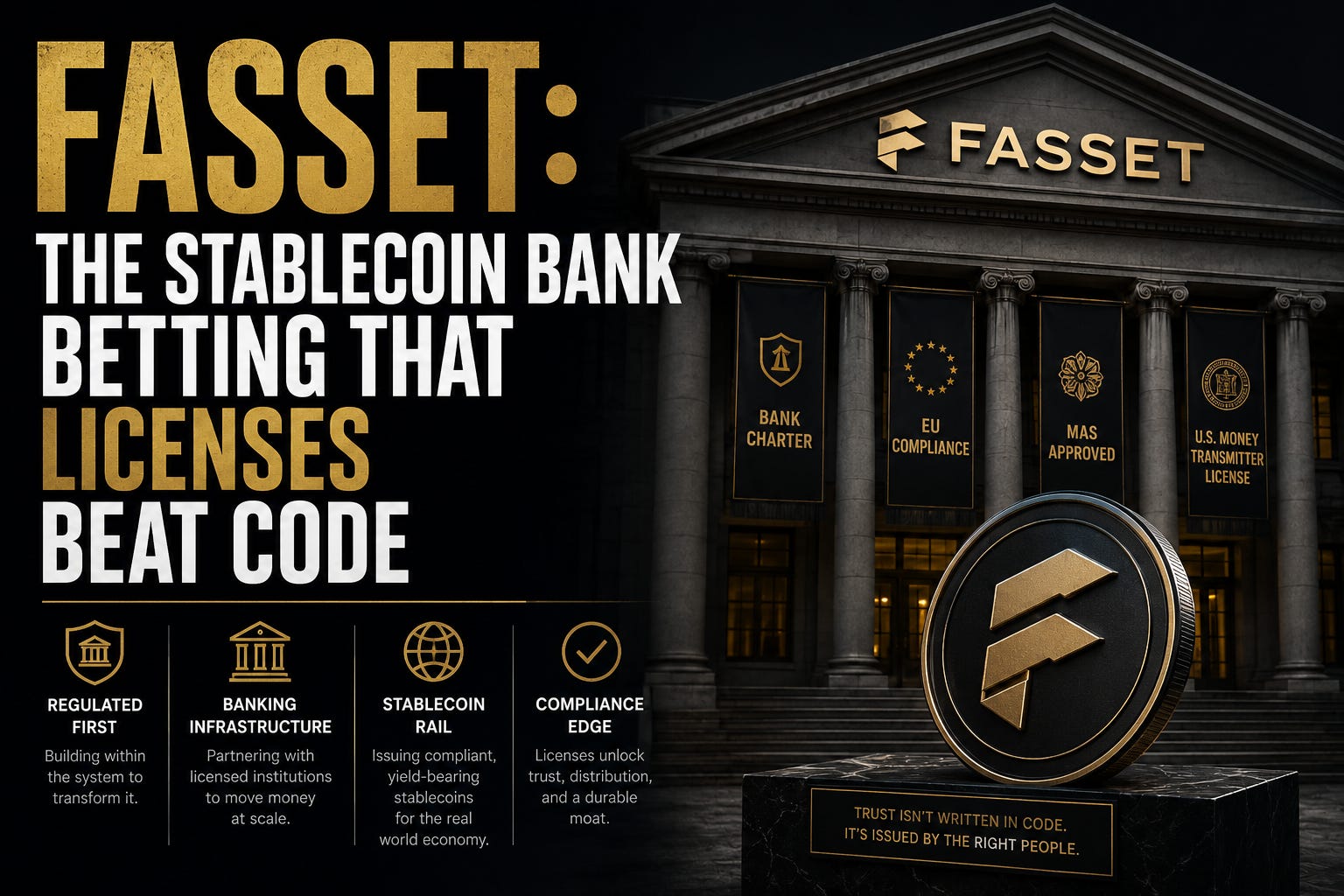
Now the moat, and this is the whole company. Fasset holds regulatory licenses across the UAE, Indonesia, Malaysia, the EU, Turkey, and Pakistan. It runs a Shariah-compliant model that has earned genuine trust in Gulf and South Asian markets, which is not something a competitor replicates with a press release. And it owns its full stack, from the licenses down through liquidity provision to core infrastructure, including a proprietary settlement network the company calls Own Network for tokenized real-world assets.
Compare that to the competition. Pure-play stablecoin protocols can move a dollar anywhere, instantly, for fractions of a cent. But they can’t legally bank a small business in Karachi or settle a remittance into Jakarta under local rules. The travel-rule and FATF compliance that locks them out of institutional liquidity pools is exactly what Fasset has spent six years building. The rail is becoming a commodity. The license to operate on it, locally and legally, is not.
This is also where a real-world parallel helps. /mkt, the athlete-tokenization platform, operates on the same structural logic in a different vertical: it runs its offerings through a Reg A+ framework with tZERO as the trading infrastructure, because in regulated markets the compliance architecture is the product surface, not a cost center bolted on later. Different assets, same insight. When you build in a regulated market, the regulation is the moat, provided you treat it as core engineering from day one rather than legal cleanup at the end.
Section 4: Spence’s Take
Two models do the work here.
Commoditize Your Complement. The smartest move in any value chain is to drive the price of the thing next to you toward zero, so all the margin pools in the layer you control. Fasset is doing this deliberately. It treats the blockchain rail as a commodity, cheap, open, interchangeable, and even builds its own to make settlement nearly free. Why give the rail away? Because the moment moving money is free, the only thing anyone will pay for is legal access to move it. And legal access is precisely what Fasset owns: six jurisdictions of licensing, local banking corridors, Shariah-compliant trust. Cheap rails don’t threaten Fasset. They make the license stack more valuable, because they strip margin out of every competitor who has nothing but the rail.
Margin of Safety. Borrowed from value investing, this is the buffer between you and disaster when you’re wrong. Fasset’s license stack is its margin of safety. Six regulatory approvals are a wall that a well-funded competitor needs years to climb, and SBI Group’s backing widens it with Asian banking relationships that pure-play protocols cannot buy.
But a margin of safety cuts both ways, and that’s the bull-and-bear hinge. The same licenses that protect Fasset are slow, expensive, and reversible. Here’s the bull case: regulated rails win, Fasset compounds its lending book on top of $32 billion in flow, and it becomes the default bank for a billion underbanked people. Here’s what kills it: a single major license revocation in a core market, a sovereign deciding stablecoins threaten monetary control, or a deep-pocketed incumbent buying its way through the regulatory wall. Stripe just paid $1.1 billion for the stablecoin firm Bridge. When the giants decide compliance is buyable, a license moat starts to leak. Fasset’s margin of safety is real today. The question is how fast it erodes.
Section 5: Why It Matters
For investors and VCs. This is a deal worth watching, not for the headline but for the signals underneath it. SBI led, and SBI doesn’t write checks into Asian fintech it can’t distribute. Track three things: whether the SME lending book actually scales (that’s the margin, not payments), whether Fasset adds licenses faster than rivals can copy the existing ones, and whether transaction volume growth holds without burning the FX spread to buy it. Watch the regulatory headlines in Indonesia and Pakistan most closely. Those are the load-bearing markets.
For potential customers. If you’re an SME in an emerging market drowning in 5-to-8% cross-border fees and multi-day settlement, the product coming at you is a bank account that settles in seconds, holds multiple currencies, and is bolting on lending and trade finance. The pitch isn’t “crypto.” It’s “your supplier in Shenzhen gets paid today, at a fraction of the bank’s cut, legally.” That’s a real problem solved.
For competitors and builders. The lesson is uncomfortable if you’ve been building rail-first. Speed is table stakes now, and table stakes don’t command margin. The defensible position is the regulated layer that’s miserable to build and impossible to skip. If you’re a founder in any regulated market, fintech, healthcare, securities, the takeaway is to treat compliance as a core product surface from the first commit, not a cost you minimize. The companies that win regulated markets are the ones that fell in love with the paperwork early.
Section 6: The Bottom Line
Fasset isn’t betting that stablecoins win. It’s betting that regulated stablecoin banking wins, and that the licenses are the asset while the technology is the commodity. The model is sound and the scale is real; the risk is that a moat made of regulation can be revoked by regulators or bought by giants. Watch the lending book and the license count. Those two numbers will tell you everything.
This is Startup Spotlight. Every week I break down a company worth watching. Subscribe for $7.99/mo to get the full analysis.
Disclaimer: Funding amounts, valuations, transaction figures, and investor details are drawn from public disclosures, company announcements, and third-party market research, and have not been independently verified. Market-size figures are third-party estimates. This newsletter is for informational and educational purposes only. It is not investment advice, a solicitation, or a recommendation to buy or sell any security or asset. References to /mkt are provided solely as an operational and structural example and are not an offer, solicitation, or recommendation of any security. Do your own research.