

Everybody wanted the robotaxi. Gatik wanted the box truck. On Aug 25 the autonomous freight company announced a $200 million Series D, its largest round yet, and it closed the round with something most self-driving startups still can’t put on a slide: real, contracted revenue. Here’s the full breakdown of what Gatik built, why it works, and where it could still come apart.
1. Company Overview
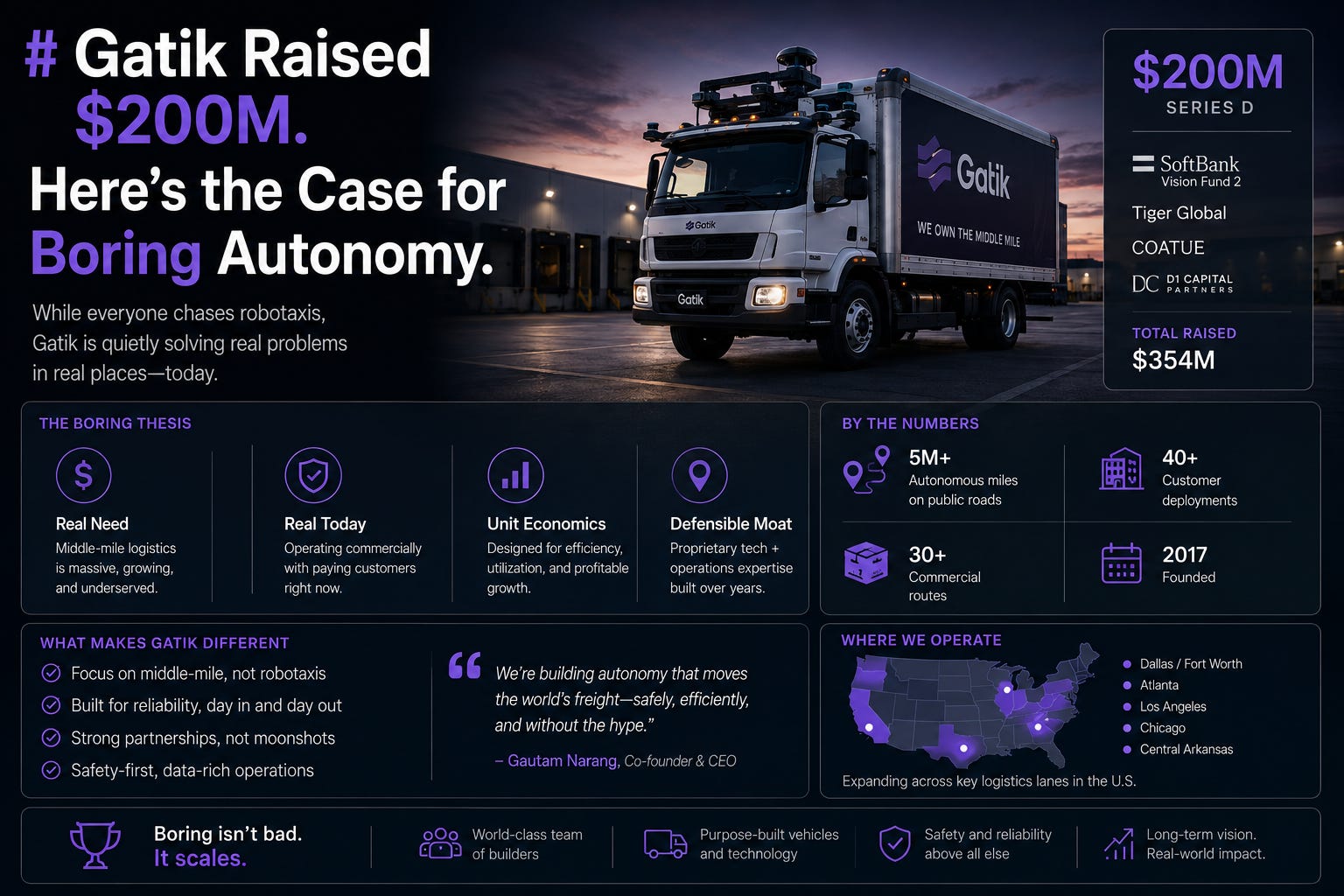
Gatik, founded in 2017 by veterans of the autonomous-tech world, runs driverless medium-duty box trucks on the “middle mile,” the short, repeatable regional hops between distribution centers and stores. On Aug 25 it announced a $200 million Series D led by the Qatar Investment Authority and Koch Disruptive Technologies, with Millennium Management, ARK Invest, Arca Continental, and Intact Private Capital joining. Intact tripled its prior commitment. It’s Gatik’s largest round to date and brings total funding to roughly $500 million.
The numbers Gatik put behind the raise are the part worth sitting with. The company reports more than $600 million in contracted revenue, 85,000 fully driverless orders completed, and a 99% on-time rate. Those are company-reported figures, and Gatik declined to disclose its valuation, so treat the metrics as self-reported and the price as unknown. It runs dozens of fully driverless trucks today and, per a company spokesperson, is targeting more than 100 by the end of 2026, with plans to reach thousands over the following years.
The customer list is the credential. Walmart was the first named customer, and in 2021 Gatik launched what it calls the world’s first driverless commercial delivery service on those routes. PepsiCo is now the largest public partnership: since signing a multiyear deal in June, 41 driverless Gatik trucks move Frito-Lay products from distribution centers to roughly 250 retail locations around Dallas, Phoenix, and Northwest Arkansas. Kroger, Tyson Foods, and Canada’s Loblaw are also customers. The trucks come off Isuzu assembly lines with Gatik’s “Gatik Driver” system on board, and the company partners with NVIDIA, Cummins, Ryder, and Goodyear. Operations run in Texas, Arizona, Arkansas, and Ontario.
2. The Market
Gatik isn’t chasing the whole autonomous-trucking number, and that matters, because the whole number is a mess of competing definitions. The slice it actually plays in is middle-mile autonomous delivery, and Future Market Insights pegs that at about $490 million in 2026, growing to roughly $14.2 billion by 2036, a 40% compound annual rate, with Level 4 box trucks the leading vehicle type. Those are third-party estimates, not gospel, but the shape is clear: this is a small, fast-forming market, not a mature one.
The demand underneath it is structural, not hype. The American Trucking Associations estimates a driver shortage near 82,000 in 2026, projected to climb past 160,000 by 2031. Federal hours-of-service rules cap a human driver at 11 driving hours inside a 14-hour window, which means a human-driven truck sits idle for a big chunk of every day. A driverless truck doesn’t clock out. On repetitive regional routes that carriers have always struggled to staff, that’s a real economic gap, and it’s exactly the gap Gatik sells into.
One more market fact frames the raise. Autonomous middle-mile is consolidating early: by some estimates the top handful of players already account for the large majority of commercially active driverless middle-mile miles. In a market like that, the durable asset isn’t a demo. It’s certified routes and signed customers.
3. Business Model and Moat
Gatik’s model is autonomy as a service. It doesn’t build trucks, it buys them from an OEM and supplies the brain, then runs the routes around the clock. The strategic choice that makes the whole thing work is the constraint. Instead of trying to drive anywhere, Gatik locks its trucks to a tightly defined operational domain: known regional routes, mapped and validated, run over and over. Early routes were fixed and under 10 miles. Today the dynamic version stretches to as much as 400 miles with multiple pickups and drop-offs, but the principle holds. Certify a route once, and every additional shipper you layer onto it makes the route more valuable. That’s a compounding asset, not a one-off.
The moat is the stack of things that are hard to copy fast: a driver-out operational record on public roads, route certifications that took years to earn, a Fortune 50 customer base with switching costs, a manufacturing and supplier web (Isuzu, NVIDIA, Cummins, Ryder, Goodyear), and a regulatory footprint across the states with workable AV frameworks. Gatik also joined NVIDIA’s Halos AI Systems Inspection Lab in March 2026, an accreditation layer that signals it’s treating safety validation as a moat rather than a checkbox. Right now, in driver-out middle-mile box trucks specifically, Gatik largely sits alone.
4. Spence’s Take
Gatik’s edge is what it refused to build. That’s circle of competence in action, one of the 50 models in the book. The glamorous problems in autonomy, robotaxis and long-haul highway trucking, are also the hardest ones, with the widest range of situations a system has to handle perfectly. Gatik drew a tight circle around a problem it could actually master, the repeatable distribution-center-to-store run, and refused to step outside it. Staying inside your circle isn’t a limitation. It’s how you ship while everyone else is still demoing.
Pair that with a second model: margin of safety. A narrow, validated route gives you engineering margin, fewer edge cases means fewer ways to fail. And more than $600 million in contracted revenue gives you financial margin that hype-funded peers just don’t have. This is the same logic behind building in regulated markets, which is the game I play day to day as CPO at /mkt: you don’t win by moving fast and breaking things, you win by owning a defined, compliant domain so completely that speed becomes safe. Gatik took the autonomy version of that bet.
The bull case is clean. Driver-out operations are live and commercial, the revenue is contracted, the customers are household names, the tailwinds (driver shortage, hours-of-service limits) are structural, and the company now has the capital to scale.
The bear case is just as real. “Dozens” of trucks to “thousands” is a brutal jump that tests manufacturing, operations, and capital all at once. One serious safety event could reset public and regulatory trust overnight, no matter how good the on-time rate is. Customer concentration is heavy, with PepsiCo and Walmart doing a lot of the lifting. The regulatory patchwork still varies state by state, and a national framework isn’t in place yet. And with the valuation undisclosed, nobody outside the round can judge whether the price is sane. None of this is a prediction. It’s the list of things to watch.
5. Why It Matters
For investors and VCs: Gatik is a template for capital-efficient autonomy. Narrow the domain, sign real contracts, and let the revenue, not the narrative, carry the round. Notice who led it, too: a sovereign fund and strategic industrial capital taking equity in a platform they can deploy against. As middle-mile consolidates, certified routes and signed revenue are the assets that survive. That’s the pattern to pressure-test in any autonomy deal that crosses your desk.
For potential customers (retailers, grocers, CPG, and 3PLs): driverless middle-mile has moved past pilot theater and into live supply chains. The pitch is capacity and reliability on exactly the routes that are hardest to staff. If you’re evaluating it, the questions that matter are on-time performance, how much of your route network fits the operational domain, insurance terms, and how much you’re comfortable concentrating with a single provider.
For competitors and builders: the lesson is wedge selection. Pick a domain you can certify and repeat, build the operations layer rather than just the model, and partner for the hardware instead of trying to build it. Certification and operational history are becoming the real barriers to entry here, and they compound with time. Speed to a flashy demo is not the same as speed to a signed, driver-out route.
6. The Bottom Line
Gatik didn’t win by solving the hardest problem in autonomy. It won by choosing a valuable one, drawing a hard line around it, and shipping revenue while the rest of the field argued about robotaxis. The next 18 months are a straight execution test: get from dozens of trucks to hundreds to thousands without a safety event that resets the clock. Hold that 99% on-time rate through the scale-up, and Gatik doesn’t just lead the middle mile, it defines it. Fumble the scaling, and the moat starts to look like a head start. Either way, this is the clearest proof yet that boring, contracted, driver-out autonomy is a real business, not a someday story.
If this was useful, share it with someone who builds things, and if you want the full toolkit, you can grab my book, Mental Models: How to Think, Act, and Win, on Amazon right now.
This is Startup Spotlight. Every week I break down a company worth watching. Subscribe for $7.99/mo to get the full analysis.
Disclosure and disclaimer: Spencer Gareiss is Chief Product Officer at /mkt, referenced above as an example of building in regulated markets. This newsletter is for information and education only. It is not investment advice, and it is not an offer or solicitation to buy or sell any security. Gatik is a private company; its valuation was not disclosed, and its revenue, delivery, on-time, and fleet figures are company-reported and have not been independently verified. Forward-looking targets, including fleet-growth plans, are the company’s statements, not facts. Market-size, driver-shortage, and consolidation figures are third-party estimates from named sources (Future Market Insights, the American Trucking Associations, and others) and will vary by methodology. Funding and operating details reflect reporting as of August 28, 2026, drawn from the company’s announcement and outlets including TechCrunch, Bloomberg, Reuters, Forbes, SiliconANGLE, and FreightWaves.
If you want the mental models behind breakdowns like this, my book, Mental Models: How to Think, Act, and Win, is on Amazon now.


This post is for informational and educational purposes only. It is not investment advice, a recommendation, or a solicitation to buy or sell any security. Funding figures, revenue, and valuation are as reported by the company, regulatory filings, and named outlets; the ~$470M valuation is a reported, time-sensitive snapshot and not independently verified. Dhoni's individual investment amount was not disclosed. The /mkt reference is a structural illustration of building in regulated markets and is not an offer or solicitation. Past performance and third-party investment decisions do not indicate future results.