

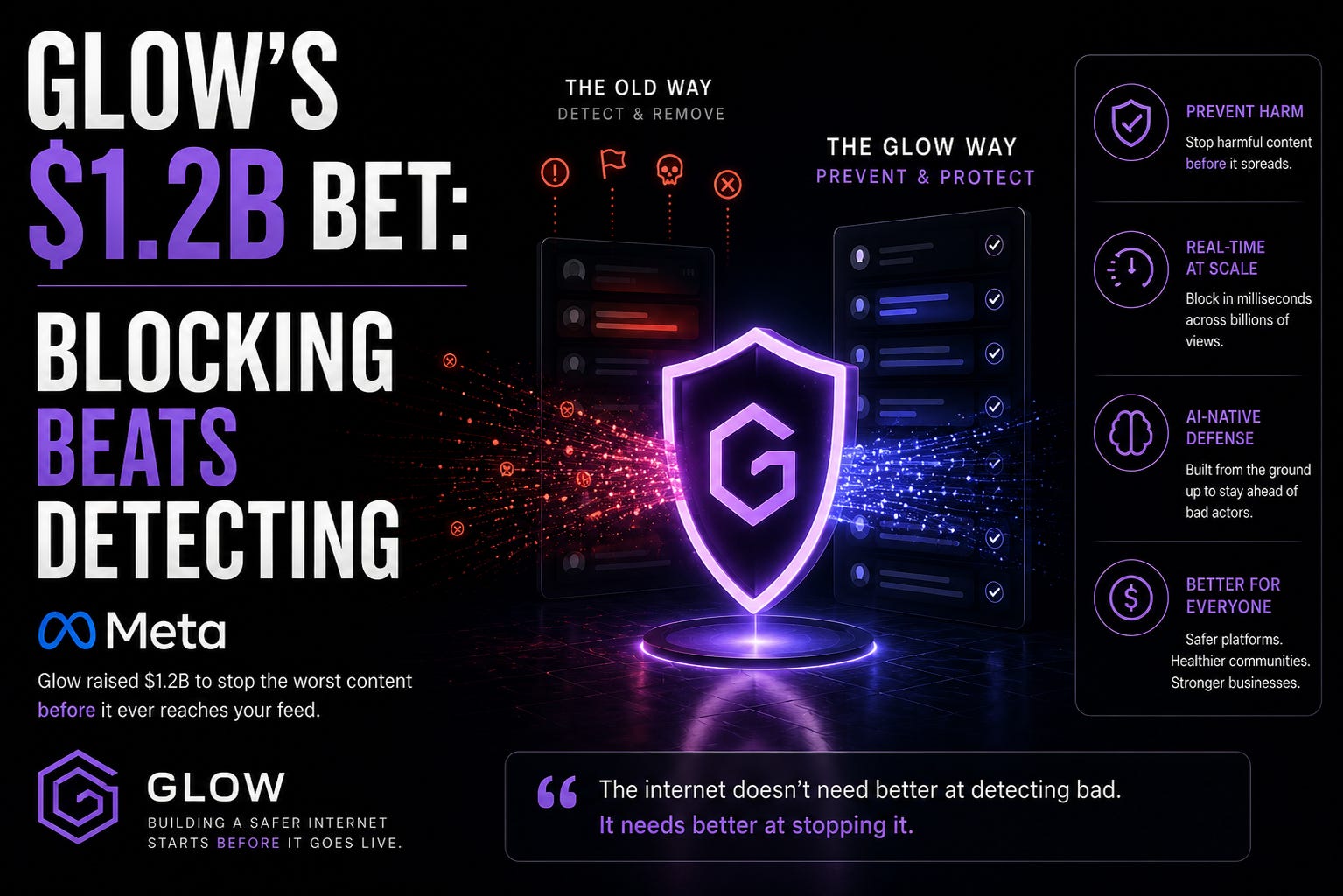
Every security vendor for a decade has sold you the same thing: more visibility, more alerts, more dashboards. Glow just raised at a $1.2 billion valuation selling the opposite.
The company came out of stealth Wednesday from Tel Aviv and Palo Alto with $180 million in funding at a $1.2 billion valuation. Sequoia, Cyberstarts, Greenoaks, and Redpoint led, with Index Ventures, Lux Capital, Swish, Operator Collective, and Holly Ventures along for it.
One thing worth flagging, because the coverage is muddled. Several outlets called the whole $180 million a Series A. Israeli outlet CTech breaks it into three rounds since founding: a $20 million seed, a $60 million round at roughly a $400 million valuation, and about $100 million now. The company’s own release just says $180 million in funding at $1.2 billion, without labeling it. Either way, the markup is the story. Roughly 3x in a matter of months, for a company founded in 2025.
The team explains the price. CEO Roi Tiger spent nine years at Meta, most recently as VP of Engineering. CTO Omer Singer ran cybersecurity strategy at Snowflake. Ophir Arie was VP of R&D at Claroty. Emily Heath was CISO at United Airlines and DocuSign and sat on Wiz’s board through its $32 billion sale to Google. Several backers here also funded Wiz. They’re buying the same shape twice.
The product thesis is narrow and sharp. Tiger’s framing is that the last decade moved everything to cloud and SaaS, and now AI has landed on the endpoint in a way nobody’s seen. By the company’s own count, unauthorized AI use on corporate devices went from 15% to 45% in a year. That’s a company-reported number, so weigh it accordingly, but the direction is obvious to anyone running IT right now. Glow’s agents map what’s running on a device, score it in real time, and block unapproved software before it lands instead of flagging it afterward.
The mental model here is Via Negativa. Improvement by subtraction. Most progress comes not from adding a better thing but from removing the bad thing, and the removal is usually more reliable than the addition. Detection is addition: more sensors, more alerts, more analysts drowning in a queue. Prevention is subtraction: the bad thing never enters, so there’s nothing to triage. Glow’s whole pitch is that in a world where employees spin up AI agents faster than any team can review them, adding review capacity is a losing race. You have to shrink what gets in.
Here’s my contrarian read, though. Subtraction is the right strategy and the hardest sale. Blocking creates friction, and friction is exactly what gets a security tool ripped out. Every prevention-first company eventually meets the VP of Engineering whose build broke at 2am because the agent said no. Detection vendors survive by never being the reason work stopped. Glow is choosing to be that reason, on purpose. That’s a real bet, not a marketing angle.
We think about the same tradeoff at /mkt. Building athlete offerings under Reg A+ means designing constraints in from the start rather than monitoring for problems later. Constraints upfront feel expensive. They’re cheaper than cleanup.
So watch renewals, not logos. Anyone can sell prevention once. The question is who’s still deployed after it blocks something important.
If this was useful, share it with someone who builds things. And if you want the full toolkit of 50 mental models, you can grab my book, Mental Models: How to Think, Act, and Win, on Amazon right now.
If you want the mental models behind breakdowns like this, my book, Mental Models: How to Think, Act, and Win, is on Amazon now.


This post is for informational and educational purposes only. It is not investment advice, a recommendation, or a solicitation to buy or sell any security. Funding figures, revenue, and valuation are as reported by the company, regulatory filings, and named outlets; the ~$470M valuation is a reported, time-sensitive snapshot and not independently verified. Dhoni's individual investment amount was not disclosed. The /mkt reference is a structural illustration of building in regulated markets and is not an offer or solicitation. Past performance and third-party investment decisions do not indicate future results.