


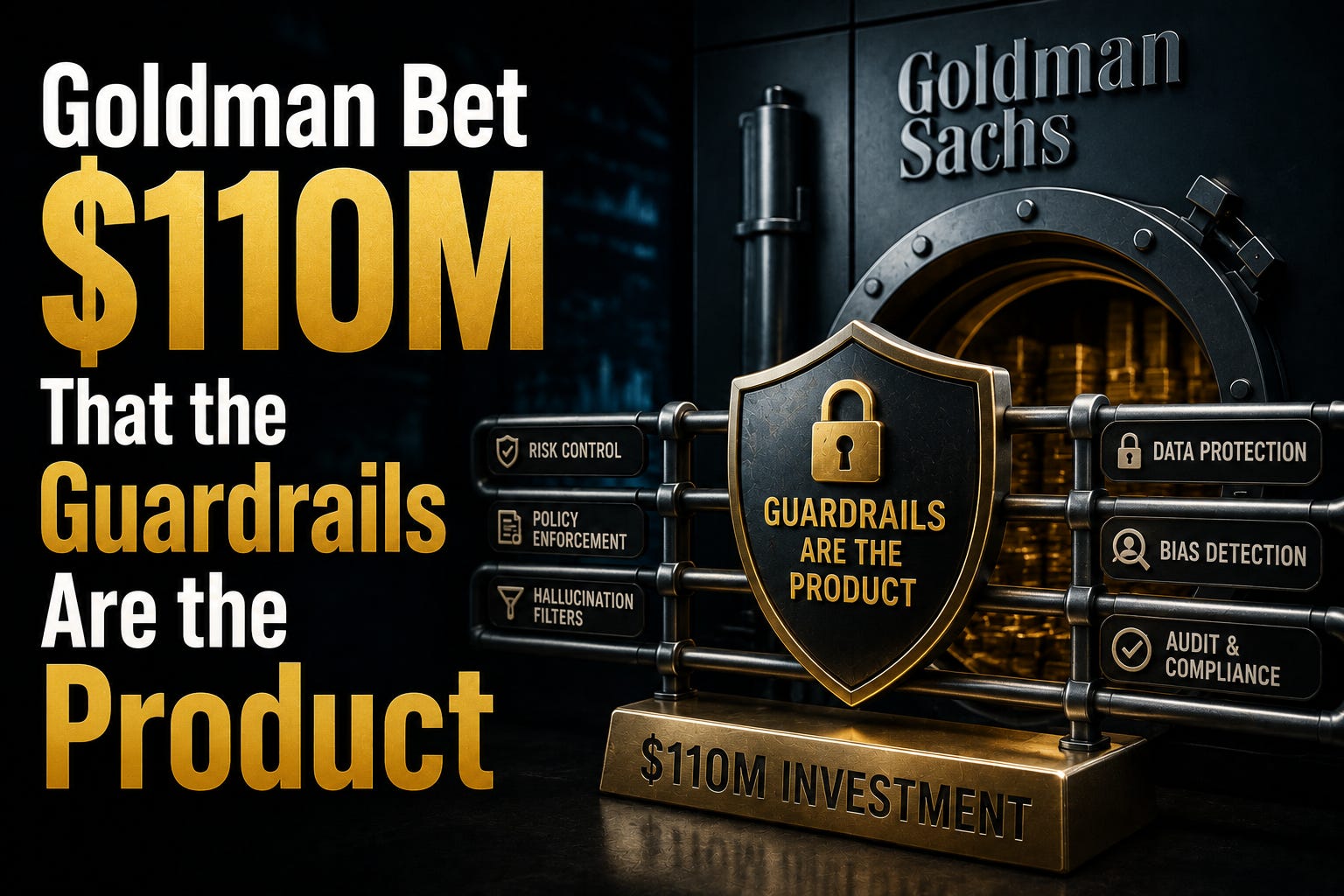
Everyone thinks the AI story is about replacing people. Goldman just put $110 million behind the opposite bet.
Taktile, a New York startup, announced a $110 million Series C led by Growth Equity at Goldman Sachs Alternatives, with Tiger Global, Index Ventures, Balderton, and Y Combinator joining. Fortune broke it in late June, and total funding now sits at $184 million. The valuation wasn’t disclosed. Taktile builds what it calls an agentic decision platform: AI agents that handle the high-stakes calls banks and insurers used to reserve for people, like loan underwriting, claims processing, and anti-money-laundering checks. The company says some customers hit 95% automation in B2B underwriting and cut AML false positives by 75%. Moody’s pegs average KYC and AML spend at $72.9 million a year per institution, so the prize is real.
Here’s the tell, though. Taktile doesn’t just hand the decision to a model. Its platform stitches together AI agents, hard business rules, and human oversight, and it gives the credit officer or fraud lead direct visibility and control. Goldman’s team said the whole point is that these are high-stakes, regulated decisions.
The mental model: Margin of Safety.
Most people know margin of safety from investing. Leave room between price and value so you survive being wrong. It applies anywhere the downside is lopsided.
Automating an underwriting call isn’t like automating a marketing email. Get the email wrong and you lose a click. Get the AML decision wrong and you get a regulator, a fine, and a headline. So the smart design isn’t maximum autonomy. It’s autonomy with engineered headroom: rules the model can’t override, a human in the loop, an audit trail a regulator can actually read. That headroom is the margin of safety, and it’s what turns a black box nobody trusts into a system a bank will actually run.
I built derivatives at Robinhood, where “margin” wasn’t a metaphor. The lesson stuck. In finance, the buffer isn’t the boring part. It’s the whole game.
Same discipline shows up building in regulated markets. Running athlete offerings under Reg A+ with tZERO at /mkt means designing as if things go wrong from day one, because the downside is asymmetric and the rules don’t grade on effort. You build the oversight in first, not after something breaks.
Here’s the contrarian read. The hype says AI wins by removing humans. Taktile’s raise says the money is in the guardrails, not the autonomy. In regulated finance, whoever makes AI auditable and controllable beats whoever makes it most independent. Margin of safety isn’t the tax you pay to ship AI into high-stakes work. It is the thing you’re selling.
Disclaimer: This post is for informational and educational purposes only. It is not investment, financial, legal, or tax advice, and it’s not a recommendation or solicitation to buy, sell, or trade any security, contract, or instrument, or to participate in any prediction market. Valuations, volumes, and funding figures reflect public reporting and third-party estimates that vary by source and change over time; past performance and private valuations are not indicative of future results. Regulatory status referenced here is described generally and is subject to ongoing litigation and change. /mkt is referenced only to illustrate how regulated-market infrastructure is built, and nothing here is an offer or solicitation with respect to any security.
If you want the mental models behind breakdowns like this, my book, Mental Models: How to Think, Act, and Win, is on Amazon now.


Startup Spotlight is for informational and educational purposes only. It is not investment advice, an offer, or a solicitation to buy or sell any security. Company metrics are self-reported, and funding details are drawn from public reporting and company statements. Figures may change.