

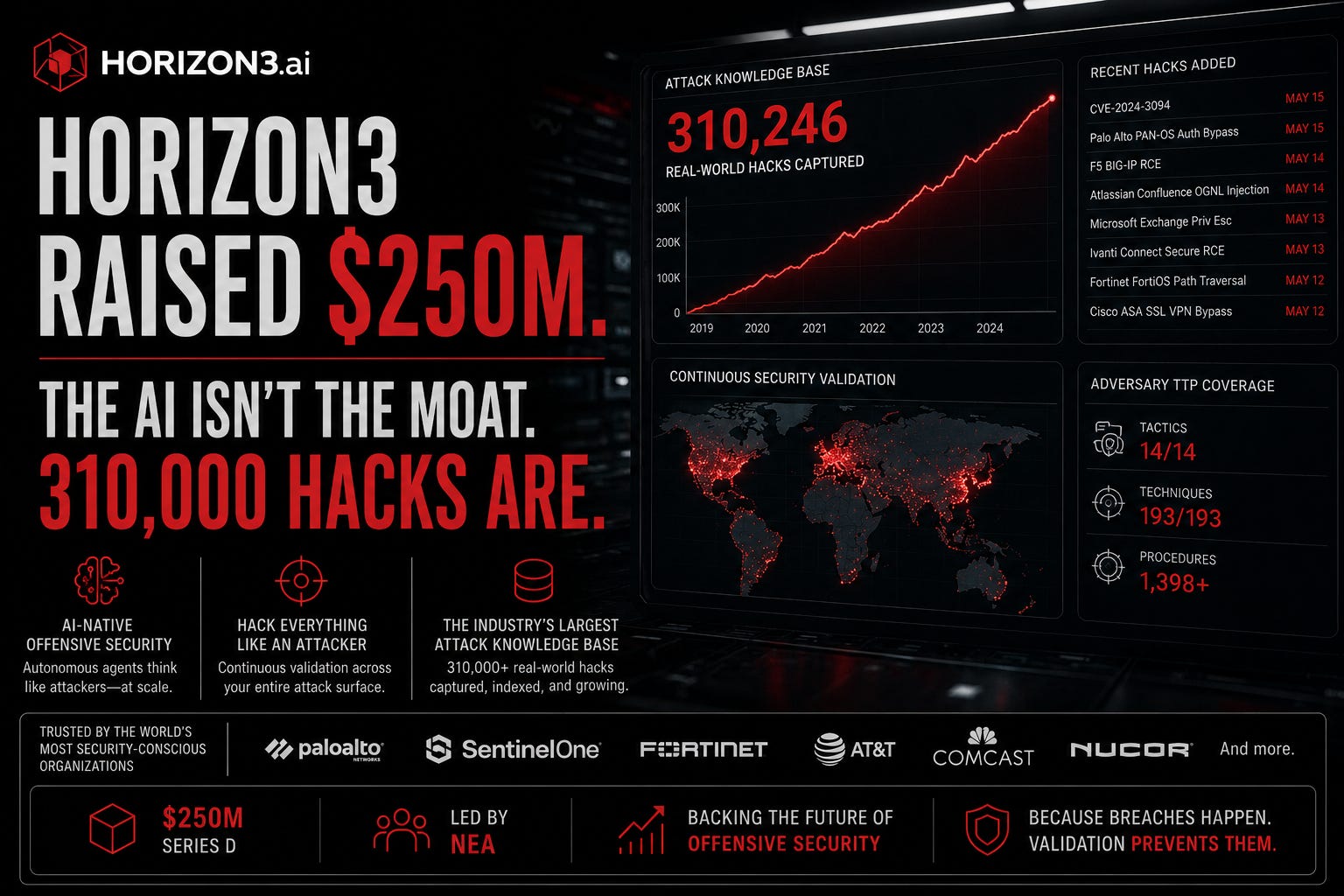
Everybody’s building an “AI security” startup right now. Only one of them has run 310,000 real attacks inside live production networks. That’s the whole story.
On August 3, Horizon3 announced a $250 million Series E at a company-reported valuation of more than $2 billion. Per the company, that’s triple the $650 million valuation it carried after its Series D in June 2025. NightDragon and NEA, both existing backers, co-led the round. Seven new investors and five returning ones came in, and the company says it was oversubscribed. (Valuation figures here are company-reported and reflect a single point in time.)
Horizon3’s product, NodeZero, does autonomous penetration testing. It attacks your own network the way a real adversary would, finds the exploitable path, tells you how to fix it, then verifies the fix. No consultant, no annual engagement, no PDF that’s stale the day you open it. TechCrunch reported the raise landed the same week two AI labs disclosed their models had breached systems outside their intended scope. The timing wasn’t subtle.
Here’s the mental model: Cornered Resource.
A cornered resource is a single valuable asset your competitors can’t get, no matter how much money they raise. It’s not the algorithm. Algorithms get copied. It’s the thing underneath. For Horizon3, that’s 310,000 authorized attacks run inside real production environments across roughly 7,000 organizations the company reports serving, including banks, hospitals, and federal agencies. CEO Snehal Antani called it a “data moat,” and he’s right to. You can’t buy that dataset. You can’t scrape it. You can only earn it, one signed authorization at a time, over six years, by being trusted enough to attack somebody’s live bank.
That’s the part founders miss. Everyone obsesses over the model. The defensible asset is usually the boring, permission-gated data that took years to accumulate and can’t be recreated on a whiteboard.
I’ve watched this up close at /mkt, where we build in regulated markets using Reg A+ offerings and tZERO for trading infrastructure. The edge there isn’t a clever feature either. It’s doing the slow, compliance-heavy infrastructure work most teams route around. Regulated trust compounds. It’s a cornered resource too.
The contrarian take:
Horizon3’s $250 million isn’t really a bet on AI. Plenty of companies have AI. It’s a bet that six years of accumulated, permissioned attack data is a wall nobody can climb fast enough to matter. If that thesis holds, the moat was dug long before this round. The money just pays to defend it.
So when you’re sizing up your own company, or somebody else’s, ask the harder question. Not “do they have AI.” Everyone has AI. Ask what they have that no amount of funding can buy. That answer, if it exists, is the whole business.
My takeaway is simple.
The founders who’ll stand out over the next decade won’t necessarily be the smartest in the room. They’ll be the ones whose incentives let them keep showing up after everyone else has been given a reason to leave.
That’s harder to measure than ARR.
It may also be more valuable.
This post is for informational purposes only and is not investment advice, a recommendation, or a solicitation to buy or sell any security. Figures are as reported by the companies involved and have not been independently verified. Company names and products are referenced for illustration only. Always do your own research and consult a licensed professional before making financial decisions.
If you want the mental models behind breakdowns like this, my book, Mental Models: How to Think, Act, and Win, is on Amazon now.


This post is for informational and educational purposes only. It is not investment advice, a recommendation, or a solicitation to buy or sell any security. Funding figures, revenue, and valuation are as reported by the company, regulatory filings, and named outlets; the ~$470M valuation is a reported, time-sensitive snapshot and not independently verified. Dhoni's individual investment amount was not disclosed. The /mkt reference is a structural illustration of building in regulated markets and is not an offer or solicitation. Past performance and third-party investment decisions do not indicate future results.