
India’s AI Funding Is Heating Up. That’s Not the Story.
Two fresh rounds show where the next wave of venture capital is actually going.
AI funding in India is moving from curiosity to competition.
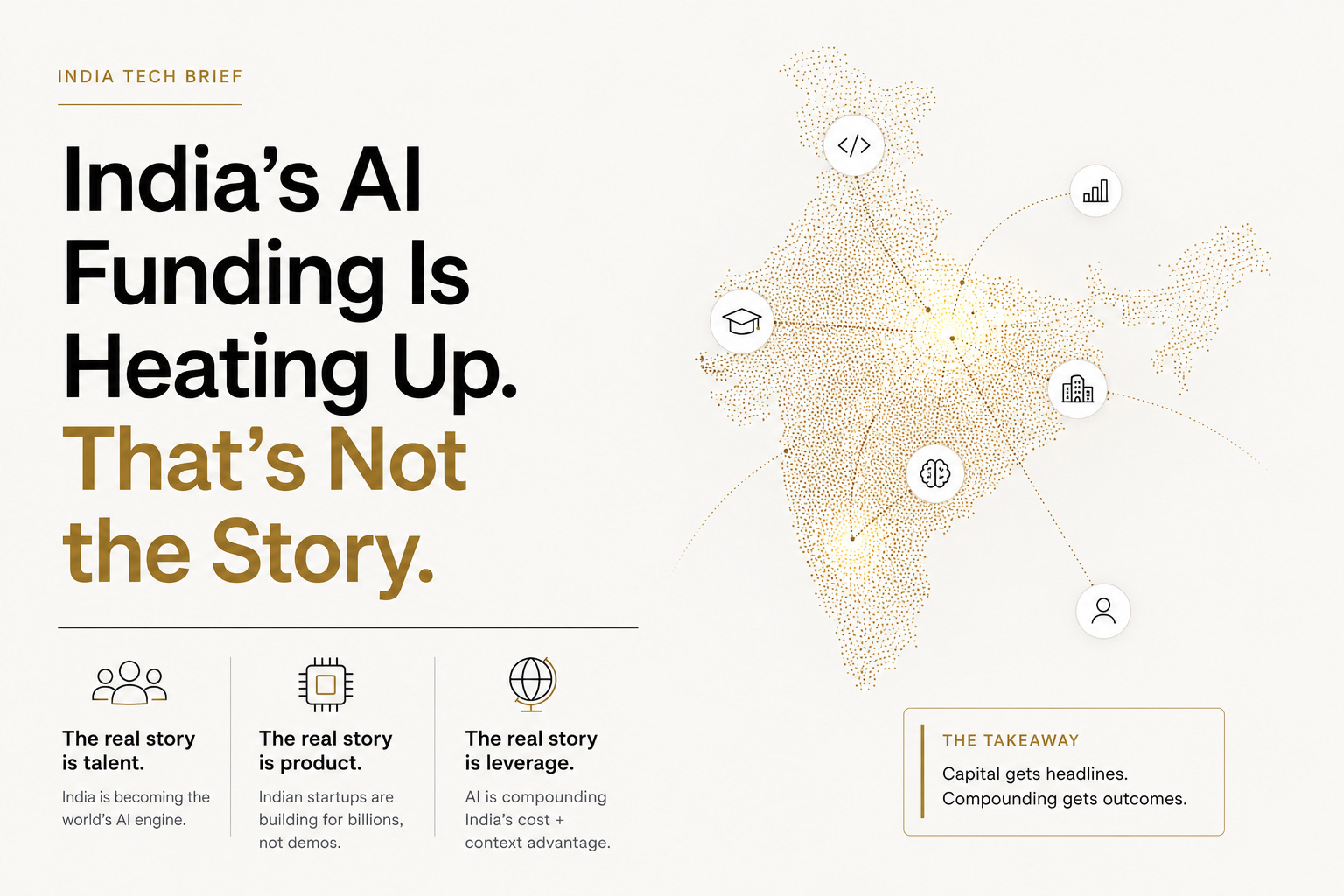
Today, MStack AI is reportedly in advanced talks to raise at least $30 million, potentially expanding the round to $40 million or $50 million, at roughly a $230 million pre-money valuation. At the same time, generative AI startup Simplismart is discussing a $50 million round at a valuation somewhere around $120 million to $140 million.
That’s meaningful capital. But the bigger signal is what sits underneath it.
Investors aren’t just chasing another chatbot. MStack is building AI-native chemical R&D and manufacturing technology. Simplismart is focused on generative AI infrastructure. And the investors circling these deals include Alpha Wave, Lightspeed, Prosperity7, Peak XV and potentially Nvidia.
Then there’s the fund side.
Aum Ventures announced the first close of a new ₹750 crore, roughly $80 million deeptech fund, with more than 65% of the initial commitments coming from international LPs. The fund plans to back 25 to 30 companies across AI, semiconductors, space, robotics, defense, energy transition and advanced manufacturing. Initial checks are expected to be $750,000 to $2 million.
That’s a different kind of AI story.
The capital isn’t only flowing toward model companies. It’s moving into businesses where AI intersects with hard science, specialized infrastructure and regulated or difficult-to-replicate industries.
The mental model: Inversion
In Mental Models: How to Think, Act, and Win, I call Inversion one of the simplest ways to improve a decision.
Instead of asking, “How do we win?”
Ask: “How do we definitely lose?”
For AI startups, one obvious answer is building something that can be copied by the next model release.
If your entire moat is a better wrapper around someone else’s model, you should assume that advantage has an expiration date.
Invert the problem.
What would make the business difficult to replace?
Proprietary data. Deep domain expertise. Distribution. Physical infrastructure. Regulatory approvals. Workflow integration. Specialized research. Switching costs.
That’s where today’s funding is getting interesting.
At /mkt, we’re building in a regulated market using Reg A+ offerings and tZERO’s trading infrastructure. The lesson is similar: regulation can look like friction, but the right structure can become part of the product. The key is building the business around the rules, not pretending the rules aren’t there.
My contrarian take: the next great AI companies won’t necessarily look like AI companies.
They’ll look like chemical companies, defense companies, chip companies, financial infrastructure companies and industrial businesses that happen to have AI as a core capability.
The winners won’t just have the best model.
They’ll have the best reason the model matters.
This is for informational and educational purposes only. It isn’t investment, financial, legal, tax, or regulatory advice, and it isn’t an offer or solicitation to buy or sell any security or financial instrument. Funding figures and valuations are based on public reporting and may change or remain unconfirmed.
If you want the mental models behind breakdowns like this, my book, Mental Models: How to Think, Act, and Win, is on Amazon now.


This post is for informational and educational purposes only. It is not investment advice, a recommendation, or a solicitation to buy or sell any security. Funding figures, revenue, and valuation are as reported by the company, regulatory filings, and named outlets; the ~$470M valuation is a reported, time-sensitive snapshot and not independently verified. Dhoni's individual investment amount was not disclosed. The /mkt reference is a structural illustration of building in regulated markets and is not an offer or solicitation. Past performance and third-party investment decisions do not indicate future results.