

Betting apps don’t ship order management systems. Exchanges do.
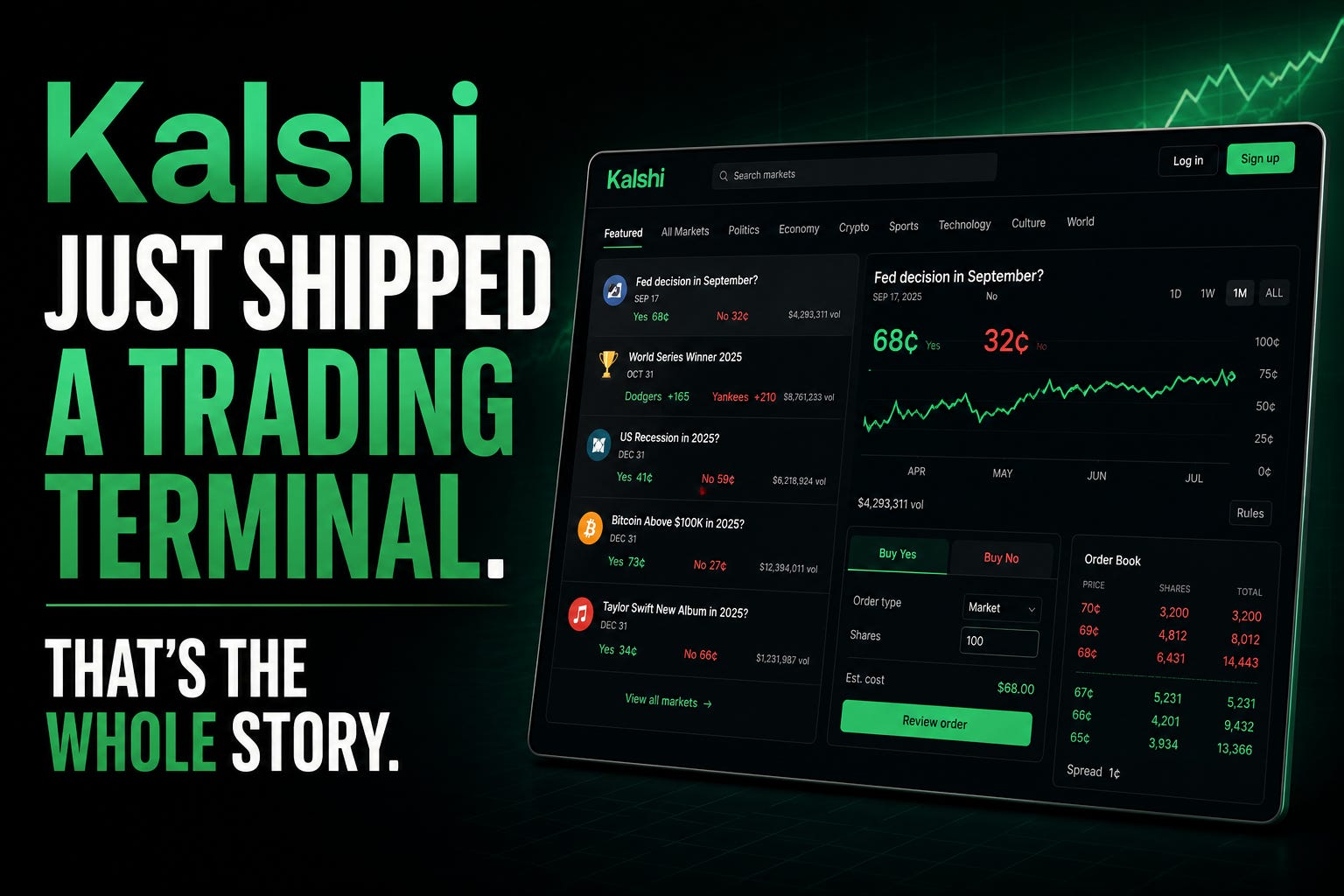
On Monday, Kalshi opened Kalshi Pro to the public. CNBC reported the launch citing a company memo, and the product’s still in beta. What’s in it: a terminal for traders running several markets at once, complex order types, resting orders that sit until a contract hits a price, and access to perpetual futures.
Read that feature list again and tell me who it’s for. It isn’t for the person betting twenty bucks on the Super Bowl coin toss.
Here’s the run-up. In May, Kalshi announced a $1 billion Series F at a $22 billion valuation, led by Coatue, with Sequoia, Andreessen Horowitz, IVP, Paradigm, Morgan Stanley and ARK Invest all in. That was double the $11 billion mark it carried five months earlier. The company said institutional trading volume climbed 800% over six months and that annualized volume went from $52 billion to $178 billion. Those are company-reported figures, so weigh them accordingly. Kalshi also says it accounts for more than 90% of U.S. prediction market activity.
Then on June 24 the FT reported, citing people familiar, that Kalshi’s already in talks to raise again at roughly $40 billion, possibly closing in Q3. Kalshi declined to comment. Treat it as reported, not done.
Meanwhile Polymarket filed an application with the NFA on July 10 to offer margin trading. Same direction of travel.
Block trading. Perps. Margin. Broker integrations. A pro terminal. Nobody’s building a casino here. They’re building the CME.
The model: Inversion
Inversion means you stop asking “how does this win?” and start asking “how does this die?” Then you go look at whether anyone’s actually solved that.
Ask the forward question about prediction markets and you get a boring answer. Does demand exist? Obviously. The volume numbers settled that argument. Product velocity? They’re shipping faster than most fintechs I’ve worked near.
So invert. What kills this?
Not competition. Not user growth. Jurisdiction.
CME sued the CFTC over its approval of Kalshi’s perpetual futures. States including Illinois and Arizona have gone after the sports contracts as unlicensed gambling. The CFTC has sued states back, arguing the Commodity Exchange Act gives it exclusive authority over contracts listed on a federally licensed exchange. A federal appeals court sided with Kalshi against New Jersey on exactly that reasoning. This is unresolved and I’m not going to predict how it lands.
But that’s the point. Every real risk on the board is a legal risk. Zero of them are product risks.
Spence’s take
Everybody’s still arguing about whether prediction markets are gambling or a legitimate asset class. That debate is a distraction and it’s been a distraction for two years.
Invert it and the picture gets simple: Kalshi’s most valuable asset isn’t Kalshi Pro. It’s the CFTC registration underneath it. The terminal is downstream of the license. Without the license, the terminal is a felony in eleven states.
I’ve built derivatives and prediction markets before, and I’ll tell you what nobody puts on a pitch deck: in regulated markets, your permission to operate is your moat. Features get copied in a quarter. Registrations take years and you can lose them in a day.
That’s why at /mkt we settled on Reg A+ and tZERO before we argued about a single feature. Rules first, then the thing.
Watch the courts, not the roadmap.
If you want the mental models behind breakdowns like this, my book, Mental Models: How to Think, Act, and Win, is on Amazon now.


Startup Spotlight is for informational and educational purposes only. It is not investment advice, an offer, or a solicitation to buy or sell any security. Company metrics are self-reported, and funding details are drawn from public reporting and company statements. Figures may change.