

A two-year-old company that writes apps from plain-English prompts is now worth $13.3 billion. Eight months ago it was worth half that. The bull case is easy. The useful question is the opposite one.
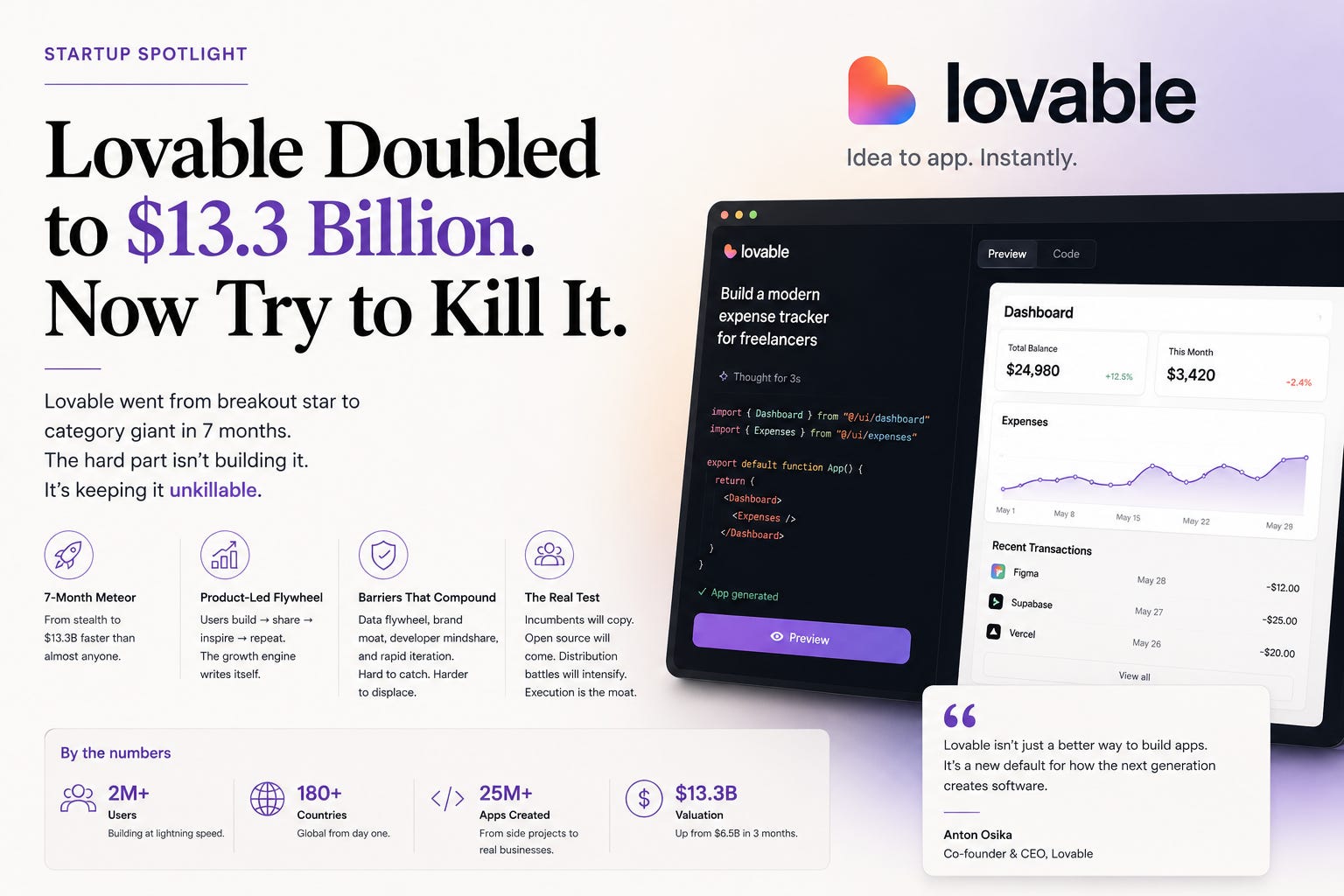
Lovable, the Stockholm vibe-coding startup, announced a $400 million Series C on Wednesday at a $13.3 billion valuation, per the company and reporting from Reuters and Bloomberg. Menlo Ventures led it, with EQT’s Scaleup Europe Fund co-leading and backers including Tencent, Accel, and Salesforce Ventures.
The growth is the story. Lovable says its annual recurring revenue has nearly tripled from $200 million and is tracking toward $600 million by the end of August. The valuation doubled from $6.6 billion in December. More than 60 million projects have been built on the platform since it launched in November 2024, and the company says names like Nvidia and Adidas build on it. For a company that’s barely two years old, those numbers are absurd, and I mean that as a compliment.
Here’s a mental model from the book: inversion. Most people size up a hot company by asking why it wins. Inversion flips it. Don’t ask why Lovable is worth $13.3 billion. Ask what would have to be true for it to be worth zero, then go check whether the company is defusing those things.
So invert. The obvious kill shot for any AI app-builder is that it’s a thin layer on top of somebody else’s model. If the real value lives with the frontier labs, then Lovable is renting its core and competing with rivals like Replit and Cursor on a feature a bigger player could copy in a quarter.
Now go check. On August 11, Lovable published an engineering post saying its own in-house models now handle a growing share of the build work: routing requests, summarizing responses, writing commit messages, with harder tasks next. It calls the orchestration layer a control plane, and outside models have to earn their traffic against the in-house ones. In its words, model independence is the product. That’s not a coincidence. That’s a company that ran the same inversion and is building away from its biggest failure mode in public.
My take: the ARR chart is the least interesting thing here. Revenue growth this fast is real, but it’s also the easiest thing to fund and the easiest thing to lose. The durable question is whether Lovable owns any part of the stack that a frontier lab or an incumbent can’t absorb. The model-independence bet is their answer, and it’s the right thing to obsess over. Whether it works is a different question, and I’m not calling it.
Contrarian close: a $13.3 billion price tag isn’t really a bet on how many apps got built. It’s a bet that Lovable ends up owning the orchestration layer, the boring plumbing that decides which model does what. If it does, the wrapper worry goes away. If it doesn’t, the growth was rented. None of this is investment advice. But if you’re building anything on top of AI, run the inversion on yourself first: what kills you, and are you building away from it, or just away from the topic?
If this was useful, share it with someone who builds things. And if you want the full toolkit of 50 mental models, you can grab my book, Mental Models: How to Think, Act, and Win, on Amazon right now.
Disclaimer: This post is for informational and educational purposes only. It is not investment, financial, legal, or tax advice, nor a recommendation to buy, sell, or hold any security or asset. Lovable’s valuation, funding, and revenue figures are company-reported as of publication, with additional reporting from Reuters, Bloomberg, and TechCrunch; they are point-in-time, subject to change, and have not been independently verified. References to other companies are for context only and are not endorsements. Forward-looking statements reflect the companies or sources cited, not statements of fact. Do your own research and consult a licensed professional before making any financial decision.
If you want the mental models behind breakdowns like this, my book, Mental Models: How to Think, Act, and Win, is on Amazon now.


This post is for informational and educational purposes only. It is not investment advice, a recommendation, or a solicitation to buy or sell any security. Funding figures, revenue, and valuation are as reported by the company, regulatory filings, and named outlets; the ~$470M valuation is a reported, time-sensitive snapshot and not independently verified. Dhoni's individual investment amount was not disclosed. The /mkt reference is a structural illustration of building in regulated markets and is not an offer or solicitation. Past performance and third-party investment decisions do not indicate future results.