


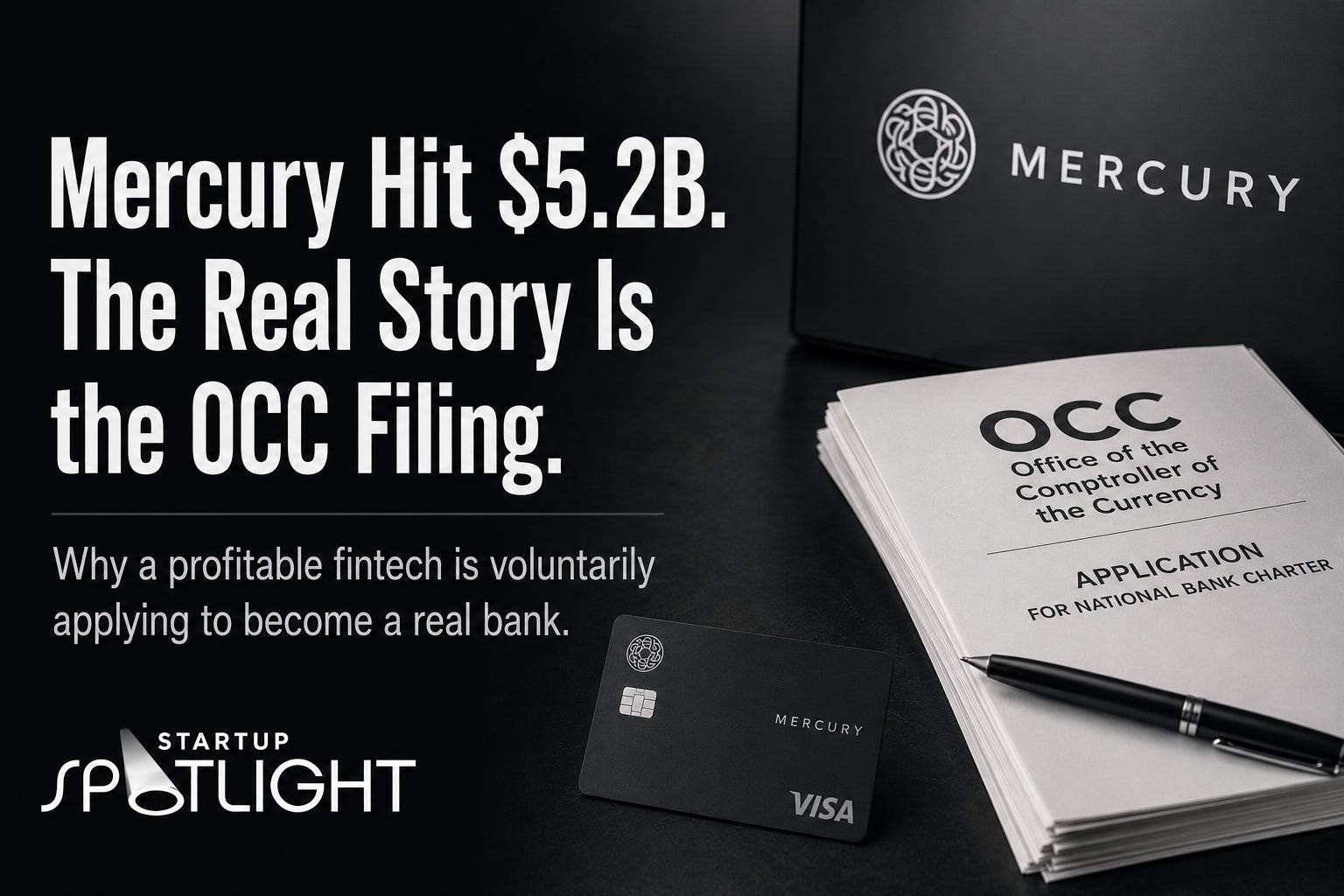
Most fintechs spend a decade trying to capture banking-like economics without becoming a bank. Mercury just did the opposite.
The headline last Wednesday was the money. Mercury closed a $200M Series D at a $5.2 billion valuation, led by TCV, with Andreessen Horowitz, Coatue, Sequoia, Sapphire, Spark, and CRV all participating. That’s up 49% from a $3.5B valuation just 14 months ago. CEO Immad Akhund told CNBC the company is at $650M annualized revenue with four years of profitability. Total funding to date sits at roughly $700M across primary and secondary.
The number that actually matters is buried lower in the announcement. Mercury submitted an application to the Office of the Comptroller of the Currency for a national bank charter, and applied for federal deposit insurance with the FDIC. The company has stated plans to file with the Federal Reserve to restructure as a bank holding company.
For context, this is the hardest path in fintech. Estimated timeline is 12 to 24 months. Capital requirements are steep. Operating constraints are real. Very few fintechs in the modern era have made it through.
So why do it?
