


When your suppliers write the check, it’s validation and a warning at the same time.
Forget the dollar figure for a second. Look at who showed up.
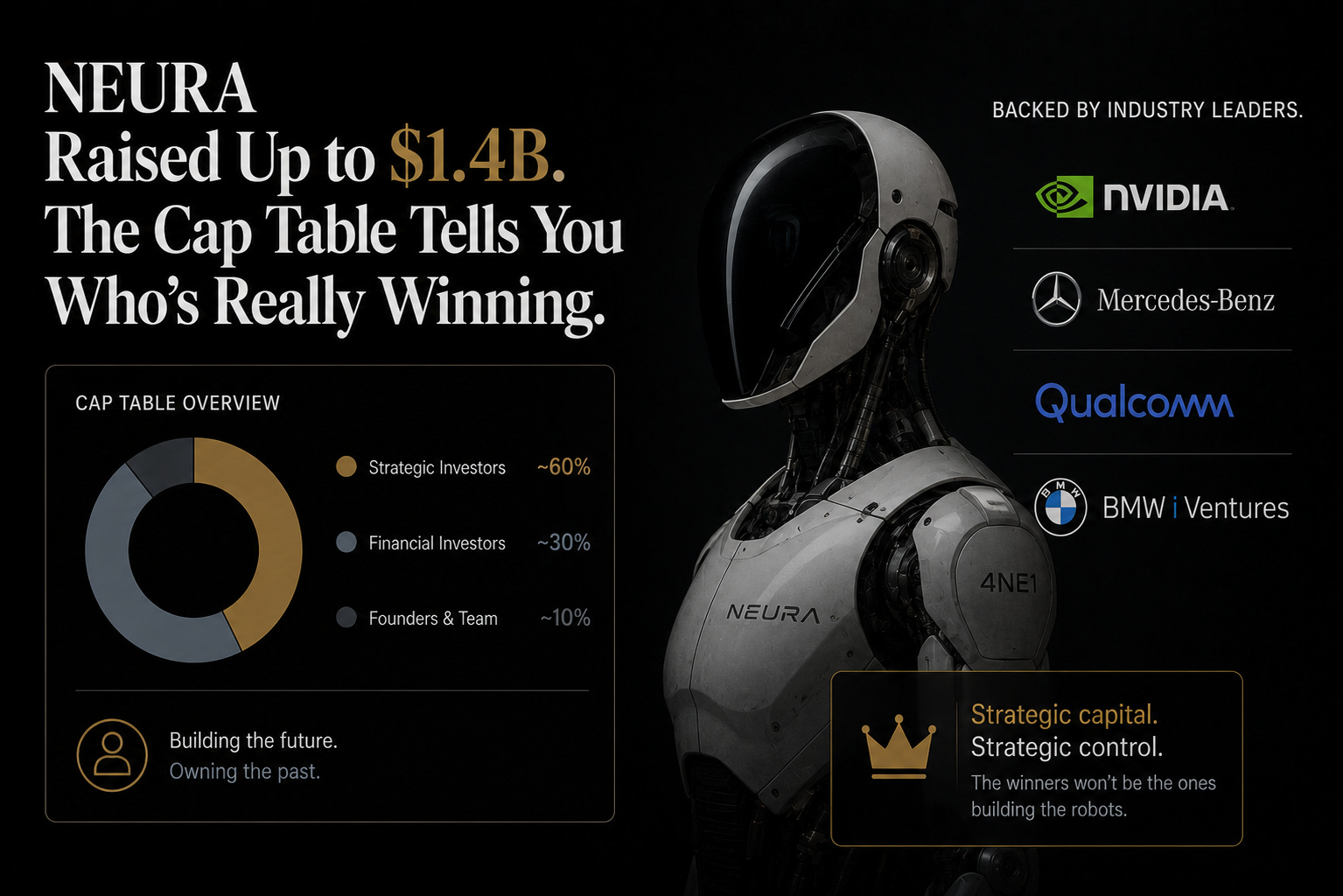
NEURA Robotics, the German maker of humanoid and “cognitive” robots, announced a Series C of up to $1.4 billion, which it calls the largest round ever for a full-stack robotics company. Reported valuation lands around $7 billion. The lead is Tether, the stablecoin issuer. Riding alongside: NVIDIA, Qualcomm, Amazon, Bosch, Schaeffler, and the European Investment Bank.
One honesty note, because numbers matter: the $1.4B is a ceiling, not a wire transfer. Part of it is tied to performance milestones. NEURA’s flagship 4NE-1 humanoid runs about €98,000, large-scale shipments are slated for late 2026, and the company says it’s aiming at millions of robots by 2030. It was founded in 2019 and raised $55 million back in 2023. That’s a steep climb in a short window.
But the money isn’t the real signal. The syndicate is.
The model: Commoditize Your Complement
Here’s the idea. Every product has complements, the things people buy alongside it. When a complement gets cheaper or more available, demand for your product goes up. So if you sell the thing next to the thing, you’ve got every reason to fund, subsidize, or cheapen the thing itself. Make the complement abundant, and you sell more of what you actually make.
Now reread NEURA’s cap table. NVIDIA sells the compute and simulation tools that train robots. Qualcomm sells the chips that run them on-device. Amazon sells the cloud and moves the boxes. Bosch and Schaeffler sell the industrial guts. Humanoid robots are the complement to every one of those businesses. Each NEURA robot that ships pulls through NVIDIA silicon, Qualcomm inference, AWS compute, and German components.
These backers don’t need NEURA to win the humanoid race outright. They need the race to exist and scale, because they sell the picks and shovels no matter who’s running. Funding NEURA grows the category that drives demand for their core products. That isn’t charity. That’s Commoditize Your Complement, run at the cap-table level.
My take
When your suppliers fund you, take it as validation and a warning in the same breath.
The validation: the people best positioned to know whether humanoids are real, the ones selling the parts, are voting with capital. The warning: strategic money carries an agenda. These same backers are funding NEURA’s rivals too. NVIDIA is in nearly every robot company alive. Their interest is a thriving category, not your specific victory, and they’ll happily watch humanoid hardware turn into a low-margin commodity if it moves more chips and cloud.
So here’s the contrarian question NEURA has to answer. It believes it’s building the platform. But to NVIDIA, Amazon, and Qualcomm, NEURA might be the complement they’re commoditizing. The model cuts both ways, and only one side of the table gets to decide which.
The moat that lasts won’t be the logos on the press release. It’ll be whether NEURA owns something its suppliers can’t just re-buy from the next startup. I watch the same dynamic at /mkt, building in a heavily regulated market: partners help, but the edge you keep is the hard operational core you own yourself.
If this was useful, share it with someone who builds things. And if you want the full toolkit of 50 mental models, my book is coming soon.
This newsletter is for informational and educational purposes only. It isn’t investment advice, nor an offer or solicitation to buy or sell any security. References to companies, including /mkt, are illustrative and not recommendations. Figures cited are drawn from public disclosures and reporting, and the round’s full size is reported to be contingent on performance milestones. Do your own research and consult a licensed professional before making any financial decision.