



Company Overview
Here’s the problem in one number. McKinsey estimates the US could be short about 100,000 financial advisors by 2034, with roughly 110,000 expected to retire in that window. Those retirees hold about 42% of industry assets, per the same analysis.
You can’t recruit your way out of that. You have to make each advisor dramatically more productive.
That’s the pitch behind Nevis, a London- and New York-based company building what it calls an “AI operating system for wealth management.” In plain English: one platform that combines the advisor’s CRM, meeting notes, financial planning and custodial paperwork, with AI agents that finish the operational work instead of just suggesting it. Nevis sells software to advisory firms. It doesn’t manage money or give advice itself.
The round: On October 26, Nevis announced a $70M Series B led by EQT Ventures, bringing total funding to $110M in about two years. Charles Schwab and QuantumLight, the fund of Revolut founder Nik Storonsky, came in as new strategic investors. Sequoia, ICONIQ and Ribbit Capital all increased their commitments. EQT’s Carolina Brochado joins the board.
Valuation: Not disclosed. Fortune, citing a source, reported about $500M. Bloomberg reported a $200M valuation on the $35M Series A last December. Both are outlet-reported, point-in-time figures the company hasn’t confirmed.
The founders: All three are Revolut alumni. CEO Mark Swan led global strategy and operations at Revolut. COO Ivan Chalov ran its consumer retail business. CPO Philipp Burda led AI. That’s a team that has already scaled a regulated financial product across dozens of markets. Not a bad résumé for selling into one of the most regulated industries in America.
Traction (all company-reported): Nevis says it launched in late 2024. In 2026, it says, revenue grew more than 25x, and client assets at firms on its platform went from $50B to $700B, with about $75B added per month. Its agents have completed more than 100,000 operational tasks. Named customers include Focus Financial Partners, IEQ Capital and United Capital. Headcount is about 70.
One important clarification: that $700B is client assets at the firms using Nevis. Nevis doesn’t hold or manage it. It’s a useful proxy for reach, not a revenue figure.
The Market
The incumbent here isn’t one company. It’s the stack.
According to Swan, advisors can spend up to 80% of their time on admin, spread across 8 to 10 separate software tools. Treat that as a founder’s estimate, not a study. But anyone who has watched an advisor re-enter the same client data into a CRM, a planning tool and a custodian’s account-opening form knows the direction is right.
The size of the prize:
$176.8 trillion in assets managed by US investment advisers in 2025, up 22.3% in a year, per the IAA and Comply’s 2026 Industry Snapshot.
16,544 advisers serving 73.7 million clients, also per the Snapshot.
$260 billion in US fee-based advisory revenue in 2024, up from $150 billion in 2015, per McKinsey.
67 to 71 million advised relationships projected by 2034, up from 53 million in 2024, per McKinsey.
Demand rises 28% to 34%. Supply shrinks. That gap is the whole opportunity.
Why the unit economics work: McKinsey says technology and generative AI could raise advisor capacity by 7% to 15%. Nevis claims its customers reclaim up to 10 hours a week and run 30% more prospect meetings. If even part of that holds, the math for a firm is simple: an advisor who can serve more households is worth far more than the software seat that enables it. That’s an easy ROI story to sell to a firm’s COO.
Why now:
The talent cliff is real and dated. Firms have to plan for 2034 today.
AI agents can finally finish tasks. Meeting summaries were the first wave. Account opening, planning and CRM updates, done end to end, is the second.
Consolidation is pushing standardization. Large RIA aggregators like Focus Financial want one platform across dozens of acquired firms, not 40 separate tech stacks.
The custodians are leaning in. Schwab serves more than 17,000 independent RIAs. When it invests in your platform, distribution conversations get easier.
Business Model and Moat
How it makes money: Software sold to advisory firms. Nevis hasn’t disclosed pricing, but the category typically charges per advisor seat or per firm. Revenue scales with seats, not with client assets, which keeps Nevis on the vendor side of the line rather than acting as an investment adviser.
The competition is crowded and well funded:
Jump: Raised an $80M Series B led by Insight Partners in February, $105M total. It says more than 27,000 advisors use it, nearly one in ten in the US, across firms including Focus Financial, LPL and Osaic. It started with meeting notes and is now pitching itself as an “AI operating system” too.
Savvy Wealth: Raised a $100M Series C at a reported $600M valuation, per Tech Funding News, though it’s an advisory firm with its own tech, not a pure vendor.
Arca: Emerged from stealth with $64M.
The legacy stack: Established CRMs, planning tools and custodian portals, each owning one slice of the workflow.
Notice something? Focus Financial appears as a customer of both Nevis and Jump. Large firms are clearly testing multiple vendors. The winner hasn’t been picked.
What’s defensible:
Custodial workflow integrations. Notes are easy to copy. Plugging into custodians to actually open accounts and move paperwork is slow, regulated and relationship-driven. Schwab on the cap table helps.
Being the system of record. If Nevis replaces the CRM, it holds the client data every other tool needs. That’s real switching cost.
Enterprise rollouts. Selling to aggregators means one contract can cover hundreds of advisors and become the default across acquired firms.
What’s not defensible: transcription and summaries. Every competitor does them, and foundation model vendors make them cheaper every quarter.
Spence’s Take
Mental Model #1: Bundling and Unbundling
Jim Barksdale’s line: there are only two ways to make money in business, bundling and unbundling. Wealth tech spent 15 years unbundling. A tool for CRM, one for planning, one for risk, one for notes, one for onboarding. Each was best in class. Together they turned advisors into data entry clerks.
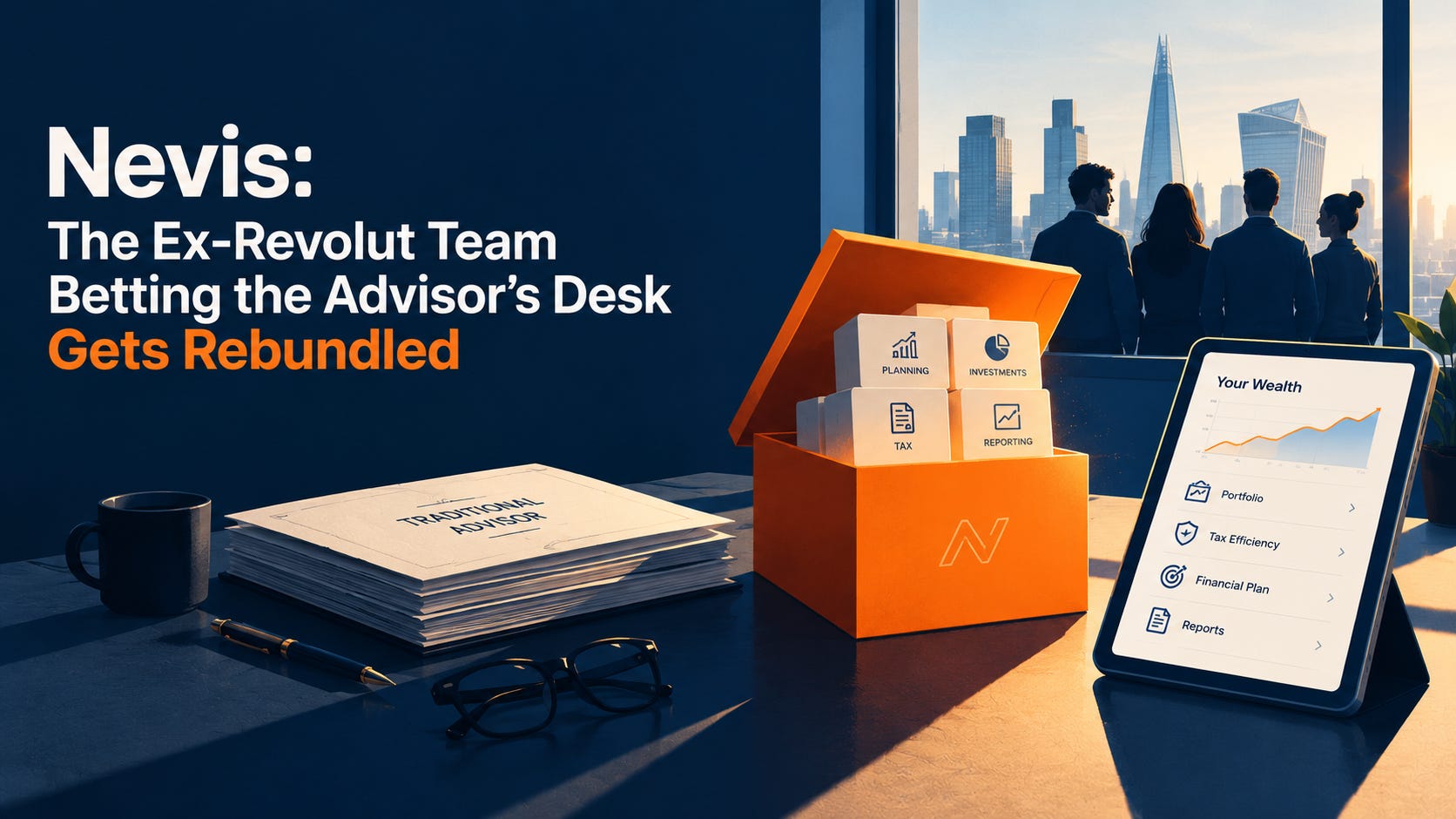
AI agents make rebundling possible because the agent is the glue. It reads the meeting, updates the CRM, drafts the plan and starts the account paperwork without a human copying fields between screens.
The bull case: Nevis becomes the bundle, and the bundle becomes the system of record across large RIAs. Point tools get pushed to the edges or absorbed.
There’s a lesson here from building /mkt, where we structure athlete offerings under Reg A+ with tZERO as trading infrastructure: in regulated finance, the workflow is the product, and every step has a compliance owner. Bundling only wins if the bundle is easier to supervise than the pieces it replaces.
Mental Model #2: Regression to the Mean
Extreme results tend to drift back toward normal. Revenue up 25x in a year is an extreme result, and it almost always comes off a small base. The next 25x doesn’t happen. The question is what normal looks like once the early adopters are signed.
What could kill it:
The bundle war. Jump is chasing the same “operating system” position with a much larger advisor base. Two companies can’t both be the system of record at the same firm.
Incumbent response. Big CRM and planning vendors can bolt agents onto products advisors already know. Good enough plus already installed is a hard combination to beat.
Regulation. The SEC has already brought “AI washing” cases against advisers that overstated their AI use. Advisors also face recordkeeping and data privacy obligations, including amended Regulation S-P. Any AI that touches client communications has to fit those rules, and a single compliance failure at a customer could slow adoption across the industry.
Agent errors. An AI that writes a meeting summary can be wrong cheaply. An AI that opens accounts or drafts proposals can be wrong expensively.
Concentration. A few large aggregators drive the headline asset number. Losing one would show.
5. Why It Matters
(a) For investors and VCs
This is a company worth watching, not a call on anything. Sequoia, Ribbit and ICONIQ re-upping, plus Schwab joining, is a strong signal of insider conviction. Signals I’d track:
Seats vs. assets. Platform assets are a reach metric. Paid advisor seats and revenue per seat tell you more.
Agent task depth. The share of tasks completed fully end to end versus drafted for human review.
Custodian integrations. Each new custodian connection widens the addressable base.
Head-to-head wins. Which vendor large multi-vendor firms standardize on.
Net revenue retention once growth normalizes.
(b) For potential customers
If you run operations at an RIA or a wealth management firm, here’s what’s on offer: one platform that replaces separate CRM, meeting notes, planning and onboarding tools, with agents that complete tasks rather than just drafting them. Nevis says it’s expanding agent capabilities and adding integrations across custodians and other wealth software.
Before you buy, ask the hard questions. Where does client data live? How are AI outputs logged for books-and-records purposes? Who reviews agent actions before they reach a client? Your compliance team should sign off before your advisors do.
(c) For competitors and builders
Four lessons worth stealing:
Sell capacity, not features. “Your advisors can serve 30% more households” beats “we have AI notes.”
Pick the scarce resource. Nevis isn’t selling to the fastest-growing input. It’s selling against the shrinking one: advisor time.
Get the infrastructure owner on your side. A custodian investor is distribution, credibility and integration access in one.
Hire people who’ve shipped in regulated markets. The Revolut background isn’t trivia. It’s how you get through a large firm’s compliance review.
If you’re a point-solution vendor, you have two choices: become the best integration partner for the bundle, or become the bundle. Standing still is the riskiest option.
The Bottom Line
Nevis is betting that AI agents turn wealth tech’s sprawl back into one system, at exactly the moment the industry runs short of advisors. The team, investors and early traction are strong, but Jump is chasing the same position. Watch which one large firms standardize on.
This is Startup Spotlight. Every week I break down a company worth watching. Subscribe for $7.99/mo to get the full analysis.
Startup Spotlight is a reader-supported publication. To receive new posts and support my work, consider becoming a free or paid subscriber.
If you want the mental models behind breakdowns like this, my book, Mental Models: How to Think, Act, and Win, is on Amazon now.


Author affiliation: Spencer Gareiss is Chief Product Officer at /mkt, which structures athlete offerings under Regulation A+ using tZERO trading infrastructure. /mkt is referenced as an industry example only. This post is not sponsored or paid for by any company mentioned.

Thanks for reading Startup Spotlight! This post is public so feel free to share it.