

A three-year-old nuclear company just raised a billion dollars. If that sentence sounds impossible, you understand the nuclear industry perfectly
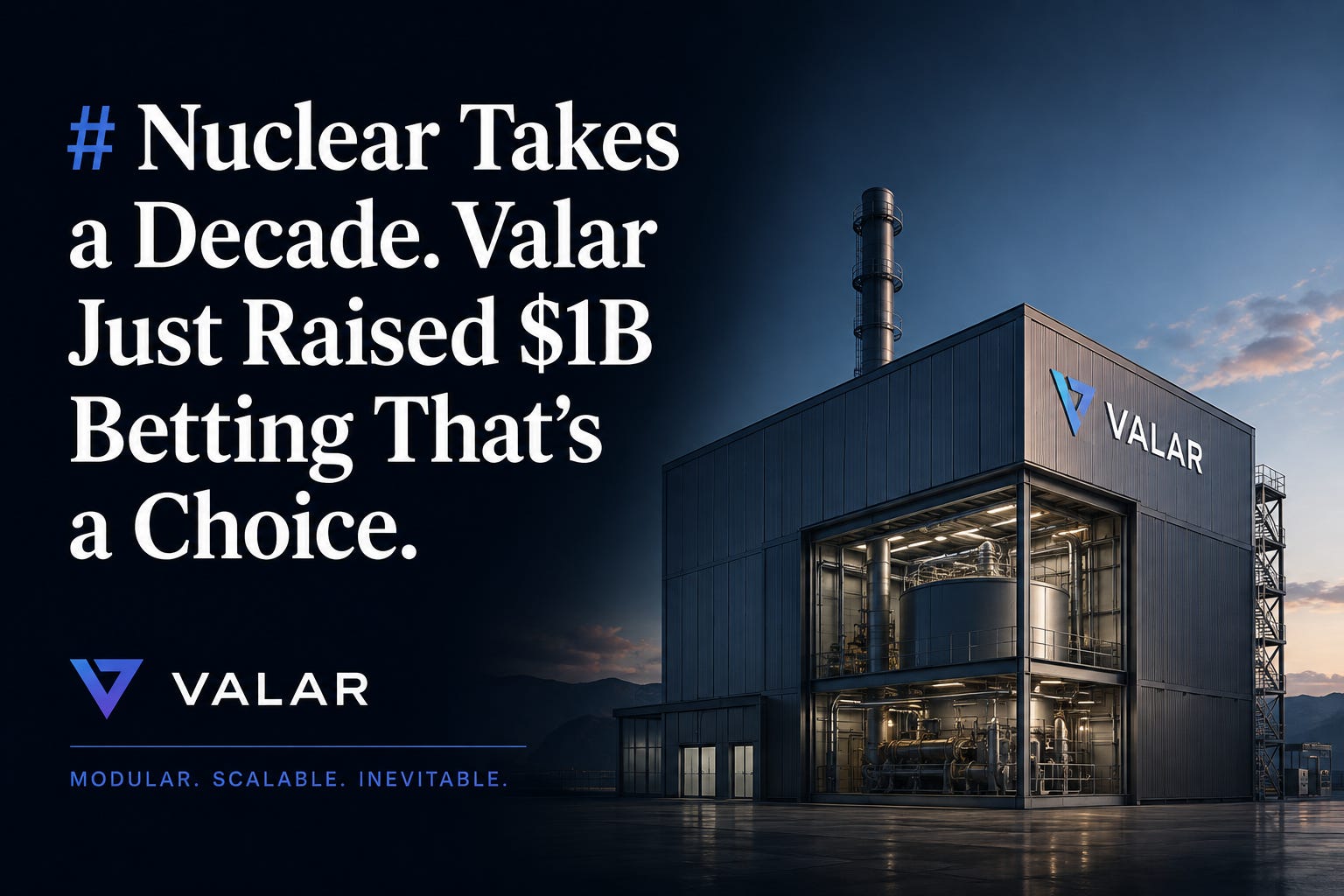
On Monday, Valar Atomics announced a $1 billion Series B led by Sequoia, plus a $200 million credit facility, for $1.2 billion in new financing. Bloomberg reported the round valued the company around $6 billion, a figure Valar didn’t confirm. This is a company that raised just $130 million last October. Its pitch is simple to say and brutally hard to do: build small nuclear reactors like manufactured products instead of one-off construction projects. It says its Ward 250 reactor went critical in June, and that it has powered an Nvidia AI chip directly off a fission reaction. AI data centers are its biggest target customer.
The easy read is “AI needs power, nuclear is back, money floods in.” True, but shallow. Demand for power has been around for decades. It never turned nuclear into a venture-scale bet before. Something else changed.
Here’s the model from my book: first principles. Most people reason by analogy. Nuclear is slow and absurdly expensive, so it’ll always be slow and absurdly expensive, so smart money stays away. First-principles thinking throws out the analogy and asks what’s actually true at the bottom. And at the bottom, the physics of a small reactor isn’t the problem. The problem is how we build them: as bespoke, multibillion-dollar megaprojects, each one a cathedral poured in concrete over a decade. Valar looked at that and asked a different question. What if a reactor were a product you manufacture on a line, not a monument you construct on a site? Same physics. Completely different cost curve.
That reframe is the whole thing. Valar’s own founding observation was that nuclear is one of the most abundant energy sources on earth, saddled with one of the worst cost curves in industry, and that almost nobody was actually trying to fix the curve itself. Attack it with manufacturing, vertical integration, and repetition, and a source everyone wrote off as too expensive starts marching toward the cost of simply making the thing.
Spence’s take: Sequoia didn’t write a billion-dollar check because AI is thirsty. Everyone knows AI is thirsty. It wrote the check because Valar is betting the industry’s defining number, the cost and time to stand up a reactor, was never a law of physics. It was an inherited habit. That’s the first-principles move: find the thing everyone treats as fixed and prove it’s a choice. Now comes the part the model can’t do for you. Nuclear is one of the most regulated, least forgiving arenas on earth, and manufacturing economics only matter if the reactors actually get built, approved, and run safely at scale. The insight is real. The execution is where bets this size go to be tested.
If this was useful, share it with someone who builds things. And if you want the full toolkit of 50 mental models, you can grab my book, Mental Models: How to Think, Act, and Win, on Amazon right now.
Disclaimer: This newsletter is for informational and educational purposes only. It is not investment, financial, legal, or tax advice, and nothing here is a recommendation or solicitation to buy, sell, or hold any security or to participate in any investment strategy. Funding amounts reflect information reported by the company as of the publication date. The approximately $6 billion valuation was reported by Bloomberg and was not confirmed by the company; it is a point-in-time figure that may change and could not be independently verified here. Forward-looking statements, including plans to mass-produce reactors, drive down the cost curve, and serve AI data centers, and the company’s own descriptions of its technical milestones, are attributed to the company and are not statements of fact. Advanced nuclear energy is heavily regulated and carries substantial execution, regulatory, and safety risk. Private company figures are difficult to verify independently. Do your own research and consult a licensed professional before making any financial decision. The author may hold positions in companies or sectors mentioned and receives no compensation from any company covered here.
If you want the mental models behind breakdowns like this, my book, Mental Models: How to Think, Act, and Win, is on Amazon now.


This post is for informational and educational purposes only. It is not investment advice, a recommendation, or a solicitation to buy or sell any security. Funding figures, revenue, and valuation are as reported by the company, regulatory filings, and named outlets; the ~$470M valuation is a reported, time-sensitive snapshot and not independently verified. Dhoni's individual investment amount was not disclosed. The /mkt reference is a structural illustration of building in regulated markets and is not an offer or solicitation. Past performance and third-party investment decisions do not indicate future results.