

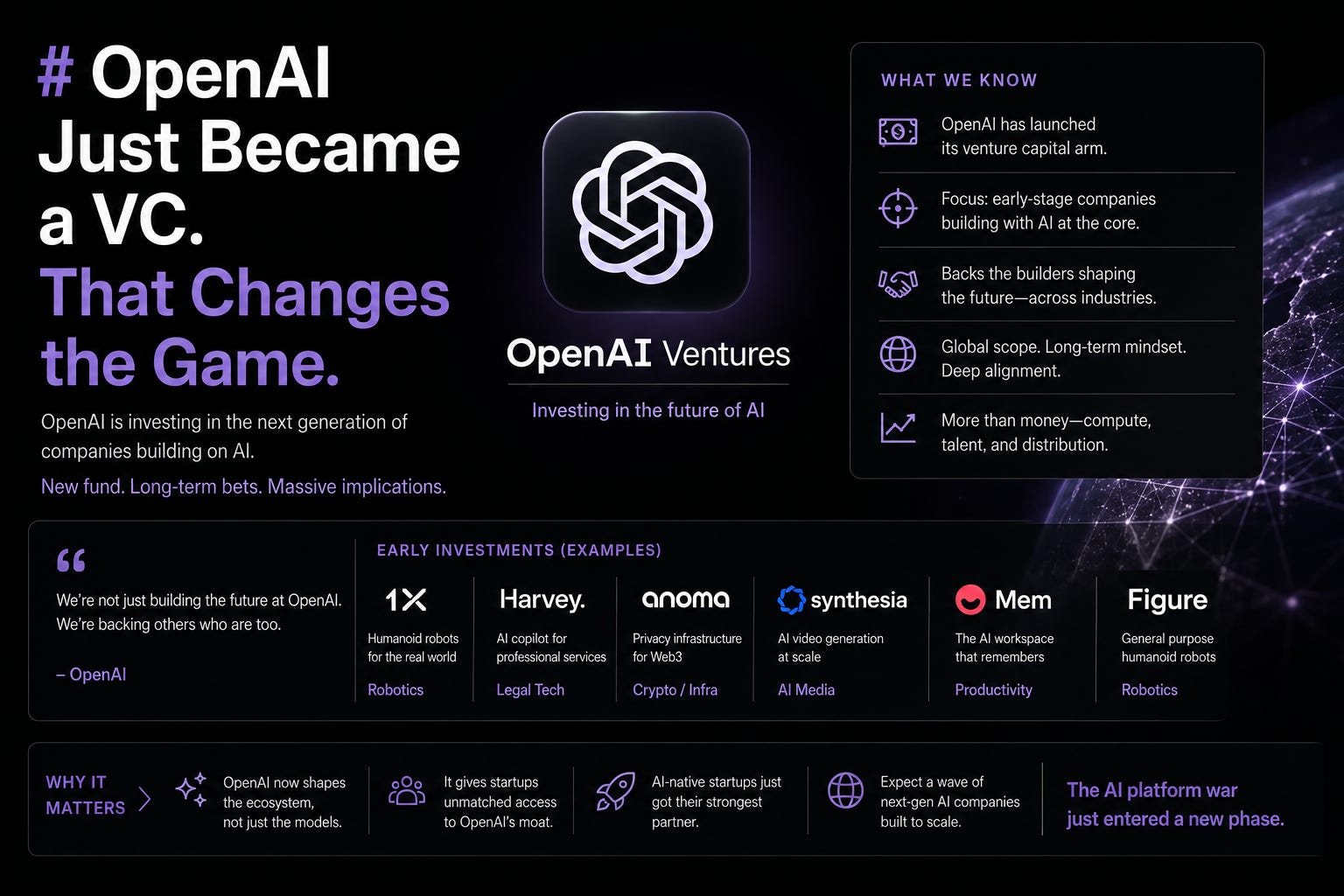
OpenAI is putting $400 million of its own money into a new venture fund.
No outside LPs.
That’s a big change from its first fund, which raised $175 million from outside investors including Microsoft. The new fund plans to make roughly 8 to 10 lead investments a year, with checks ranging from the low millions to as much as $50 million to $100 million for select companies.
And OpenAI isn’t starting from zero.
Its first fund backed 24 startups, including Harvey and Cursor. That fund is now fully deployed.
At the same time, the rest of the market is showing just how aggressive AI venture has become.
Instinct is reportedly raising $250 million at a $2.5 billion valuation after launching its private beta in February. Socure raised $156 million at a $5.2 billion valuation while acquiring agentic AI startup Fravity. DeepSeek is reportedly seeking $7.4 billion at a $74 billion valuation.
So what’s actually happening?
The AI companies aren’t just raising money.
They’re increasingly becoming part of the capital allocation system around AI itself.
That’s where one mental model from Mental Models: How to Think, Act, and Win becomes useful:
The mental model: Incentives
Don’t just ask what someone says they want.
Ask what they’re structurally incentivized to do.
A traditional VC firm needs financial returns for its LPs.
OpenAI has another incentive layered on top: build an ecosystem around the technology it develops.
If a startup becomes an important customer, distribution channel, developer platform or infrastructure partner, the strategic value may extend beyond the ownership stake.
That doesn’t make the investment good or bad.
It makes the incentive structure different.
Founders should understand that difference before taking capital from anyone.
We’ve seen the same principle at /mkt. When you’re building in a regulated market, the incentives of the issuer, investors, trading infrastructure, regulators and customers all matter. You can’t design the product around one participant and assume everyone else will follow.
My contrarian take: the next generation of venture capital may look less like investors financing startups and more like companies financing ecosystems.
That’s powerful.
It’s also something founders should examine carefully.
When your investor can benefit from your success in multiple ways, understand every one of those incentives.
Capital isn’t just capital.
Who provides it matters. Why they provide it matters even more.
This is for informational and educational purposes only. It isn’t investment, financial, legal, tax, or regulatory advice, and it isn’t an offer or solicitation to buy or sell any security or financial instrument. Reported funding amounts, valuations and deal terms may change or remain unconfirmed.
If you want the mental models behind breakdowns like this, my book, Mental Models: How to Think, Act, and Win, is on Amazon now.


This post is for informational and educational purposes only. It is not investment advice, a recommendation, or a solicitation to buy or sell any security. Funding figures, revenue, and valuation are as reported by the company, regulatory filings, and named outlets; the ~$470M valuation is a reported, time-sensitive snapshot and not independently verified. Dhoni's individual investment amount was not disclosed. The /mkt reference is a structural illustration of building in regulated markets and is not an offer or solicitation. Past performance and third-party investment decisions do not indicate future results.