

A year ago, barely anyone was talking about it. Today, it’s the difference between an AI company that ships and one that’s stuck in queue purgatory.
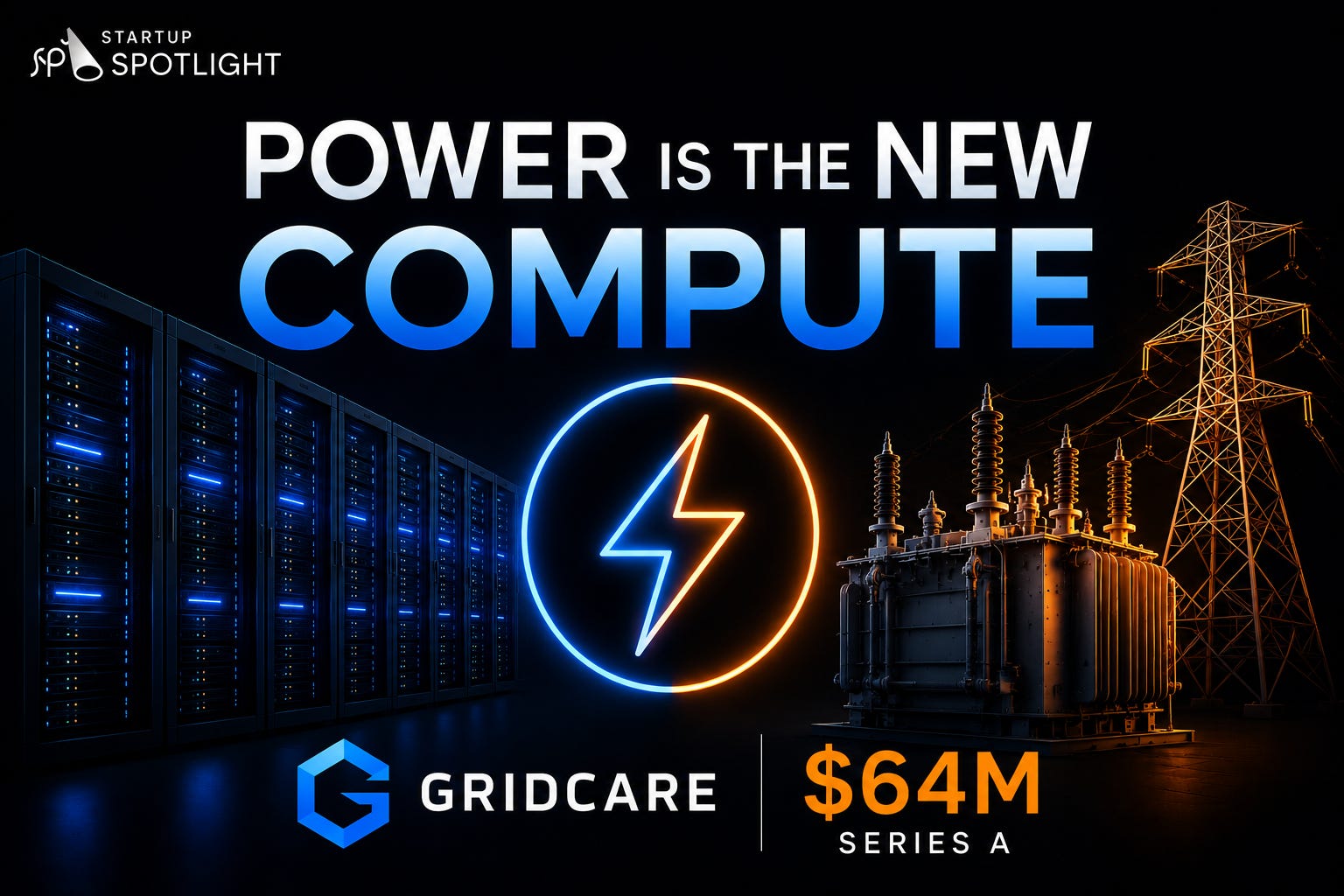
GridCARE just closed a $64 million Series A led by Sutter Hill Ventures and backed by John Doerr—and if you’re not paying attention to what this deal signals about where venture capital is moving in 2026, you’re missing something critical.
The Setup
Here’s the thing about infrastructure bottlenecks: they’re invisible until they’re not. Everyone’s been talking about compute and GPUs for three years. Fine. But the reality is that power, not compute, has become the rate-limiting step for the entire AI industry. That’s not metaphorical. A data center that can’t get electricity online doesn’t care how many H100s you’ve got in a shipping container.
GridCARE’s physics-based AI platform evaluates quadrillions of grid conditions in real time, modeling congestion, outages, weather, and demand variability to identify capacity that traditional interconnection processes can’t see. Translation: they’re finding power that’s already on the grid but buried in bureaucratic infrastructure. With a Portland General Electric project, they validated the model and unlocked a path to 400 megawatts of capacity in Hillsboro, Oregon, with 80 MW arriving in 2026.
That’s 80 MW in one region in one year. And GridCARE is now engaged in power acceleration projects spanning more than a dozen markets and over 2 GW of new AI compute capacity.
The Pattern
What’s really happening here is a shift in how venture capital thinks about infrastructure. Capital is concentrating into fewer companies, not spreading across a broad startup base—and the venture market is open but selective. That selectivity isn’t just about picks and shovels anymore. It’s about systemic unlocking.
When Doerr backs a company, it’s rarely because the narrative is flashy. It’s because the founder has identified the genuine constraint that nobody else is solving at scale. GridCARE does that. They took a regulatory and grid physics problem, layered AI on top, and created 5-10x faster time-to-power for data centers. That’s a real leverage point in an infrastructure ecosystem that’s moving at light speed.
The Mental Model: Leverage Points in Complex Systems
If you’ve read my book, you know one of the core models I lean on is Donella Meadows’ “Leverage Points in Complex Systems.” Her insight is dead simple: most people try to change systems by pushing harder at the obvious places. But the places where you get real change are often invisible—they’re the small moves in the right places that cascade through everything else.
GridCARE is a leverage point. They’re not building new power plants. They’re not writing regulations. They’re identifying and unlocking latent capacity that exists but isn’t being accessed because of information gaps and process friction. In a system as complex and regulated as the electric grid, that’s leverage. One company makes it easier for 2 GW of new capacity to come online 4–6 years faster than the baseline. That’s not incremental. That’s structural.
What’s wild is that this strategy—finding the invisible constraint and solving it—works everywhere. At /mkt, we’re thinking about this constantly. We’re building in a heavily regulated market (Reg A+, SEC oversight, trading infrastructure). The opportunity isn’t in swimming against regulation. It’s in identifying what the real bottleneck is (in our case, it was founder and athlete liquidity without the complexity of traditional venture rounds) and then building a system that works within the rules but unlocks something that wasn’t accessible before.
The Contrarian Bit
Here’s what I’m noticing: the most interesting venture deals in 2026 aren’t the AI companies that are raising at insane valuations. Those rounds are obvious. The deals worth watching are the ones solving infrastructure that’s boring on the surface but strategically invaluable underneath. Power. Energy logistics. Grid coordination. Regulatory automation. The stuff that makes the flashy companies possible.
Sutter Hill got rich backing NVIDIA, Snowflake, and Astera Labs. They didn’t get there by following the hype. They got there by understanding that unsexy infrastructure wins scale and create real optionality for everything built on top of them.
If you’re raising, if you’re fundraising, or if you’re thinking about what matters in this market, ask yourself: What’s the constraint nobody’s talking about? What’s the leverage point?
If this was useful, share it with someone who builds things. And if you want the full toolkit of 50 mental models, my book is coming soon.