


The pitch is that you shouldn’t have to rent your intelligence from five companies. The funniest part is who’s backing it: the chipmakers who sell those five companies their picks.
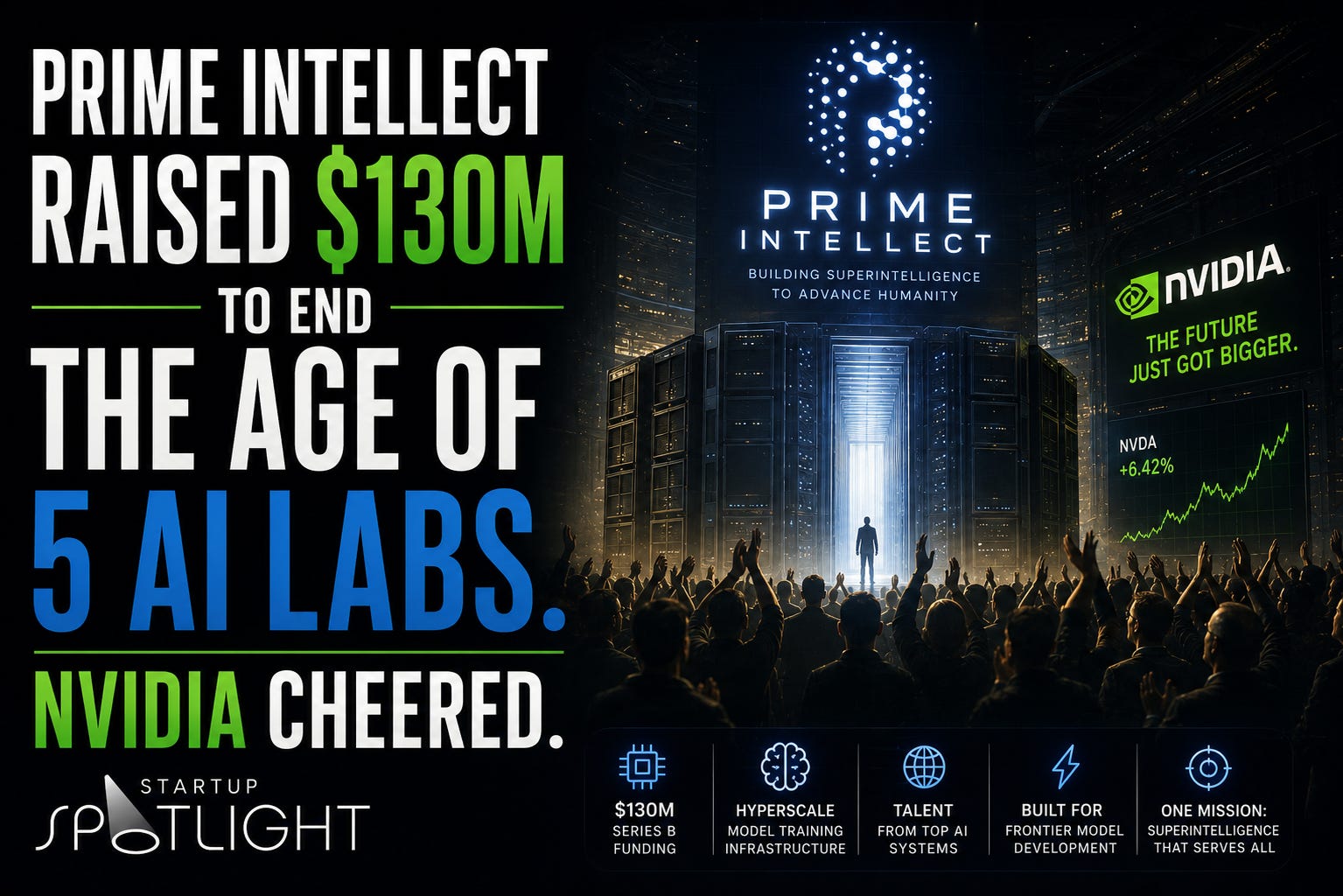
Prime Intellect, founded in 2024 and led by Johannes Hagemann, raised a $130 million Series A at a $1 billion valuation, led by Radical Ventures, with NVIDIA Ventures, Intel Capital, and Dell Technologies Capital all in, alongside a roster of angels that includes the founders of Perplexity, Box, Harvey, and Cognition. Total funding now tops $150 million. The company runs what it calls an “open superintelligence stack”: open-source, distributed infrastructure that lets a company train and own its own AI models instead of leaning entirely on a frontier lab. About 6,000 customers, including Ramp and Zapier, and roughly $100 million in annualized revenue, per the company.
The proof point is the best part. Ramp used Prime Intellect to train a small reinforcement-learning agent to find answers inside spreadsheets. Ramp says it beat the frontier models on accuracy, ran faster, and cost a fraction as much. That’s the whole thesis in one story: for your specific task, a small model you own can beat a giant one you rent.
The mental model here is Jevons Paradox. In 1865, the economist William Stanley Jevons noticed something odd. As steam engines got more efficient and coal got cheaper to use, total coal consumption went up, not down. Cheaper access expanded demand faster than efficiency shrank it. The same thing is about to happen to model training. Prime Intellect makes training your own model dramatically cheaper and more accessible. The instinct is that this threatens the compute giants. The opposite is true. When training gets cheap enough for 6,000 companies instead of five labs, total compute demand explodes. That’s exactly why NVIDIA and Dell wrote checks. They don’t care whether OpenAI or Ramp trains the model. They sell shovels to both.
Here’s my take. Everyone’s framing this as decentralization versus the frontier labs, David against Goliath. That’s the wrong lens. Prime Intellect isn’t shrinking the pie. It’s multiplying the number of people baking. I watched a version of this at Robinhood: when you take something gatekept and make it suddenly accessible, you don’t just redistribute the demand that exists, you manufacture a wave of new demand that didn’t exist before. So the contrarian read isn’t “the labs are in trouble.” It’s that the biggest winners of democratized AI training might be the exact infrastructure players people assume it threatens. Cheap doesn’t mean less. Cheap means more.
——————————————————————————————————————
If this was useful, share it with someone who builds things. And if you want the full toolkit of 50 mental models, you can grab my book, Mental Models: How to Think, Act, and Win, right now.


——————————————————————————————————————
Next week’s deep-dive:
Next Wednesday’s paid deep-dive goes the other direction: the biggest AI infrastructure bet of the moment might be the one that never touches the cloud. I’m breaking down the on-prem AI shift, who’s quietly winning it, and why “private by default” is about to matter far more than it sounds. Paid subscribers get the full teardown.

——————————————————————————————————————