

Section 1: Company Overview
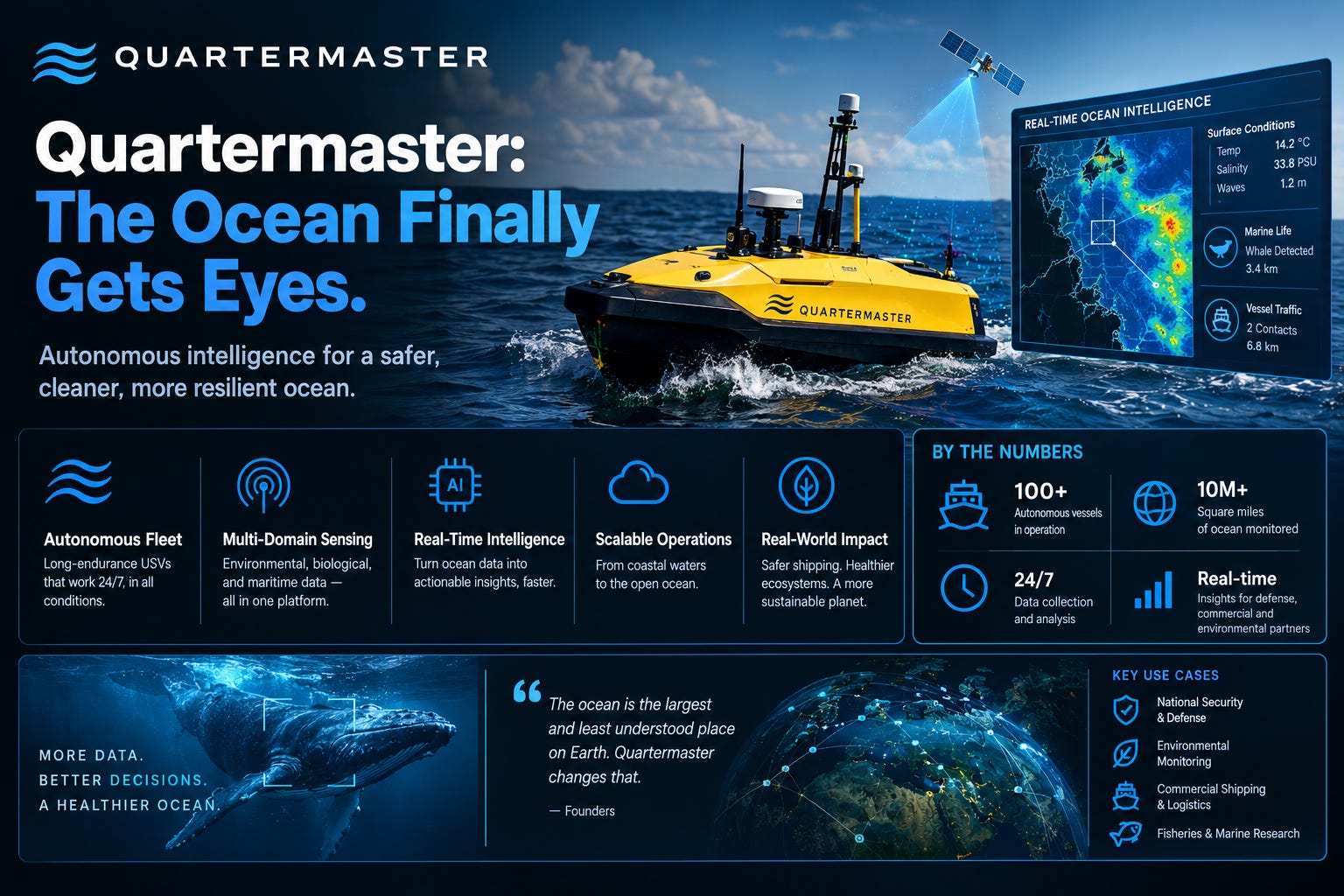
What they do, in plain English: Quartermaster makes SmartMast, a weather-hardened box of cameras and radios that bolts onto a ship’s mast. It runs AI on the vessel, watches the water around it, and sends back what it sees. Every equipped ship becomes a node in a shared ocean sensor network.
Stage and round: On September 28, TechCrunch reported a $140 million raise, preempted by Insight Partners. The split matters: roughly $100 million is Series B equity from Insight, new investor Overmatch Ventures (a defense-focused firm), and returning backers, plus a $40 million debt facility from Stifel. Tech Funding News lists First Round Capital, Quiet Capital, Steel Atlas, TMV, BoxGroup, and Operator Partners as returning investors.
Total raised: The Series B landed just four months after a $43 million Series A co-led by First Round and Quiet Capital in May. That puts disclosed funding at roughly $183 million including debt. The company hasn’t disclosed a valuation, so I won’t guess at one.
Founding team: CEO Neil Sobin helped build Hivemapper, the network that mapped streets using cameras on everyday vehicles. Quartermaster is the same playbook pointed at the sea. Chief growth officer Steve Ribaudo was previously VP of growth at Anduril, per the company’s site, and its about page describes team members who ran Navy growth at Scale AI. Preqin dates the founding to 2023.
Traction (company-reported): More than 650 vessels in 25 countries now carry a SmartMast, and 800-plus units have shipped. Sobin says the gap exists because full-fleet rollouts are about to start. Coverage has reached nearly 46 million square kilometers, up 77% since May, per Smart Maritime Network. SmartMast-equipped ships have also assisted in more than 20 rescues at sea.
Section 2: The Market
The gap incumbents left open. Today’s maritime intelligence stack mostly stitches together AIS pings, satellite passes, and port records. The problem is the foundation. As Sobin put it to TechCrunch in May, AIS is opt-in and self-reported, so anyone doing something shady, from petty smuggling to sanctions evasion, can go dark or spoof a position.
Satellites help, but they’re expensive and they don’t stare at one patch of water all day. A camera on a ship that’s already there does.
The numbers:
The fleet: UNCTAD counts about 116,000 merchant vessels of 100 gross tons or more as of January 2026, including roughly 62,000 over 1,000 GT. At 650 installs, Quartermaster sits well under 1% of that fleet. That’s either a warning or a runway, depending on execution.
The insurance pool: The International Union of Marine Insurance reported last week that global marine premiums hit $42.6 billion in 2025, up 5.5%. Cargo was $24.2 billion and ocean hull $10.5 billion.
Surveillance spend: Precedence Research pegs maritime surveillance at $28.36 billion in 2026, growing to $50.93 billion by 2035. Research firms define this category differently, so treat it as directional.
Why now. Two words: the Gulf. TechCrunch reports that Sobin credited the conflict involving Iran and the resulting shipping chaos with sharpening investor conviction. According to the company, GPS jamming and spoofing earlier this year told ships across Gulf waters they were somewhere they weren’t, and several underwriters stopped writing cover for the region. S&P Global reported in July, citing broker Marsh, that war-risk premiums for Hormuz transits reached as much as 10% of hull value. For context, UNCTAD estimates Hormuz handles around 11% of global maritime trade volume.
When a single chokepoint that important goes dark, “we can see the water” stops being a nice-to-have.
Section 3: Business Model and Moat
The model is the clever part. Per Tech Funding News, ship operators pay nothing beyond space on the mast. Quartermaster covers the hardware, installation, support, route hazard alerts, and broadband internet at sea. In exchange, the data feeds a shared network that insurers, fleets, energy operators, and government customers like coast guards and navies can use.
Sobin explained the logic in May: fleet operations are low-margin businesses, so selling a sensor to a shipowner is a brutal pitch. Giving it away is an easy one. Pricing for the data side hasn’t been disclosed.
The competitive field:
Data aggregators. Windward, taken private by FTV Capital in 2025 at about $280 million, fuses AIS, satellite imagery, and ownership records. Kpler bought Spire’s maritime data business for $241 million in 2025. Both are software layers on top of largely shared inputs.
New hardware at sea. Saildrone, Oshen, and Online Oceans build autonomous vessels. They add new sensors to the ocean. Quartermaster rides on ships that are already out there.
Satellites. Insight also led a $145 million round for HawkEye 360, the RF geolocation company. That tells you how Insight views this category: layered sensing, not a single winner.
What’s defensible: Proprietary first-party data. Every mast generates tens of gigabytes a day that no aggregator can buy, and every new ship widens a moat a competitor would need years of installs to cross. The pro-mariner angle (free internet, hazard alerts, rescue support) also raises the cost of ripping a unit out.
Section 4: Spence’s Take
Mental Model #1: The Map Is Not the Territory.
AIS is a map. It’s what ships say about themselves. The territory is what’s actually happening on the water. For decades the maritime world priced risk, enforced sanctions, and routed cargo off the map. When the map and territory drift apart, as they did in the Gulf this year, underwriters can’t price it, so they walk.
Quartermaster’s pitch is simple: stop trusting the map, go look at the territory. That’s a far stronger foundation than another analytics layer on the same self-reported pings.
I spent years at Robinhood building derivatives and prediction markets. Here’s what that taught me: a market is only as good as the data it settles on. If you can’t observe it, you can’t price it. Insurance is no different.
Mental Model #2: Network Effects.
One SmartMast is a camera. Ten thousand is infrastructure. Each added ship improves coverage for every customer, which makes the data more valuable, which funds more free installs. Sobin has already run this flywheel once at Hivemapper. That pattern recognition is a real asset.
The bull case: Insurers start pricing specific straits and routes off Quartermaster’s data. At that point the mast network becomes something rivals can’t copy quickly, and the company becomes a quiet utility for global trade.
What could kill it:
The payer problem. Tech Funding News said it plainly: if insurers don’t adopt the data, Quartermaster owns a big sensor network that still has to prove who’ll pay for it. Free hardware is a cost center until data buyers show up at scale.
Hardware drag. Salt, storms, installs across 25 countries, and doubled manufacturing capacity. Hardware businesses burn cash in ways software businesses don’t, and $40 million of this round is debt.
Geopolitical timing. Crisis-driven demand is real, but it can cool. The question is whether buyers stay when the headlines move on.
Trust and access. Cameras on commercial ships near contested waters raise questions for flag states, port authorities, and crews. One regulatory or privacy backlash could slow installs.
Section 5: Why It Matters
(a) For investors and VCs. This is a company worth watching, not a call to action. The signals I’d track:
Installed base velocity. Does the 650-to-800 gap close fast as fleet rollouts begin?
Named data buyers. Especially insurers and government contracts. Paying customers on the demand side validate the whole model.
Coverage density on key lanes. Total square kilometers is a vanity stat. Density in Hormuz, the Red Sea, and major fishing grounds is what buyers pay for.
Debt usage. How the $40 million Stifel facility gets deployed tells you a lot about capital discipline.
(b) For potential customers. If you’re a fleet operator, the pitch is free hardware, free broadband, and hazard alerts for mast space. Read the data-sharing terms carefully and understand who can see what your vessel captures. If you’re an underwriter, energy operator, or coast guard, this is a new first-party feed that doesn’t depend on a ship choosing to report itself.
(c) For competitors and builders. Three lessons travel well:
Pay your supply side in what they actually need. Mariners want connectivity and safety, not a sensor. Quartermaster pays in bandwidth, not cash.
Own your inputs. Aggregators compete on models. Quartermaster competes on data nobody else has.
Let the crisis prove the thesis, then build past it. Timing opened the door. Durable revenue has to keep it open.
Section 6: The Bottom Line
Quartermaster is betting that the ocean’s biggest problem isn’t analysis, it’s observation, and that the cheapest way to watch the sea is from ships already on it. The network logic is sound and the founder has done this before. Now it has to prove that insurers and governments will pay for what the masts see, at a scale that justifies giving the hardware away.
This is Startup Spotlight. Every week I break down a company worth watching. Subscribe for $7.99/mo to get the full analysis.
Disclaimer: This post is for informational and educational purposes only and does not constitute investment, legal, tax, or financial advice, or an offer or solicitation to buy or sell any security. Quartermaster is a private company; its securities are not publicly traded, and nothing here should be read as a recommendation. Funding amounts, investor names, vessel counts, coverage figures, and other operating metrics are as reported by the company and by TechCrunch (September 28, 2026 and May 20, 2026), Tech Funding News (September 29, 2026), and Smart Maritime Network, and have not been independently verified. The company has not disclosed a valuation for this round. Market figures are drawn from UNCTAD, the International Union of Marine Insurance, S&P Global, and Precedence Research; third-party market estimates vary by methodology. Descriptions of geopolitical events and their effect on shipping and insurance are attributed to the cited sources and the company. Any forward-looking statements reflect the company's stated plans or the author's opinion and are subject to risks and uncertainties. Past performance and private funding rounds are not indicators of future results. The author has no position in or business relationship with Quartermaster. Always do your own research and consult a qualified professional before making any financial decision.
If you want the mental models behind breakdowns like this, my book, Mental Models: How to Think, Act, and Win, is on Amazon now.


This post is for informational and educational purposes only. It is not investment advice, a recommendation, or a solicitation to buy or sell any security. Funding figures, revenue, and valuation are as reported by the company, regulatory filings, and named outlets; the ~$470M valuation is a reported, time-sensitive snapshot and not independently verified. Dhoni's individual investment amount was not disclosed. The /mkt reference is a structural illustration of building in regulated markets and is not an offer or solicitation. Past performance and third-party investment decisions do not indicate future results.