


Venture capital runs on stories.
Not pitch decks. Not spreadsheets. Stories about what the future looks like.
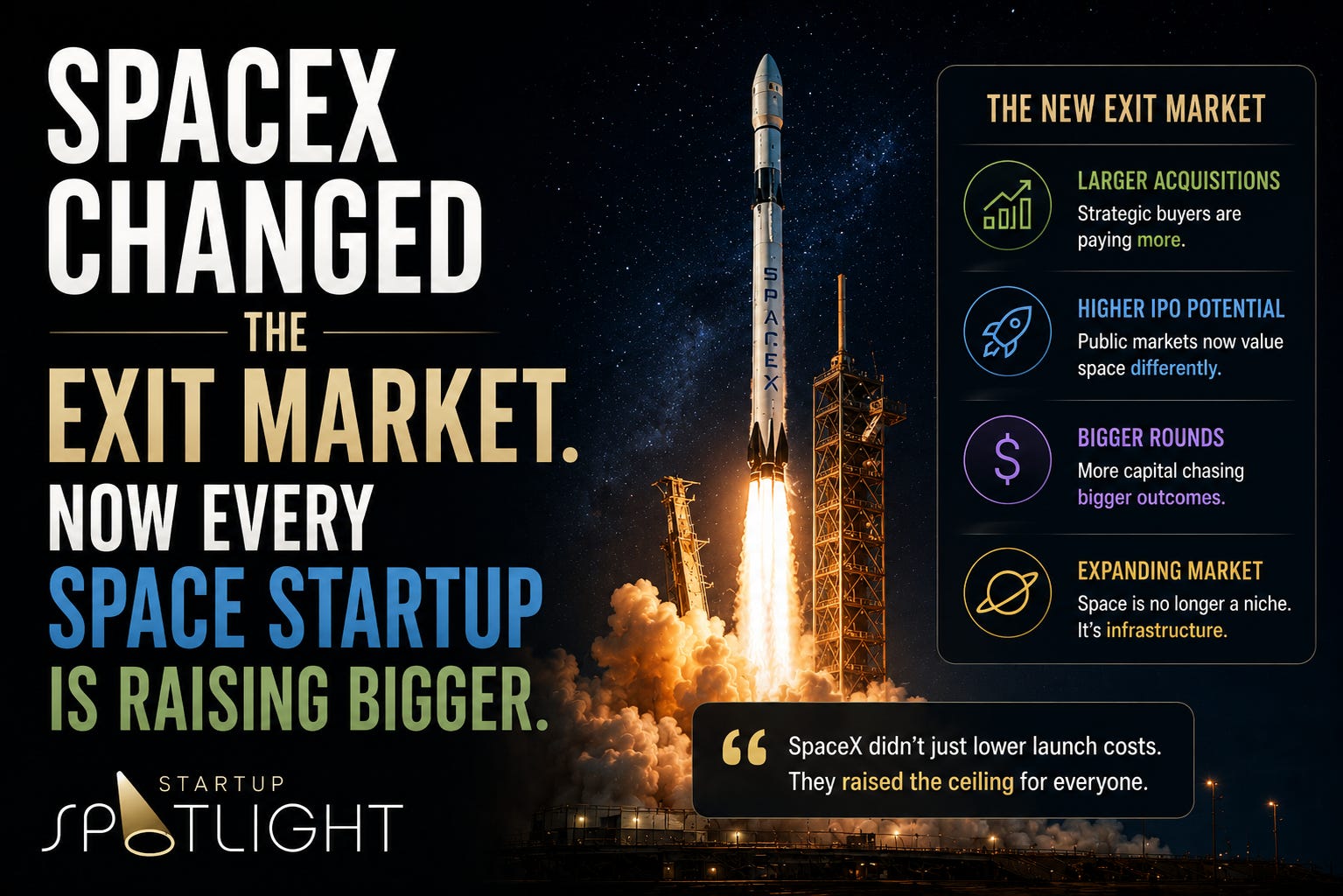
Last week, Seraphim Space released data showing that space startups raised roughly $7.5 billion across 141 venture deals in Q2 2026, keeping funding near all-time highs. The biggest catalyst wasn’t a breakthrough rocket or satellite. It was SpaceX’s nearly $86 billion IPO. Suddenly, investors who had never touched the category started paying attention.
That’s an important shift.
For years, space investing lived in a niche corner of venture capital. It attracted specialists who understood orbital mechanics, launch economics, and government procurement. Today, it’s becoming a mainstream asset class.
The mental model that explains this best is Social Proof.
People like to think investing is purely analytical. It isn’t.
When the largest and most successful company in a category produces a massive public outcome, uncertainty falls. Institutional investors become more comfortable. Generalist funds start asking questions. Founders get bigger meetings. Talent follows the capital.
Nothing about orbital physics changed overnight.
Perception did.
That’s why the funding numbers matter. The report shows investors are increasingly backing companies with proven technology instead of just ambitious ideas. Capital is flowing toward satellite infrastructure, launch systems, defense technology, and in-space computing. Investors appear more willing to write larger checks for businesses that have already demonstrated product-market fit.
This isn’t unique to space.
We’ve seen the same pattern in fintech, AI, and crypto. One breakout company creates confidence for an entire generation of founders.
The catch is that social proof cuts both ways.
When capital floods into a category, competition rises just as quickly. The average company doesn’t become exceptional because the sector gets hot. In many cases, the bar gets higher. Customers have more choices. Talent becomes more expensive. Investors become more selective after the initial excitement fades.
That’s why founders shouldn’t confuse market momentum with company momentum.
They’re different things.
It’s also why regulated markets often produce stronger long-term businesses than people expect. Success isn’t just about having a great product. You need infrastructure, compliance, distribution, and trust. At /mkt, that’s a reality we think about every day. Those pieces may not generate headlines, but they often become the hardest advantages to copy.
So here’s my take.
My takeaway is simple.
The biggest outcome from the SpaceX IPO may not be the return for its shareholders. It may be that thousands of founders now believe billion-dollar space companies are normal.
Sometimes the most valuable thing a market leader creates isn’t a product.
It’s permission.
Nothing in this post should be interpreted as investment, legal, or financial advice. It’s commentary on publicly reported industry data and venture capital trends.
If this was useful, share it with someone who builds things. And if you want the full toolkit of 50 mental models, you can grab my book, Mental Models: How to Think, Act, and Win, on Amazon right now.
If you want the mental models behind breakdowns like this, my book, Mental Models: How to Think, Act, and Win, is on Amazon now.


Informational and educational only. Not investment advice, and not an offer or solicitation of any security. Figures on volume, growth, and licenses are as reported by the company and haven't been independently verified; Cyclops is private and didn't disclose a valuation. /mkt is referenced solely as an operating example of building in regulated markets, not as an investment opportunity.