


SpaceX wants to be worth $1.75 trillion. It booked about $18.7 billion in revenue last year. Do that math and you’re not buying a rocket company. You’re buying a forecast
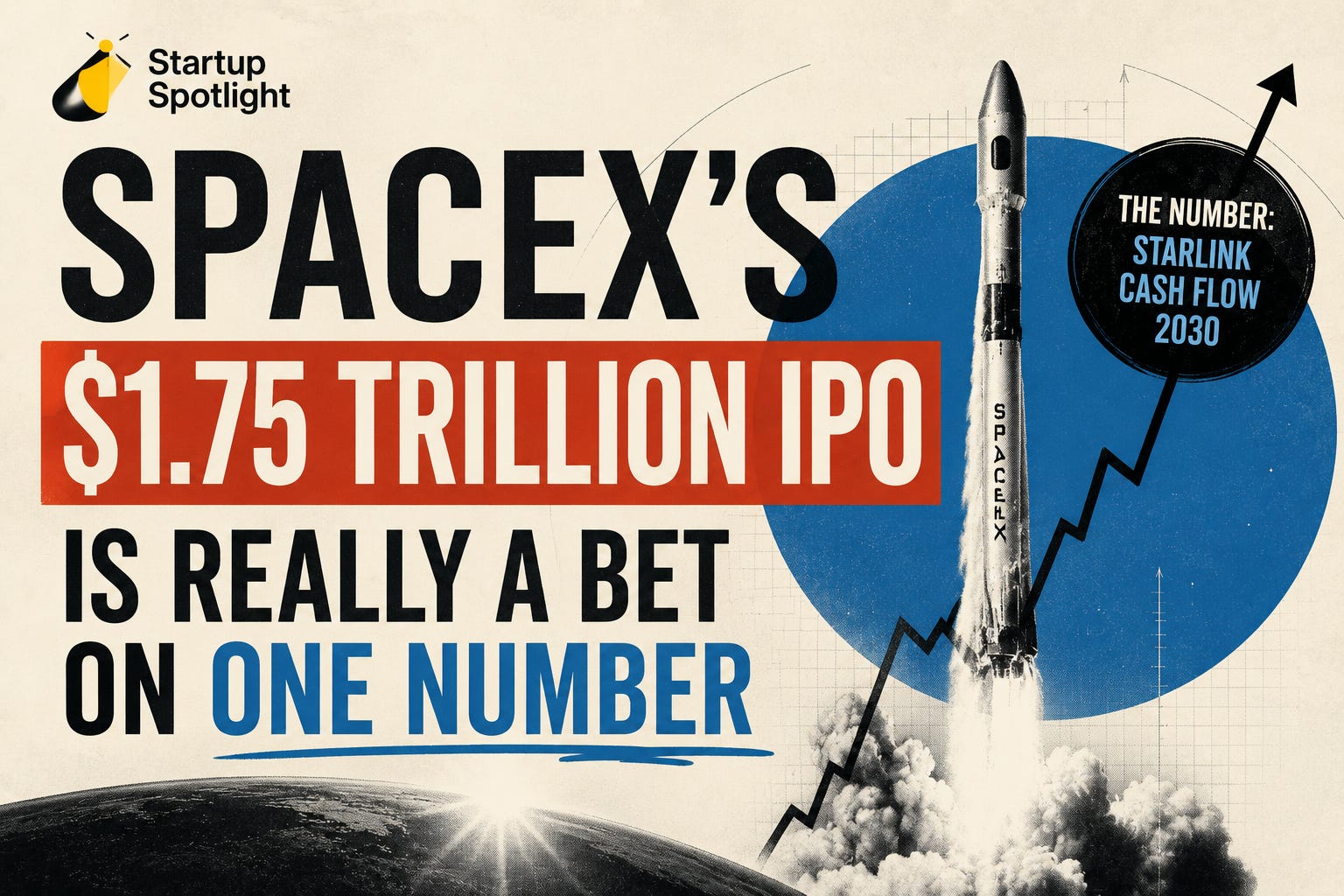
This week SpaceX kicked off the roadshow for what would be the largest IPO in history. Reuters-reported terms put it at a fixed $135 per share, roughly 556 million shares, a raise of about $75 billion, and a valuation near $1.75 trillion. It’s set to list on Nasdaq under the ticker SPCX, with pricing expected June 11 and trading June 12. Final numbers aren’t official until pricing.
For scale: Saudi Aramco’s 2019 record raise was about $29 billion. This would more than double it. The valuation works out to roughly 110 times last year’s revenue.
Here’s the catch. Inside the SpaceX group, only Starlink makes money. The AI unit, xAI, reportedly lost $6.4 billion in 2025 and is projected to burn around $10 billion this year. So how do you get to $1.75 trillion? Goldman Sachs, the lead underwriter, reportedly told investors it expects the AI division’s revenue to grow about 100 times by 2030. That single projection is the scaffolding holding up the price. Strip it out and Morningstar, one of the few independent shops to publish a number, pegs fair value at $780 billion, less than half the ask, and suggests investors wait.
The mental model here is margin of safety. Ben Graham’s whole idea was this: never pay a price that only works if everything goes right. The gap between what you pay and what the thing is worth is your protection against being wrong, and you will sometimes be wrong. At 110 times revenue, that gap is gone. The price already assumes the 100x AI forecast lands, that Grok catches and passes Anthropic, Google, and OpenAI, and that Starship and the launch business turn profitable roughly on schedule. Any one of those could happen. But you’re paying full freight for all of them, today, with nothing left over if one slips.
That’s the tension worth sitting with. A great company and a great price are not the same sentence. Graham never said avoid great companies. He said mind the price you pay for them.
One detail I keep circling: SpaceX is reportedly reserving up to 30% of shares for retail, triple the usual allocation, requestable through Robinhood, Schwab, Fidelity, and others. I’m genuinely for regular people getting first-class access to deals like this. It’s also why structure matters. At /mkt we build under a Reg A+ framework on tZERO precisely because opening regulated markets to retail should come with real disclosure and sound rails, not just a buy button. Access without a margin of safety built into the structure isn’t access. It’s exposure.
The headline is “biggest IPO ever.” The sharper story is a trillion-dollar price resting on one assumption about a money-losing AI unit. A teachers union representing 1.8 million members has already asked the SEC to take a hard look at exactly that. So strip the narrative and ask the only question margin of safety cares about: what do you get if you’re wrong? The best builders price for the world being messy. This is priced for everything going right. Know which bet you’re making.
Figures above are sourced from public disclosures, SEC filings, and press reporting, and may change. Pricing terms are as reported and are not final until the offering prices. This newsletter is for informational and educational purposes only. It is not investment advice, and nothing here is a recommendation to buy, sell, or hold any security, including SPCX. Do your own work and talk to a licensed professional before making any financial decision.
If this was useful, share it with someone who builds things. And if you want the full toolkit of 50 mental models, my book is coming soon.