

Company Overview
Here’s a stat that should bother every CFO in Europe. Spiko says roughly $50 trillion of cash across Europe and the US earns next to nothing. That’s the company’s math, not mine. Haircut it by half and it’s still an enormous leak
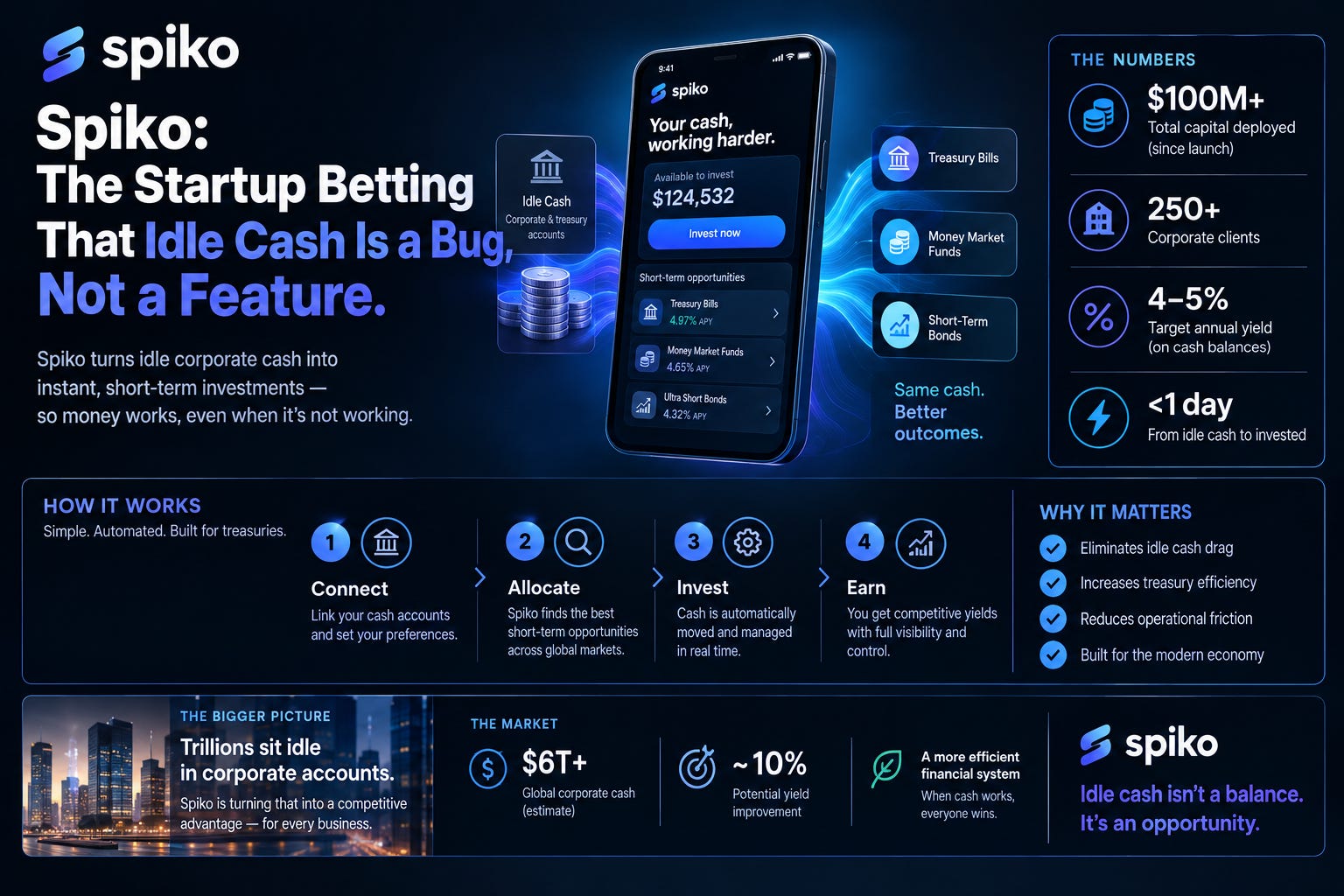
Spiko is a Paris- and London-based fintech that lets businesses park surplus cash in regulated money market funds, then automate where it goes. The twist is the plumbing: Spiko records fund shares on public blockchains and acts as its own transfer agent. Businesses use an app. Banks and fintechs embed the funds via API.
The round: On October 6, Spiko announced a $90M Series B led by NEA, bringing total funding to about $120M. Index Ventures, which led the $22M Series A in July 2025, came back, as did Bpifrance. New names include Speedinvest, Flourish Ventures and Wintermute Ventures. Angels include former Bundesbank president Axel Weber and Qonto’s founders.
Valuation: FinTech Futures, citing Bloomberg, reported an $800M valuation. Spiko didn’t disclose a valuation in its announcement, so treat that as an outlet-reported, point-in-time figure.
The founders: Paul-Adrien Hyppolite (CEO) is a Corps des Mines engineer who served as deputy head of the French Treasury’s financial markets division, the office that shapes how French securities markets are regulated. Antoine Michon was a technology adviser to France’s Minister of Public Transformation and previously worked at Palantir. One founder helped write the rules. The other built software inside government. That pairing explains this company.
Traction (all company-reported): About $400M in assets in mid-2025. $1B by February 2026. $2B by July. $2.7B by late September. Users grew from roughly 1,000 to more than 10,000 across 25+ jurisdictions, with funds in euros, dollars, sterling and Swiss francs.
2. The Market
The incumbent Spiko is attacking isn’t BlackRock. It’s the bank current account.
American companies have had easy access to money market funds for decades. European SMEs mostly haven’t. Cash sits in deposits because fund access means paperwork and high minimums, and nobody in a 40-person company owns the job. Spiko calls this the “cash yield gap.” Hyppolite’s framing is simple: as long as central bank rates are positive, idle cash is a cost you’re choosing to eat.
Now the sizing, because it cuts both ways:
European-domiciled money market funds held about $1.7 trillion as of August, per Crane Data. That money is almost entirely institutional.
Tokenized US Treasury products sit around $15 billion in distributed value, per RWA.xyz data reported this month.
Spiko’s $2.7B is a big number inside the tokenized niche and a rounding error against the traditional fund market.
That’s the opportunity and the problem in one line. The tokenized market is small. The pool it’s trying to drain is huge.
Why now? Four things lined up.
Rates are still positive. The pitch only works when cash can earn something. It can.
The regulatory rails exist. Spiko’s UCITS funds are authorized by France’s AMF and can be distributed in EEA countries where the share classes are registered. France was early in allowing blockchain-based registers for fund shares.
Stablecoins grew up. A Fipto partnership lets users move EURC and USDC straight into Spiko funds, and a Morpho and SG-Forge integration lets eligible holders borrow stablecoins against fund shares.
An incumbent blinked. Spiko and Amundi launched the Spiko Amundi Overnight Swap Fund (SAFO) in March. Spiko says it passed $1B in assets and 6,500+ users in roughly four months. When Europe’s largest asset manager rents your rails, that’s validation.
The unit economics angle: When the issuer is also the transfer agent, intermediaries that take a slice of every fund disappear. Spiko reached $400M in assets with nine people, per Index Ventures. That’s software margins in asset management.
3. Business Model and Moat
How it makes money: Spiko earns management fees on assets. Public fund data shows management fees of roughly 0.25% to 0.30% a year on its T-bill funds, plus a small operating expense charge.
Quick back-of-envelope, and this is my estimate, not a company figure: $2.7B at 25 basis points is roughly $6.75M a year in gross fees. The real number could be lower, since Spiko hasn’t disclosed how SAFO economics split with Amundi.
So if the reported valuation is accurate, nobody’s paying for today’s fees. They’re paying for the pipe. This is a volume business, and the bet is that the pipe gets very, very full.
Distribution: Direct (startups, medical practices, research institutes, public bodies) and embedded (partners like Memo Bank, whose clients placed more than €35M within weeks of launch in 2025). Embedded is what matters: every integration is distribution Spiko doesn’t sell one customer at a time.
The competition:
Tokenized treasury players. Per RWA.xyz data reported October 14, Circle’s USYC sits around $2.4B, Ondo’s USDY around $2.3B and BlackRock’s BUIDL around $2.2B. Most are dollar-first. Spiko says it’s the world’s largest issuer of tokenized cash funds, a company claim that depends on how you define the category.
Traditional fund giants. They can launch tokenized share classes whenever they want. BlackRock added two tokenized money market products in August.
Banks. They own the deposit relationship and can simply start paying interest on balances.
Treasury software. Tools like Agicap and Fygr forecast cash but don’t place it. Fygr partnered with Spiko instead.
What’s defensible:
The regulatory stack. An AMF-authorized management company, a UCITS fund umbrella and an in-house transfer agent on public blockchains. That took years to assemble. It can’t be forked on GitHub.
Embedded switching costs. Once a neobank wires Spiko into its sweep logic, ripping it out means rebuilding product, compliance and ops.
Multi-currency in Europe. Most US competitors lead with dollars. Spiko runs four currencies.
Composability. Fund shares that work as collateral and move over stablecoin rails do things a traditional fund statement can’t.
What’s not defensible: the yield. A T-bill is a T-bill. Nobody wins on the underlying asset. You win on access, automation and trust.
4. Spence’s Take
Mental Model #1: The Default Effect
People don’t optimize. They accept defaults. Most corporate cash isn’t idle because a CFO weighed the options and chose zero. It’s idle because nobody ever made a choice.
That’s the real product. Spiko’s stated goal is cash that earns “by default, around the clock.” Its rules let a company keep payroll money liquid and sweep the rest into funds. Set it once. Forget it.
The bull case is that Spiko becomes the default sweep layer inside dozens of European banks, neobanks and finance tools. Defaults compound quietly. Nobody revisits a setting that works.
Here’s what I’ve learned building /mkt, where we structure athlete offerings under Reg A+ with tZERO as trading infrastructure: regulation is the product spec. Spiko didn’t route around the AMF. It became a regulated manager. That path is slow and expensive, and it’s exactly why it’s hard to copy.
Mental Model #2: Base Rates
Before you get excited about “15%+ monthly growth” (Spiko’s own number), ask the boring question: what usually happens to hot cash products?
The base rate is ugly. Cash is the least loyal asset on earth. It follows yield in and out, and a $2.7B balance can shrink faster than it grew.
What could kill it:
Falling rates. If short-term yields drop, the gap between a fund and a deposit narrows, and the urgency fades with it.
Banks wake up. Memo Bank already pays on current accounts. If big banks follow, the pain point gets smaller.
Partner turns rival. Amundi is a distribution partner today. It’s also a giant that could go direct tomorrow.
Rule changes. The European Commission published expectations for money market fund resilience in May, and the UK’s FCA is consulting on MMF reforms. New rules could raise costs.
Operational risk. Smart contracts, chain outages and redemptions have to work under stress, not just in good times.
5. Why It Matters
(a) For investors and VCs
This is a company worth watching, not a call on anything. NEA’s lead suggests it beat out what the firm described as dozens of companies it studied in this space. The signals I’d track:
Net flows after any rate cut. That’s the real stickiness test.
Embedded vs. direct mix. A rising API share means the default thesis is working.
Product mix. Assets in Spiko’s own funds versus partner funds like SAFO likely carry different economics.
Hourly yield accrual. Spiko says it’s coming but hasn’t given a timeline. Shipping it matters.
Geographic expansion. Spiko named Germany, Italy, Spain, the Netherlands and the Nordics.
(b) For potential customers
If you run finance at a European startup, SME or institution, here’s what’s on offer: an app or API to place surplus cash in regulated money market funds across four currencies, with rules that sort cash by when you’ll need it. Spiko’s docs say instant bank withdrawals are available on certain euro products, up to €500,000 a day via SEPA Instant. Other redemptions follow each fund’s normal settlement cycle.
Coming next, per the company: more funds, more markets and continuous hourly accrual.
One important reality check. Money market funds aren’t bank deposits. They aren’t covered by deposit insurance, and their value can move. Availability depends on where share classes are registered. Read the prospectus and talk to your own advisers before changing how you hold cash.
(c) For competitors and builders
Four lessons worth stealing:
Pick boring money. Cash management isn’t sexy. It’s enormous.
Become the regulated entity. Owning the license is slower than partnering for it, but you capture the economics and the trust.
Partner with the giant you’ll eventually compete with. The Amundi deal gave Spiko scale and credibility in months. Just know the clock is running.
Ship rails, not features. An API that other platforms embed beats an app you have to market alone.
Banks: pay on balances or expect to lose them. Treasury software: add placement before a rival does. Dollar-first tokenizers: Europe’s multi-currency demand just got a $90M competitor.
6. The Bottom Line
Spiko isn’t selling yield. Yield is a commodity. It’s selling the end of idle cash as a default, wrapped in a regulatory stack that took years to build. The traction is real. The test is whether the money stays when rates fall.
This is Startup Spotlight. Every week I break down a company worth watching. Subscribe for $7.99/mo to get the full analysis.
Disclaimer: This post is for informational and educational purposes only and is not investment, legal, or tax advice. Nothing here is a recommendation or solicitation to buy or sell any security. Manus is a private company. Funding amounts, investors, valuations, and revenue figures are as reported by outlets including TechCrunch, Bloomberg, The Wall Street Journal, and The Information; they have not been independently verified, revenue figures are reported as unaudited, and the reported $4B valuation target was not confirmed in the closed round. Statements about possible IPO plans are reported, not confirmed, and may not occur. The author, Spencer Gareiss, is Chief Product Officer of /mkt, which is referenced in this post as an example of building in regulated markets. Past results are not indicative of future performance.
If you want the mental models behind breakdowns like this, my book, Mental Models: How to Think, Act, and Win, is on Amazon now.


This post is for informational and educational purposes only. It is not investment advice, a recommendation, or a solicitation to buy or sell any security. Funding figures, revenue, and valuation are as reported by the company, regulatory filings, and named outlets; the ~$470M valuation is a reported, time-sensitive snapshot and not independently verified. Dhoni's individual investment amount was not disclosed. The /mkt reference is a structural illustration of building in regulated markets and is not an offer or solicitation. Past performance and third-party investment decisions do not indicate future results.