


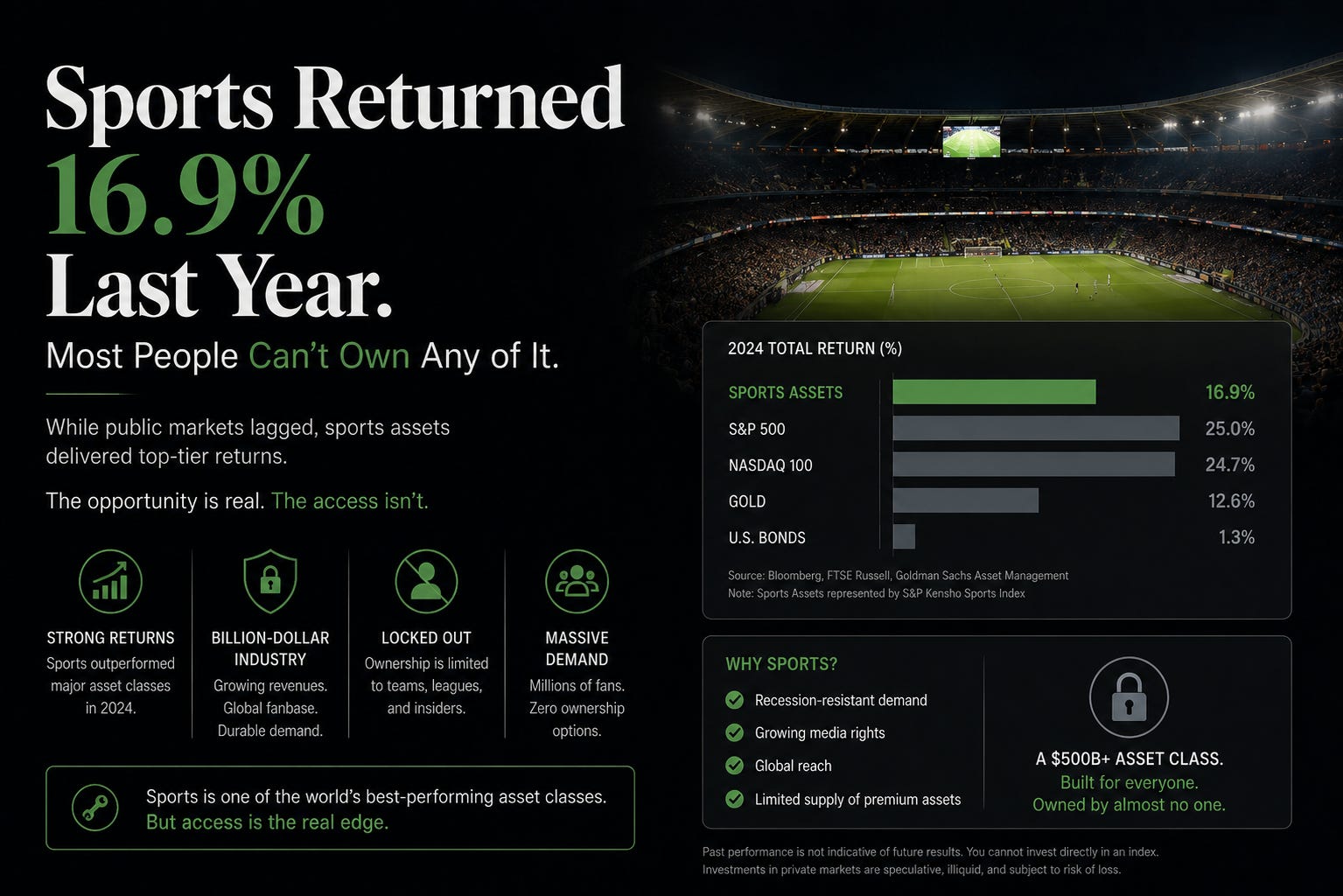
Sports franchises just posted returns most hedge funds would kill for. Almost nobody reading this could buy a single dollar of them.
Start with the numbers, because they’re the whole point. The big four North American men’s leagues returned 13.2% annualized over two decades, and 16.9% over the past year, per the Ross-Arctos Sports Franchise Index. That’s an asset class quietly beating almost everything else, and the smart money knows it. The Lakers sold for $10 billion in 2025. KKR is moving to buy sports-focused PE firm Arctos in a roughly $1 billion deal. Apollo took operating control of Atlético Madrid at an implied valuation near $2.9 billion. An IPL franchise just changed hands at $1.65 billion. Underneath all of it sits an engine that looks more like infrastructure than entertainment: NFL media contracts running past 2033 worth more than $110 billion, the kind of long-term, inflation-linked revenue that makes franchise values compound.
So capital is flooding in. And ordinary investors are, in the words of the reporting, clamoring for access. Here’s the catch. Almost all of that value gets monetized through minority sales to institutions and billionaires. The door is open to about four hundred people on earth.
Time for a model from the book: Inversion. Most people ask the obvious question. “Which team can I buy a piece of?” Invert it. Instead of asking how to get into the existing deals, ask why the asset is closed in the first place. And the answer isn’t demand. It isn’t returns. It isn’t appetite. It’s structure. Sports exposure has been packaged, for decades, as private, illiquid, and accredited-only. The bottleneck is regulatory and operational, not financial. Once you see that, the opportunity stops being “build a better sports fund” and becomes “build a different access rail.”
This is the problem we work on at /mkt. We build athlete and sports exposure inside a regulated framework, using Reg A+ offerings with tZERO handling the trading infrastructure. That’s not a glamorous sentence. But Reg A+ exists for exactly this reason: to let everyday investors access things that used to live behind an accreditation wall. The hard part was never wanting to open the door. It’s doing the compliance work to open it legally, and keep it open.
Here’s the contrarian take.
The wave of billion-dollar deals isn’t the sports finance story. It’s the symptom. Every Apollo and KKR headline is two things at once: proof the asset works, and proof the door is still mostly shut. The next $10 billion sale won’t unlock the real value. Whoever builds the rails that let the people filling the stadiums own a sliver of what they’re filling, that’s who unlocks it. The fans have always been the product. The interesting question is when they get to be owners.
If this was useful, share it with someone who builds things. And if you want the full toolkit of 50 mental models, my book is coming soon.
Valuation, returns, and deal figures cited above are sourced from public disclosures and reporting. This newsletter is for informational and educational purposes only. It is not investment advice, an offer to sell, or a solicitation of an offer to buy any security. References to /mkt describe operational and structural context only and are not an offer or solicitation. Returns referenced reflect past performance and do not predict future results. Do your own research and consult a licensed professional before making any financial decision.