


China installed nine times as many industrial robots as the U.S. last year, more than the rest of the world combined. That one stat explains a $200 million check better than any pitch deck could
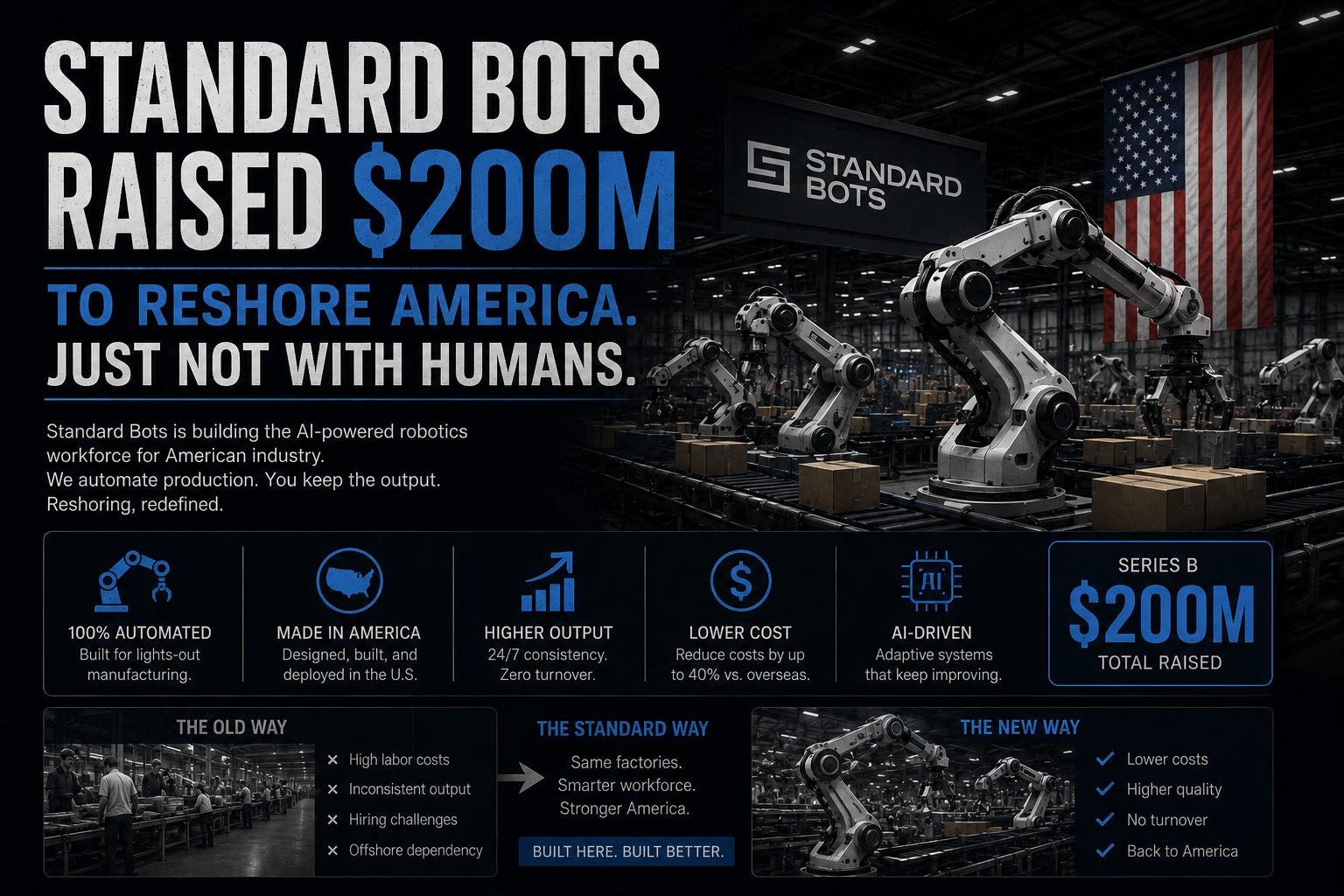
On June 9, Standard Bots announced a $200 million Series C co-led by RoboStrategy (Nasdaq: BOT) and General Catalyst, at a $1 billion valuation, per the company’s announcement. That makes the Glen Cove, New York company a fresh unicorn, with Amazon, Samsung Next, Box Group, and GiantLeap Capital also in the round. Standard Bots builds AI-native robot arms you teach by demonstration instead of code, at what the company says is a 30% discount to legacy makers. Customers already include Amazon, Lockheed Martin, NASA, Sunoco, and the U.S. Army. The money goes toward a 70,000-square-foot plant expansion and a stated goal of supplying 10% of new U.S. industrial robot deployments next year. The broader industrial robotics market sits around $24.4 billion in 2026 and is projected to roughly triple by 2034 on public estimates.
Here’s where most coverage stops, and where it gets interesting.
The model: Second-Order Thinking
First-order thinking reads this as a clean win. Capital flows to an American robot maker, factories come home, jobs follow, everybody claps. It’s the story politicians like to tell.
Second-order thinking asks the follow-up question: and then what? And the answer breaks the first story. Reshoring at a cost that can actually compete with China is only possible because of automation. American labor costs a multiple of what it costs abroad, and the skilled machinists and welders for a thousand-person floor mostly don’t exist anymore. So the robot isn’t the thing that steals the reshored job. It’s the precondition for any job coming home at all. Manufacturing is roughly a third of the U.S. economy once you count suppliers and services. You don’t rebuild a third of the economy with labor you can’t afford and can’t find. You rebuild it with machines, supervised by a thin layer of skilled technicians.
That flips the whole frame. The robots aren’t competing with the reshoring promise. They’re the only version of it that survives contact with Chinese unit costs.
