

A defense startup just closed one of the biggest rounds of the year, and it doesn’t design missiles, drones, or fighter jets.
On Thursday, Hadrian announced $1.37
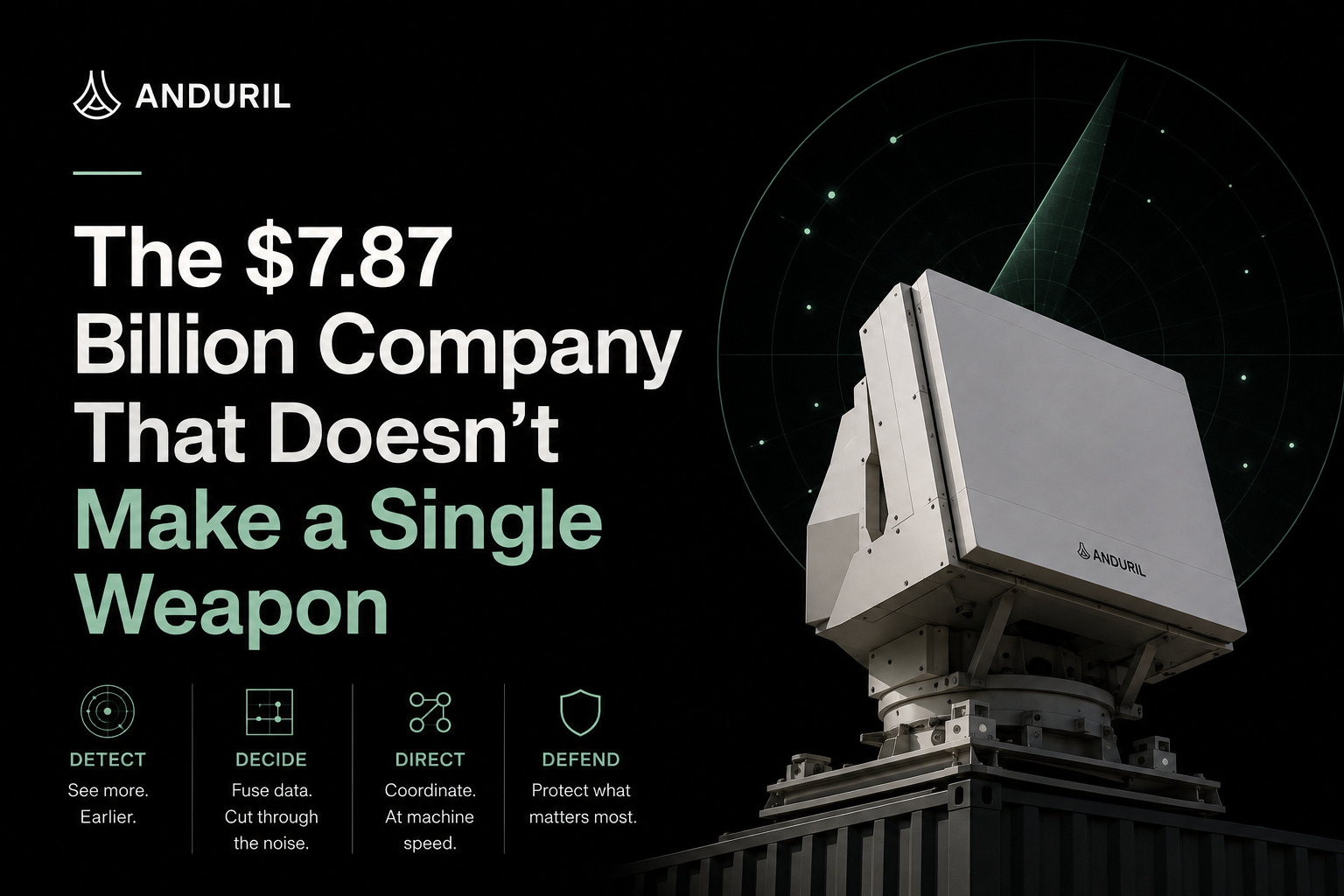
billion in Series D financing at a company-reported valuation of $7.87 billion. That’s roughly five times what investors valued it at a year ago, when it raised a $260 million Series C. The round was co-led by WCM Investment Management, Washington Harbour Partners, Valor Equity Partners, 137 Ventures, and Baillie Gifford, with JPMorgan Chase’s Strategic Investment Group anchoring as co-lead. Total capital raised to date sits near $2 billion, per PitchBook estimates.
Here’s what Hadrian actually does. It builds highly automated factories that mass-produce precision parts for submarines, munitions, and aerospace systems the military already relies on. Call it “Factories-as-a-Service,” powered by a software platform named Opus. Four sites, nearly 3 million square feet, including a facility in Muscle Shoals, Alabama tied to Virginia-class and Columbia-class submarine work.
CEO Chris Power put the thesis plainly to Axios: “This has been a five-year slog.” The company got early to a problem the rest of the market only recently woke up to. America can invent world-class defense technology. It just can’t build enough of it, fast enough.
That’s the whole story, and it’s a textbook case of a mental model from my book: the Theory of Constraints.
The idea is simple. Every system has one bottleneck that caps its total output, and improving anything other than that bottleneck is wasted motion. You can pour billions into designing better weapons, but if the factories can’t produce parts at volume, the design work doesn’t ship anything. The constraint isn’t invention. It’s capacity.
Hadrian’s investors just made a $1.37 billion bet on exactly that read. They didn’t fund the flashiest layer of the stack. They funded the choke point everyone else skipped because it’s slow, physical, and unsexy. Submarines don’t ship faster because you drew a better blueprint. They ship faster because someone built the factory.
Here’s my contrarian take. In a market obsessed with the frontier, new AI, new autonomy, new hardware, the biggest edge is often sitting one layer down in the boring part nobody wants to own. The winning move isn’t always a better product. Sometimes it’s removing the single bottleneck that caps everyone’s output at once.
I’ve lived a smaller version of this at /mkt, where we build in a regulated market using Reg A+ offerings and tZERO for trading infrastructure. The hard part was never the idea. It was the plumbing that makes the idea legal and operational at scale. Power’s “five-year slog” line landed for me, because that’s what building through a constraint actually feels like.
Watch where the smart capital flows next. It’s moving toward the bottleneck.
If this was useful, share it with someone who builds things. And if you want the full toolkit of 50 mental models, you can grab my book, Mental Models: How to Think, Act, and Win, on Amazon right now.
Compliance and attribution: Figures reflect Hadrian’s August 6, 2026 announcement (PRNewswire), corroborated by TechCrunch, Bloomberg, CNBC, and Axios. The $7.87 billion valuation is company-reported and point-in-time; private-company valuations can change materially and are not independently verified here. Statements about factory expansion, future production lines, and total capital deployed reflect the company’s stated plans and third-party estimates (PitchBook), not independent projections or fact. This post is for informational and educational purposes only. It is not investment advice, research, or an offer or solicitation to buy or sell any security. Author disclosure: Spencer Gareiss is Chief Product Officer at /mkt, referenced above solely as an illustrative example of building in a regulated market.
If you want the mental models behind breakdowns like this, my book, Mental Models: How to Think, Act, and Win, is on Amazon now.


This post is for informational and educational purposes only. It is not investment advice, a recommendation, or a solicitation to buy or sell any security. Funding figures, revenue, and valuation are as reported by the company, regulatory filings, and named outlets; the ~$470M valuation is a reported, time-sensitive snapshot and not independently verified. Dhoni's individual investment amount was not disclosed. The /mkt reference is a structural illustration of building in regulated markets and is not an offer or solicitation. Past performance and third-party investment decisions do not indicate future results.