


The biggest funded AI startups in 2026 aren’t building better chatbots.
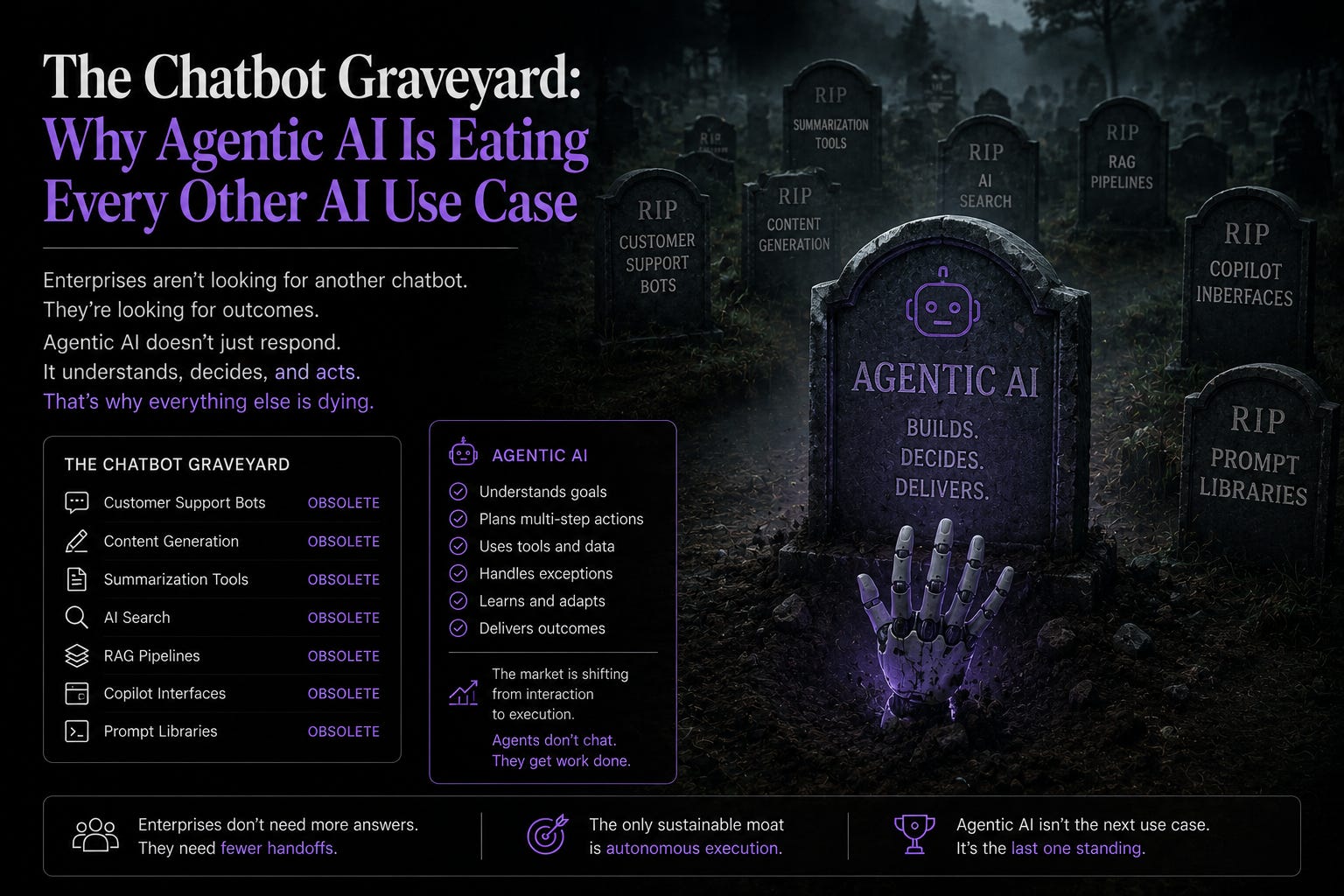
They’re building agents that do actual work. Sierra is raising billions to automate customer support workflows. Harvey is raising hundreds of millions to write legal documents. Cognition, Adept, and Poolside are racing to build coding agents that handle real development tasks. Meanwhile, every startup that pitched itself as a “ChatGPT for X” is either pivoting or dying.
The difference isn’t subtle. And it completely changes how you should think about building an AI company right now.
A chatbot improves information retrieval. An agent completes tasks. That one word, “complete,” is the difference between a feature and a business.
Why task completion is eating the market.
Here’s the brutal math: if an AI chatbot saves you 30 minutes per day but requires a human to make the final decision, you’ve built a tool. If an AI agent saves you 3 hours per day and handles the decision autonomously with human review gates, you’ve built a replacement for work. One is a nice-to-have. The other is a must-have.
Enterprises don’t pay $10K to $100K per month for something that saves a human 30 minutes. They pay for something that reduces headcount or saves significant operational cost. That’s why task-completion agents are raising while chat interfaces are sitting in acquihires.
Let me show you the capital concentration: the top 10 agentic AI startups account for roughly 49% of all funding in the entire market, even though there are 99 funded companies. That’s not distributed hype. That’s concentrated capital moving toward the things that actually work.
The breakdown tells you everything:
Customer service agents (Sierra, Parloa, Decagon, Moveworks) have raised several billion combined because they handle inbound requests autonomously and route exceptions to humans. They measure success in “tickets resolved without human,” not “conversations completed.”
Legal AI (Harvey, Legora, EvenUp, Luminance) is raising hundreds of millions because these agents actually draft documents, conduct discovery, and flag risk. They sit in workflows that cost law firms six-figure retainers. The ROI is undeniable.
Coding agents (Cognition, Poolside, Magic, Adept) are winning because they handle pull request reviews, refactor code, and complete features. Developers measure the agent not by how helpful its suggestions are, but by how many lines of code it actually writes.
This is the flip. When the AI system is advising a human, the human stays in control and the metric is “time saved.” When the AI system is doing the work autonomously, the metric is “work completed,” and the leverage is asymmetric.
Why conversational AI hit a ceiling.
The problem with chatbots is that they’re advisory, not autonomous. You ask it a question. It gives you an answer. You still have to interpret the answer, fact-check it, and act on it. The human cognitive load doesn’t actually go down. You’re just replacing one tool (Google) with another (ChatGPT).
Enterprises realized this in 2024. By 2025, they started funding agents instead. By 2026, the funding gap is obvious.
The better chatbot doesn’t scale. It plateaus. Every marginal improvement in instruction-following or reasoning takes more training, more tokens, more infrastructure. Meanwhile, agents that automate specific workflows hit exponential returns. Do the same task 1,000 times, the agent gets cheaper and faster. Do the same conversation 1,000 times, the chatbot just handles the same easy questions.
The architecture that matters.
Real agentic AI systems have three things chatbots don’t:
Autonomous decision-making. The agent makes choices (with guardrails, with human review gates, but autonomously). It doesn’t propose and wait. It acts.
Multi-step workflow execution. The agent breaks complex tasks into subtasks, executes them across systems, and tracks context. A chatbot answers one question per turn. An agent plans across an entire workflow.
Integration with business systems. The agent reads from your CRM, writes to your legal database, executes transactions, updates your spreadsheets. A chatbot talks to you. An agent talks to your infrastructure.
That’s why platforms like Adept (which positions itself as an “autonomous collaborator” that navigates software and handles workflows), UiPath (which merged RPA with agentic AI to automate cross-system workflows), and CrewAI (which lets you assemble teams of specialized agents) are winning. They’re not building better conversationalists. They’re building systems that do work.
Here’s how it applies to how we think about /mkt and regulated markets.
In a trading infrastructure, agents need to understand regulatory rules, execute transactions autonomously, and maintain audit trails. That’s not a chatbot use case. That’s an agentic AI use case. The agent needs to know the rules, make decisions within them, and prove its work. That’s why agentic systems matter in regulated markets. They’re not advisory. They’re operational.
The mental model is “Asymmetric Leverage.”
When you use AI to advise humans, the leverage is symmetric. You’re both doing cognitive work. You’re just dividing it differently. When you use AI to replace work, the leverage is asymmetric. The AI does the work, humans do the review. That’s a 10x efficiency gain, not a 1.2x gain. Capital flows toward asymmetric leverage.
My contrarian take: if you’re building “ChatGPT for X” in 2026, you’re already late.
The winners aren’t building conversational AI. They’re building task-completion agents. They’re not asking “how do we make better suggestions?” They’re asking “how do we do the entire workflow autonomously with the right safety gates?”
The chatbot graveyard is real. And it’s full of startups that could have been worth billions if they’d recognized the shift from “advise” to “automate.”
If you’re building with AI right now, don’t optimize for better answers. Optimize for autonomous task completion. That’s where the capital is. That’s where the defensible moat is. That’s where the 100x returns are.
Everything else is a chatbot. And nobody’s funding chatbots anymore.
If this was useful, share it with someone who builds things. And if you want the full toolkit of 50 mental models, my book is coming soon.