


Thea Energy builds stellarators. If you don’t know what that is, you’re not alone, most people don’t, and that’s exactly why this company is worth a closer look before the rest of the market catches on.
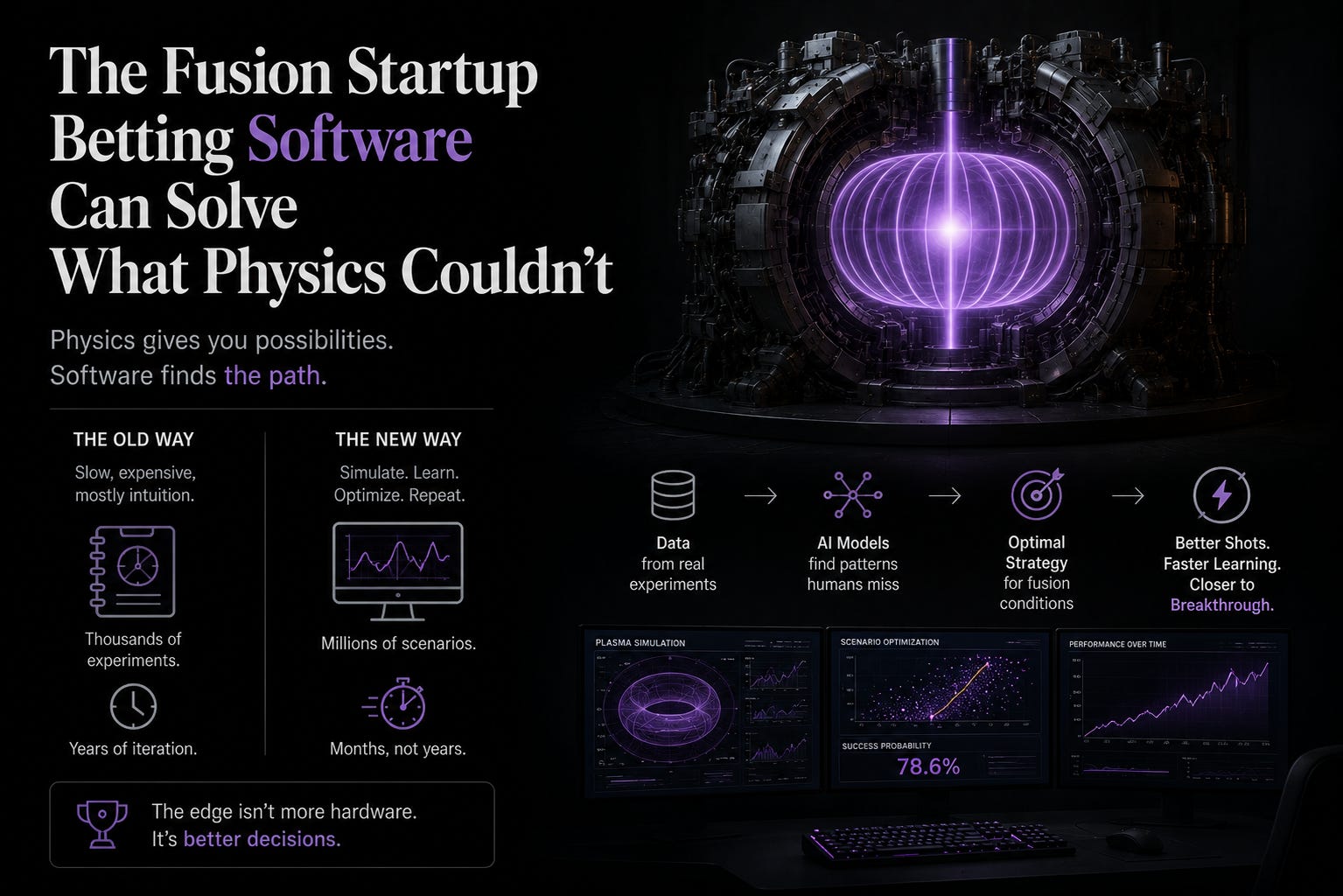
A stellarator is a type of fusion reactor that uses twisted magnetic fields to contain superheated plasma long enough to generate power. It’s one of the oldest fusion concepts in physics, and it’s historically been considered too mechanically complex to build at scale, because traditional stellarator designs require highly warped, three-dimensional magnetic coils that are extraordinarily difficult to manufacture.
Thea just raised $100 million in an oversubscribed Series B, led by Thomas Tull’s US Innovative Technology Fund, with General Innovation Capital Partners, Linse Capital, Calm Ventures, Climate Capital, Divergent Capital, Emerald Technology Ventures, Gaingels, Idemitsu Kosan, Overlay Capital, Timescale Ventures, and Whatif Ventures all participating. That brings total private investment in the company to roughly $130 million, following a $20 million Series A closed in early 2024.
The company spun out of Princeton University and the Princeton Plasma Physics Laboratory in 2022, originally under the name Princeton Stellarators before rebranding. Co-founder and CEO Brian Berzin brings a background in electrical engineering and private equity. Co-founder and CTO David Gates previously led stellarator magnet array research at PPPL, meaning the technical leadership here isn’t a software team that pivoted into energy. It’s a team that spent years inside the exact research institution that’s been working on this problem for decades.
That pedigree matters in fusion more than almost any other sector. This is a field littered with ambitious claims and very few working prototypes. A founding team with direct lineage to the national lab doing the underlying physics research is a meaningfully different signal than a founder with a deck and a vision.
The Market
Fusion has spent the last several years going from a punchline to a serious line item on institutional balance sheets. Cumulative investment in the fusion sector surpassed $15 billion by January 2026, reflecting strong investor confidence in the technology’s potential to address growing demand for clean, firm power, a need amplified by the energy requirements of AI and data centers.
That last point is the real story. This isn’t climate-driven capital chasing a feel-good thesis. Surging electricity demand is spurring interest in fusion technology, much of it driven directly by the power needs of AI infrastructure. Data centers need baseload power that doesn’t fluctuate with weather the way solar or wind does. Fusion, if it works, is exactly that: constant, clean, scalable power.
The competitive field is heating up fast. In June 2026 alone, Helion raised $465 million for its Field-Reversed Configuration approach, while Focused Energy secured a $240 million Series A for laser-based inertial fusion, showing investor appetite spreading across multiple fusion architectures rather than concentrating in a single approach the way it did in the 2021 to 2024 period.
What makes Thea’s timing specifically interesting is the technical shift underlying its raise. The core shift in the stellarator field is the move from physically complex hardware to software-defined magnetic control, which fundamentally changes the technology’s readiness level for commercial manufacturing. In plain terms, the bottleneck that made stellarators impractical for decades was a manufacturing problem, not a physics problem. If Thea has genuinely solved the manufacturing side, they’re not just one more entrant in a hot sector. They’re unlocking an architecture that was sitting on the shelf for a reason that had nothing to do with whether it worked.
Business Model and Moat
Thea doesn’t have a product on the market yet, and won’t for years. This is deep tech in the truest sense: the business model right now is building toward a demonstration system, not generating revenue from customers.
The new funding will help Thea expand manufacturing for its smaller magnets and begin construction of its Eos demonstration device, with construction starting next year. The company has utilized arrays of mass-manufacturable magnets paired with dynamic software controls to reinvent the stellarator design.
The defensibility argument here is unusual compared to a typical startup moat. It’s not a network effect or a brand. It’s a combination of deep technical IP around magnet array manufacturing, a direct talent pipeline from the lab where stellarator research originated, and government backing that’s hard for a new entrant to replicate quickly. Thea was selected as an inaugural awardee of the Department of Energy’s Milestone-Based Fusion Development Program and is supported by six separate Department of Energy INFUSE awards. That’s not capital, but it is validation, and in a field this technically demanding, validation from the agency that runs the national fusion research program is a moat in its own right.
Competitively, Thea is one of several stellarator-focused companies globally, including Germany’s Proxima Fusion, which spun out of the Max Planck Institute for Plasma Physics. But within the stellarator approach specifically, Thea’s manufacturing-first thesis, built around mass-producible magnets rather than the historically complex twisted coil designs, appears to be a genuine differentiation rather than a marketing angle.
Spencer’s Take
Two mental models apply directly here.
The first is constraint identification. For decades, people assumed the stellarator’s problem was a physics problem. Thea’s founders, sitting inside the actual lab doing this research, correctly identified that the real constraint was manufacturability, not the underlying science. That’s a subtle but critical distinction. Founders who misdiagnose the actual bottleneck waste years solving the wrong problem. Founders who correctly identify the constraint can unlock value that’s been sitting untouched for decades, simply because nobody else framed the problem correctly.
The second is the power of credentialed conviction. In binary, high-uncertainty fields like fusion, investor conviction often comes down to who’s in the room more than what’s in the deck. A CTO who spent years running the exact research program this company is now commercializing is a different kind of signal than industry experience alone. It’s worth noting how often deep tech rounds get led by funds and individuals, like Thomas Tull here, who are making a long-horizon bet on a specific technical thesis rather than chasing near-term returns.
The bull case: this is a genuinely massive market opportunity, riding a real demand tailwind from AI infrastructure power needs, backed by a technical team with direct institutional lineage to the underlying science, and validated by serious government funding programs. If the manufacturing thesis holds, Thea could be sitting on an architecture advantage that’s extremely difficult for competitors to replicate quickly.
The bull case has a serious counterweight, though. Fusion has a multi-decade history of well-funded, well-credentialed teams missing timelines by years, sometimes by a decade or more. The Eos demonstration device hasn’t been built yet. Every fusion company at this stage says the breakthrough is close. Most of them are right about the science and wrong about the calendar.
Why It Matters
For investors and operators evaluating this space: the signal to track isn’t the funding round size, it’s the Eos demonstration device timeline next year. Deep tech rounds are easy to raise on a compelling thesis. The actual test is whether construction milestones hit on schedule. If Eos breaks ground and shows progress on schedule, that’s a far stronger signal than any amount of additional capital raised in the meantime.
For potential customers, meaning utilities, data center operators, and large industrial energy buyers: there’s nothing to evaluate or purchase yet, and that’s an important distinction from the Podium Automation story in this same publication. This is a multi-year technology bet, not a near-term vendor decision. The relevant action for energy buyers right now is awareness, not procurement. Worth tracking which utilities or hyperscalers eventually sign early offtake agreements with fusion companies, since that will be the real tell for which architecture the market believes in first.
For competitors and builders thinking about adjacent spaces: the broader lesson is about where deep tech founders should look for unlocked value. Thea’s advantage didn’t come from a flashy new discovery. It came from correctly identifying that an old, well-understood physics concept had been blocked by a manufacturing constraint that modern software and materials science could finally solve. There are other corners of physics and engineering sitting in the same state, technically sound but commercially stalled because of a manufacturing or tooling gap nobody’s revisited with current technology. That’s a more repeatable playbook than waiting for a brand-new scientific breakthrough.
The Bottom Line
Thea Energy is making a credible, well-capitalized bet that the stellarator’s real obstacle was always manufacturing, not physics. The team’s direct lineage to Princeton’s fusion research, the scale of government validation, and the demand tailwind from AI power consumption all support the thesis. The real test starts next year, when the Eos demonstration device either breaks ground on schedule or joins a long list of fusion promises that slipped.
This newsletter does not provide investment advice or recommendations to buy or sell any security. The information presented is for educational and informational purposes only and reflects publicly available data at the time of writing. Private company valuations, fundraising terms, and projections are inherently uncertain, and this is especially true in early-stage deep tech sectors like fusion energy, where commercialization timelines carry significant risk. Always conduct your own due diligence and consult a licensed financial advisor before making investment decisions.
This is Startup Spotlight. Every week I break down a company worth watching. Subscribe for $7.99/mo to get the full analysis.