

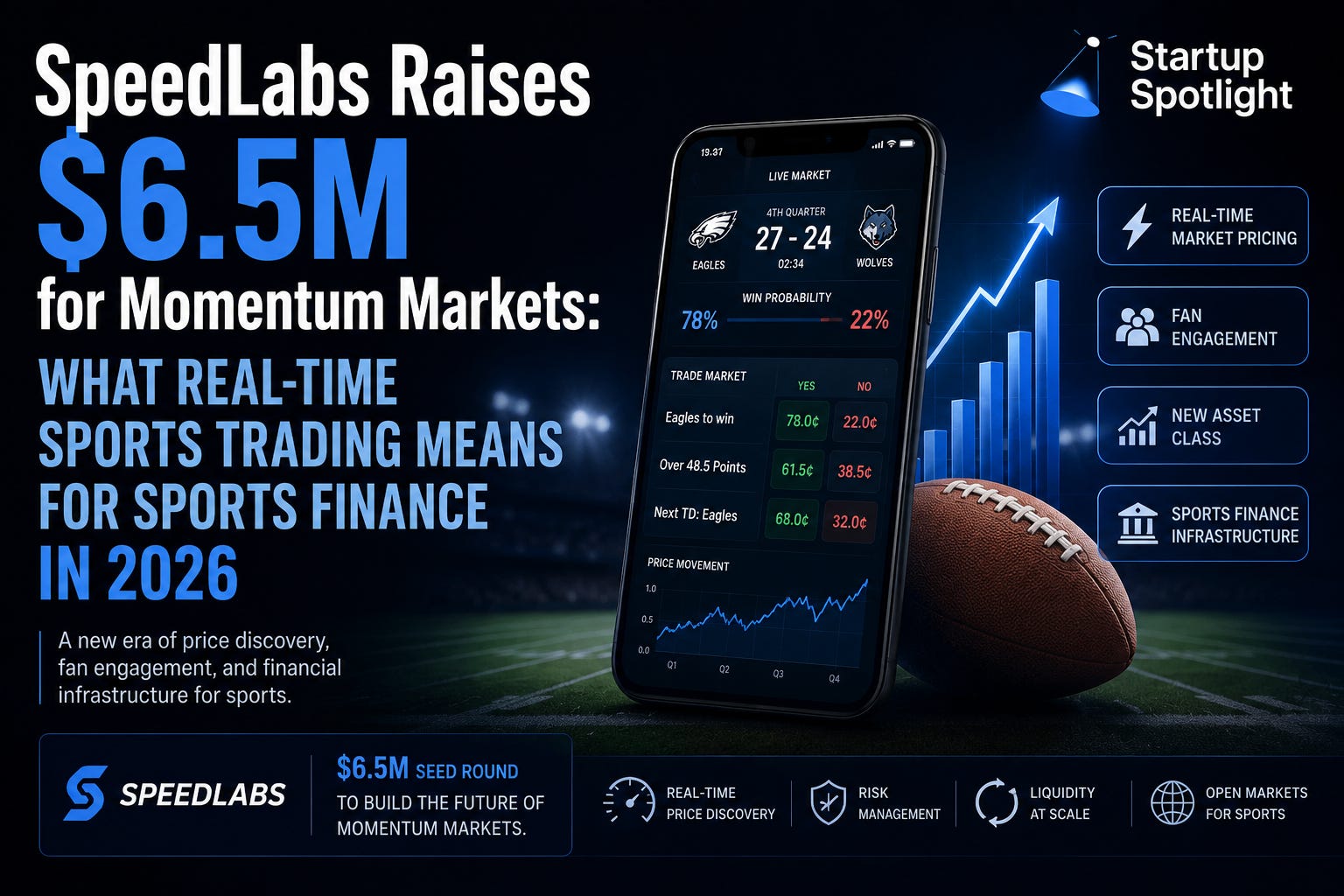
Every sports fan has felt it. The third quarter is slipping away, a run happens, the energy shifts, and you know before the scoreboard does that the game just changed. That feeling has always been worth something. Until now, there was no market for it.
SpeedLabs wants to change that. On June 1st, the New York-based sports technology startup announced a $6.5 million seed round to build what it’s calling Momentum Markets — a system that creates and prices new tradable markets in real time, keyed to live game momentum. The round was led by Parlay Capital Holdings, with participation from Bullpen Capital, TA Ventures, and EdgeEquity. The company is targeting a summer 2026 launch, just ahead of football season, with a consumer-facing skill game built on the same engine set to follow in the fall.
The idea is straightforward: momentum swings the injury that changes field position, the streak that shifts the score, the big play that flips the probability should be priceable in the second they happen. Not pregame. Not halftime. Real time.
For anyone who spent time building prediction markets, this concept is immediately legible. The hard part was never the idea. It was always the infrastructure.
Mental Model: First-Order vs. Second-Order Problems
There’s a mental model I call First-Order vs. Second-Order Problems in my book. First-order problems are the ones everyone sees. Second-order problems are the ones that kill you.
SpeedLabs’ first-order problem is product: can they build markets that move fast enough to capture momentum as it happens? That’s real engineering, and they’re hiring across machine learning, trading infrastructure, and engineering to solve it.
But the second-order problem is the one that will actually determine whether this company scales: regulatory structure.
Real-time tradable markets tied to live sports events sit at a genuinely complex legal intersection. Depending on how they’re structured, priced, and offered, they may be treated as prediction markets, sports betting products, or securities each carrying different regulatory obligations, state-by-state licensing requirements, and federal oversight frameworks. The CFTC, SEC, and state gaming commissions have overlapping and sometimes conflicting jurisdiction here, and recent precedent around prediction markets (see: Kalshi) has shown that the courts and regulators are actively sorting through where the lines are.
I know this territory. At /mkt, we’re building an athlete tokenization platform that structures its offerings under Reg A+, using tZERO for trading infrastructure. We didn’t arrive at that structure because it was the easiest path. We chose it because doing this right, inside a compliant framework from day one, is the only way to build something that lasts. Getting regulatory structure right upfront isn’t a constraint. It’s a competitive advantage.
SpeedLabs is targeting a fantasy and DFS audience players who already live in probabilities, already understand real-time game state, and are primed for this kind of product. That’s a smart beachhead. The question is whether they’ve pressure-tested the regulatory layer as thoroughly as they’ve pressure-tested the model.
Spence’s Take
Here’s the contrarian read: $6.5 million is a seed round. For a platform that needs to move fast enough to price momentum in real time, hire across ML and trading infrastructure, obtain the right licensing across potentially 30+ jurisdictions, and launch before football season that’s a tight budget with a demanding timeline.
The sports finance space is heating up fast. The U.S. collegiate NIL market alone is projected to hit $2.55 billion by end of this year. Global sports sponsorship is on a path from $114 billion in 2025 toward $195 billion by 2032. Real-money products tied to live sports are attracting serious capital and serious regulatory attention in the same breath.
SpeedLabs has a genuinely interesting product thesis. Real-time momentum as a tradable asset class is an idea whose time has been coming for a while. The companies that win in this space won’t just be the ones with the best algorithms. They’ll be the ones who figured out the compliance architecture early enough that it became a moat, not a bottleneck.
That’s the game within the game. And right now, the clock is running.
If this was useful, share it with someone who builds things. And if you want the full toolkit of 50 mental models, my book is coming soon.