

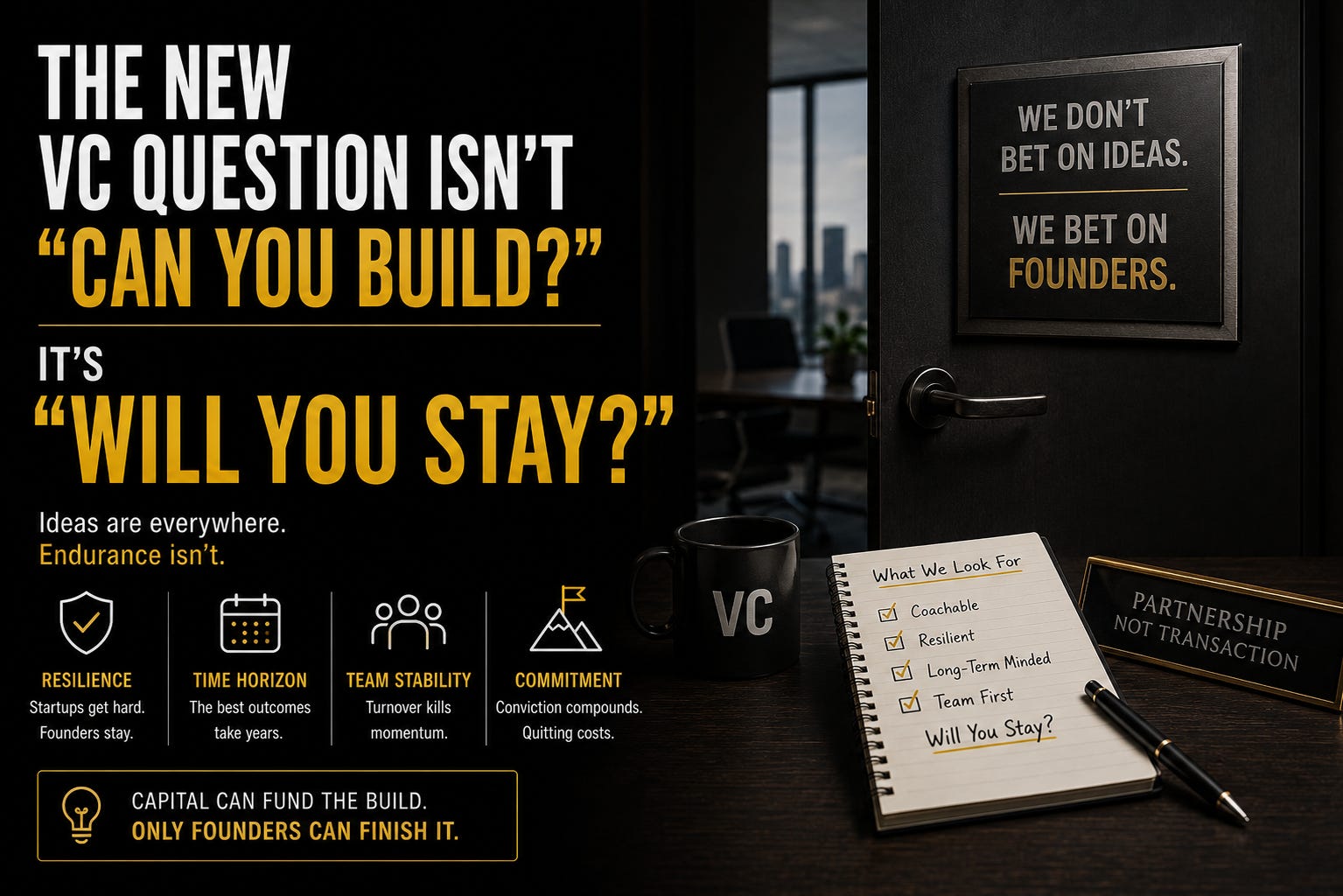
Every startup pitch used to end with the same question: How big can this become?
Now there’s a new one.
Are you actually going to stick around?
That’s not a hypothetical. It’s becoming one of the defining themes in venture capital. As AI labs and large tech companies compete aggressively for top talent, venture investors are increasingly worried that founders will sell early, accept an acquihire, or simply leave for a multi-million dollar compensation package before building an enduring company. According to reporting today, U.S. AI startup acquihires have climbed sharply, reaching 245 transactions by mid-2026. Some investors say promising deals have already fallen apart after founders accepted offers from frontier AI labs instead.
Think about how unusual that is.
For years, venture investing focused on market size, product quality, customer growth, and capital efficiency. Those still matter. But when the opportunity cost of remaining a founder skyrockets, commitment itself becomes a competitive advantage.
One mental model from Mental Models: How to Think, Act, and Win fits perfectly here: Incentives Drive Behavior.
People don’t respond to speeches. They respond to incentives.
Today’s incentives are powerful. A talented founder can spend years building an uncertain startup or accept an enormous guaranteed package from an AI company with nearly unlimited compute, distribution, and capital. That’s a rational decision for many people.
The interesting part is what happens next.
Investors aren’t just asking whether a founder is technically capable. They’re trying to understand whether that founder has reasons to keep building when the easy exit appears.
That’s a much harder question to diligence.
It also changes how founders should think about building companies. Durable businesses aren’t created by people chasing the highest short-term offer. They’re built by people whose incentives remain aligned with solving a problem over many years.
You can see similar dynamics in regulated industries. At /mkt, for example, building infrastructure around Regulation A+ offerings and secondary trading requires patience, compliance, and long development cycles. Those markets don’t reward shortcuts. They reward consistency and execution over time.
None of this means founders should reject acquisition offers or employment opportunities. Every situation is different, and there isn’t a universal right answer. But it does mean investors are paying closer attention to founder motivation because incentives often predict behavior better than pitch decks do.
My takeaway is simple.
The founders who’ll stand out over the next decade won’t necessarily be the smartest in the room. They’ll be the ones whose incentives let them keep showing up after everyone else has been given a reason to leave.
That’s harder to measure than ARR.
It may also be more valuable.
This post is for informational purposes only and is not investment advice, a recommendation, or a solicitation to buy or sell any security. Figures are as reported by the companies involved and have not been independently verified. Company names and products are referenced for illustration only. Always do your own research and consult a licensed professional before making financial decisions.
If you want the mental models behind breakdowns like this, my book, Mental Models: How to Think, Act, and Win, is on Amazon now.


This post is for informational and educational purposes only. It is not investment advice, a recommendation, or a solicitation to buy or sell any security. Funding figures, revenue, and valuation are as reported by the company, regulatory filings, and named outlets; the ~$470M valuation is a reported, time-sensitive snapshot and not independently verified. Dhoni's individual investment amount was not disclosed. The /mkt reference is a structural illustration of building in regulated markets and is not an offer or solicitation. Past performance and third-party investment decisions do not indicate future results.