

The weirdest thing about today’s biggest startup funding story is that the startup isn’t an AI model.
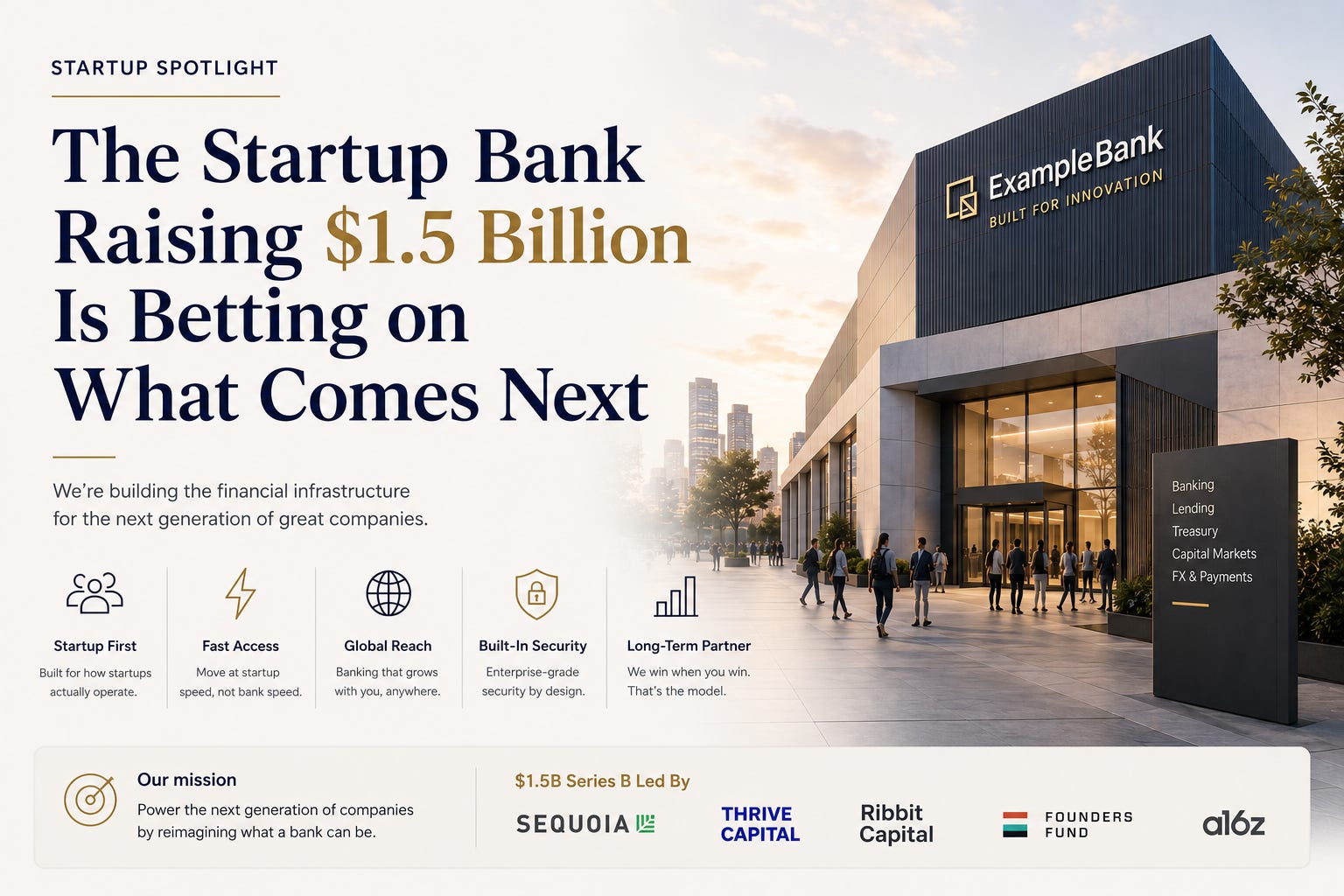
It’s a bank.
Erebor, the startup bank founded by Palmer Luckey, is reportedly nearing a $1.5 billion funding round at an $8 billion valuation. Andreessen Horowitz, Lux Capital and SV Angel are among the investors participating, alongside existing backers including 8VC and Haun Ventures.
The numbers get more interesting.
Erebor received final regulatory approval in February. Since then, deposits have reportedly climbed to $4.6 billion, while annualized recurring revenue has surpassed $100 million.
That’s an unusually fast ramp for a newly approved bank.
And the customer thesis is even more interesting.
Erebor was created partly in response to the collapse of Silicon Valley Bank in 2023. But it isn’t simply trying to recreate the old model. It’s targeting companies operating in capital-intensive sectors such as AI, defense, energy and virtual currencies.
That matters because the economics of these companies don’t look like traditional SaaS.
An AI company might need enormous computing capacity before revenue catches up. A defense startup can spend years getting through procurement. An energy company may need hundreds of millions of dollars before its first commercial project. These businesses need financial infrastructure built around long development cycles and unusual capital requirements.
The mental model: Inversion
One of the mental models in Mental Models: How to Think, Act, and Win is Inversion.
Most founders ask, “How do we win?”
Inversion asks, “How do we lose?”
For a startup bank, the obvious answer is becoming interchangeable with every other financial institution.
So flip it.
What happens if you build the bank specifically for companies that traditional banks struggle to understand?
That’s the bet Erebor appears to be making.
And there’s a broader startup lesson here.
Some of the biggest opportunities aren’t necessarily new products. They’re new infrastructure for industries that are changing faster than the institutions serving them.
We’ve seen versions of this at /mkt. Building in a regulated market means you can’t treat compliance as something to bolt on after the product works. The regulatory structure has to be part of how you build the business from day one.
That’s harder.
It can also create differentiation.
My contrarian take: the next generation of billion-dollar startups may look less like apps and more like infrastructure.
Banks for new industries. Exchanges for new asset classes. Financing platforms for capital-intensive businesses. Compliance systems for regulated markets.
The opportunity isn’t always to invent the next thing.
Sometimes it’s to build the financial and operational rails that make the next thing possible.
This is for informational and educational purposes only. It isn’t investment, financial, legal, tax, or regulatory advice, and it isn’t an offer or solicitation to buy or sell any security or financial instrument.
If you want the mental models behind breakdowns like this, my book, Mental Models: How to Think, Act, and Win, is on Amazon now.


This post is for informational and educational purposes only. It is not investment advice, a recommendation, or a solicitation to buy or sell any security. Funding figures, revenue, and valuation are as reported by the company, regulatory filings, and named outlets; the ~$470M valuation is a reported, time-sensitive snapshot and not independently verified. Dhoni's individual investment amount was not disclosed. The /mkt reference is a structural illustration of building in regulated markets and is not an offer or solicitation. Past performance and third-party investment decisions do not indicate future results.