
Five rounds closed in the last ten days. Add up what got disclosed and you clear $3 billion. But the dollar figure isn’t the story. Where the money went is.
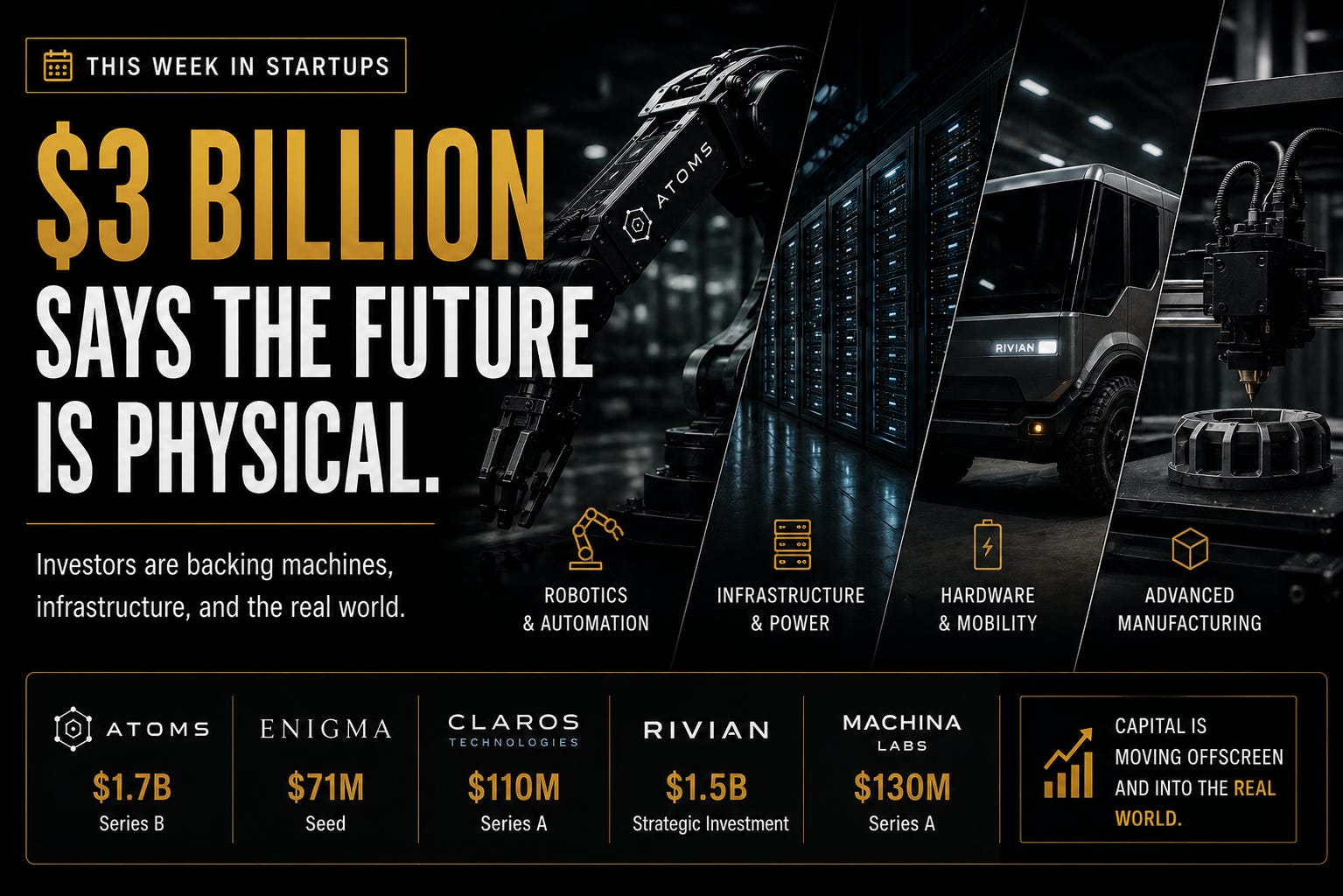
Here are the five that actually matter.
1. Atoms raised $1.7 billion to automate the physical world
Travis Kalanick is back. His industrial AI company, Atoms, closed a $1.7 billion round led by Andreessen Horowitz, with Ben Horowitz joining the board and, in a plot twist, Uber joining as an investor nine years after pushing Kalanick out. Per TechCrunch, the round did not disclose a valuation. Atoms merges CloudKitchens and the automation firm Pronto into three divisions, food, mining, and transport, all aimed at automating heavy industry.
Spence’s take: When a16z writes a check this size before there’s a disclosed valuation, they aren’t buying a product. They’re buying a track record.
Here’s the model I keep coming back to on this one: Circle of Competence. Kalanick has a real, demonstrated edge in one specific thing, taking a messy physical industry and wrapping software around it. He did it to transportation at Uber and to food logistics at CloudKitchens, and the bet is that the same competence carries into mining and heavy transport. The contrarian read: circles of competence are narrower than the decks that sell them. “Digitize the physical world” sounds like one skill, but it might be three brutally hard problems wearing a single slogan. Proven edge in food delivery doesn’t automatically transfer to autonomous mining, so watch whether Atoms ships in one vertical before you believe it ships in all three.
2. Etched hit a $10.3 billion valuation for a chip that runs one thing
AI chip startup Etched closed a $300 million Series C led by Sequoia, with the company reporting a post-money valuation of roughly $10.3 billion. That’s double its December figure in about seven months, and the company says it’s the highest valuation Sequoia has ever led at Series C. The catch: Etched’s Sohu chip runs only transformer models, and the company reports more than $1 billion in booked orders. (A private valuation is a point-in-time snapshot set by investors, not a market price.)
Spence’s take: Betting everything on one architecture is either the sharpest move in the room or the most fragile. There’s no middle.
3. Antares raised $470 million to put reactors on military bases
Nuclear startup Antares closed a $470 million Series C, $370 million in equity and $100 million in debt, co-led by Paradigm and Caffeinated Capital, with Point72 Ventures participating. The company builds small modular reactors and, per its announcement, plans deployments to U.S. military installations by 2028. Per TechCrunch, investor appetite for advanced nuclear is being driven by the AI data center building boom and its enormous power demands.
Spence’s take: The AI story isn’t just chips and models. It’s who generates the electricity to run them.
4. Meshy raised nearly $400 million to turn text into 3D
Meshy closed a roughly $400 million Series B at a $1.5 billion valuation, which the company says is its first publicly disclosed valuation and the largest round yet in AI 3D generation. It turns a text prompt or a single image into a usable, printable 3D model in about a minute. The company reports annual recurring revenue growing about 12x year over year with more than 12 million registered users. (Company-reported metrics; the valuation is a time-sensitive snapshot.)
Spence’s take: Everyone funded text and image models. The teams quietly winning built for the dimension nobody was looking at.
5. Augustus became a $1 billion clearing bank with an actual charter
Augustus raised a $180 million Series B at a $1 billion valuation, led by Tiger Global. The interesting part isn’t the round. It’s that Augustus received conditional approval from the OCC for a U.S. national bank charter, one of only a handful granted since 2010 (conditional approval is not final authorization). The company provides dollar access to international fintechs and says it already processes billions for customers including the crypto exchange Kraken.
Spence’s take: In regulated markets, the license is the moat. Anyone can write code. Almost nobody can get the charter.
That last one is close to home. At /mkt, building in a regulated corner of finance, I’ve learned the hardest part isn’t the technology. It’s earning the right to operate inside the rules. Augustus is a reminder that regulatory approval, slow and painful as it is, can end up being the most defensible asset a company owns.
Next week
The AI power crunch gets the full deep-dive. Antares is one bet. Etched is another. I’m pulling the thread on why the two hottest categories in venture right now, silicon and electricity, are really the same story, and what that means for anyone building on top of AI. Paid subscribers get the whole breakdown.
If this was useful, share it with someone who builds things. And if you want the full toolkit of 50 mental models, you can grab my book, Mental Models: How to Think, Act, and Win, on Amazon right now.
Spence
This post is for informational purposes only and is not investment advice, a recommendation, or a solicitation to buy or sell any security or asset. Funding figures, valuations, and company metrics are as reported by the companies, their investors, or the cited outlets; private-company valuations are point-in-time snapshots that do not reflect public-market prices or predict future performance. References to digital assets and platforms that handle them are informational only; digital assets are volatile and carry risk of loss. Spencer Gareiss is CPO at /mkt; any mention of /mkt is illustrative and not a solicitation. Always do your own research and consult a licensed professional before making financial decisions.
If you want the mental models behind breakdowns like this, my book, Mental Models: How to Think, Act, and Win, is on Amazon now.


This post is for informational and educational purposes only. It is not investment advice, a recommendation, or a solicitation to buy or sell any security. Funding figures, revenue, and valuation are as reported by the company, regulatory filings, and named outlets; the ~$470M valuation is a reported, time-sensitive snapshot and not independently verified. Dhoni's individual investment amount was not disclosed. The /mkt reference is a structural illustration of building in regulated markets and is not an offer or solicitation. Past performance and third-party investment decisions do not indicate future results.