

Five rounds closed this week. Two were a billion dollars each. And not one of the headliners was a pure software company.
That’s the story. Capital that spent the last few years chasing apps and models is now chasing things that plug into the grid, come out of the ground, or run an operation that used to need a room full of people.
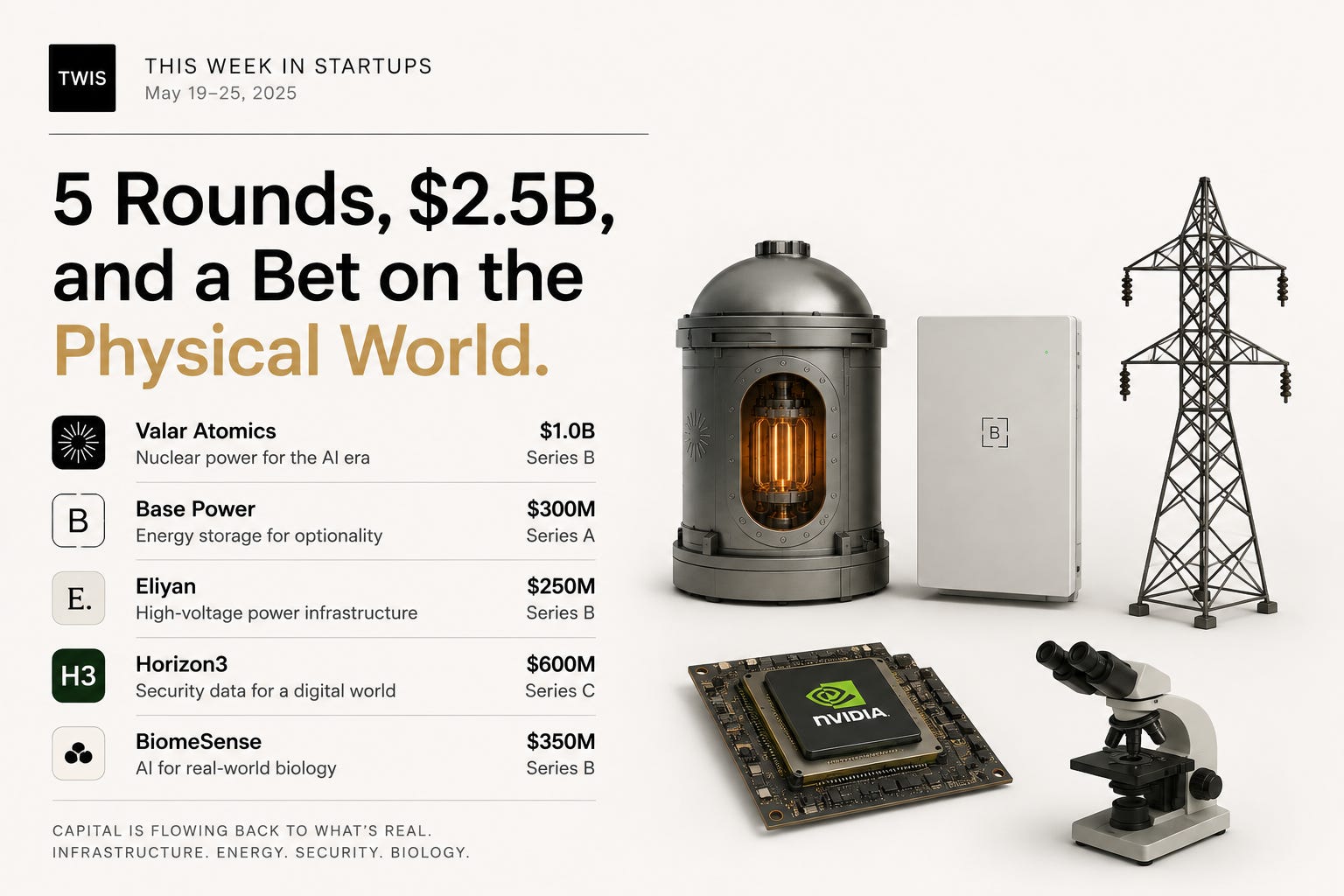
Here are the five that actually matter, with a hot take on each. Then I’ll go long on the one I’d circle.
1. Base Power — $1B Series D at a $13B valuation
Austin’s Base Power raised $1 billion in a Series D on August 3 at a $13 billion post-money valuation, its second billion-dollar round in about ten months, per the company. Ribbit, Addition, Valor Equity Partners, and JPMorganChase’s Strategic Investment Group led it, and Base says total funding now tops $2.5 billion. The same day, it started producing Base Core, a roughly 39 kWh home battery built at its Austin factory.
Spence’s take: Base isn’t selling batteries. It’s selling grid capacity one garage at a time and pricing it like infrastructure.
2. Valar Atomics — $1B Series B
Nuclear startup Valar Atomics announced a $1 billion Series B on August 3, led by Sequoia, plus a separate $200 million credit facility. The company didn’t disclose a valuation; Bloomberg reported it at $6 billion. Founder Isaiah Taylor, who started the company in 2023, is building small, factory-made reactors aimed at AI data centers, and says one of its reactors recently powered an Nvidia chip off a live fission reaction.
Spence’s take: When the pitch is “reactors as a product, not a construction project,” physics was never the hard part. The assembly line is.
3. Mariana Minerals — $310M Series B
Mariana Minerals raised $310 million on August 3, led by Khosla Ventures with a16z, Breakthrough Energy Ventures, and Mitsubishi joining, bringing total capital to roughly $400 million per the company. Fortune reported a $1.5 billion valuation. The plan: AI-run mines and refineries (copper in Utah, lithium in Texas) to cut U.S. dependence on foreign critical minerals.
Spence’s take: Mining is the least “software” business there is, which is exactly why software eating it would matter.
4. HappyRobot — $150M Series C at $1.2B
Madrid’s HappyRobot closed a $150 million Series C on August 4 at a $1.2 billion post-money valuation, led by Prysm Capital and co-led by Eurazeo. Founded in 2022, it says revenue is up 5x since its $44 million Series B late last year, with 150-plus enterprise customers including DHL, Uber Freight, and Kuehne+Nagel.
Spence’s take: The AI agents that win won’t be the ones that draft the email. They’ll be the ones that make the call and book the load.
5. Decade — $85M seed
Brazil’s Decade came out of stealth on August 4 with an $85 million seed, which the company calls the largest ever for a Latin American startup, backed by Greenoaks, Benchmark, and Diffusion. The founders, ex-Nubank CTO Vitor Olivier and Hyperplane’s Felipe Meneses, are building an AI-native wealth advisor that pairs every client with a senior human advisor plus software.
Spence’s take: An $85M seed for a pre-product company is a bet on the founders’ last ten years, not their next twelve months.
——————————————————————————————————————
The one I’d circle: Base Power
Here’s the mental model. Second-order thinking.
First-order read: home batteries are selling, so the company’s worth more. Second-order read: every battery Base installs becomes a node it can dispatch, so the fleet quietly turns into a power plant that grows without Base ever building one. That’s why a $13 billion price on what looks like a hardware company doesn’t read as crazy to its backers. They aren’t pricing battery margins. They’re pricing what a few hundred thousand coordinated batteries do to the grid.
And notice how Base makes money: selling power directly in retail-choice states like Texas, and in regulated markets handing utilities control of the batteries, who then pay for the access. That regulated-markets piece is the part most builders miss. The moat isn’t only the hardware. It’s the permission to operate. Companies that treat regulation as terrain to master rather than a wall to climb tend to compound quietest and longest. It’s the same reason we built /mkt inside Reg A+ instead of around it. When the rules are the hard part, clearing them is the advantage.
——————————————————————————————————————
Next week
Next week’s Startup Spotlight deep-dive goes long on one of these, and I’m leaning Valar Atomics: what “factory-built nuclear” actually has to prove before the valuation makes sense, and what the bull and bear cases look like from here. Paid subscribers get the full breakdown.
If this was useful, share it with someone who builds things. And if you want the full toolkit of 50 mental models, you can grab my book, Mental Models: How to Think, Act, and Win, on Amazon right now.
If you want the mental models behind breakdowns like this, my book, Mental Models: How to Think, Act, and Win, is on Amazon now.


This post is for informational and educational purposes only. It is not investment advice, a recommendation, or a solicitation to buy or sell any security. Funding figures, revenue, and valuation are as reported by the company, regulatory filings, and named outlets; the ~$470M valuation is a reported, time-sensitive snapshot and not independently verified. Dhoni's individual investment amount was not disclosed. The /mkt reference is a structural illustration of building in regulated markets and is not an offer or solicitation. Past performance and third-party investment decisions do not indicate future results.