


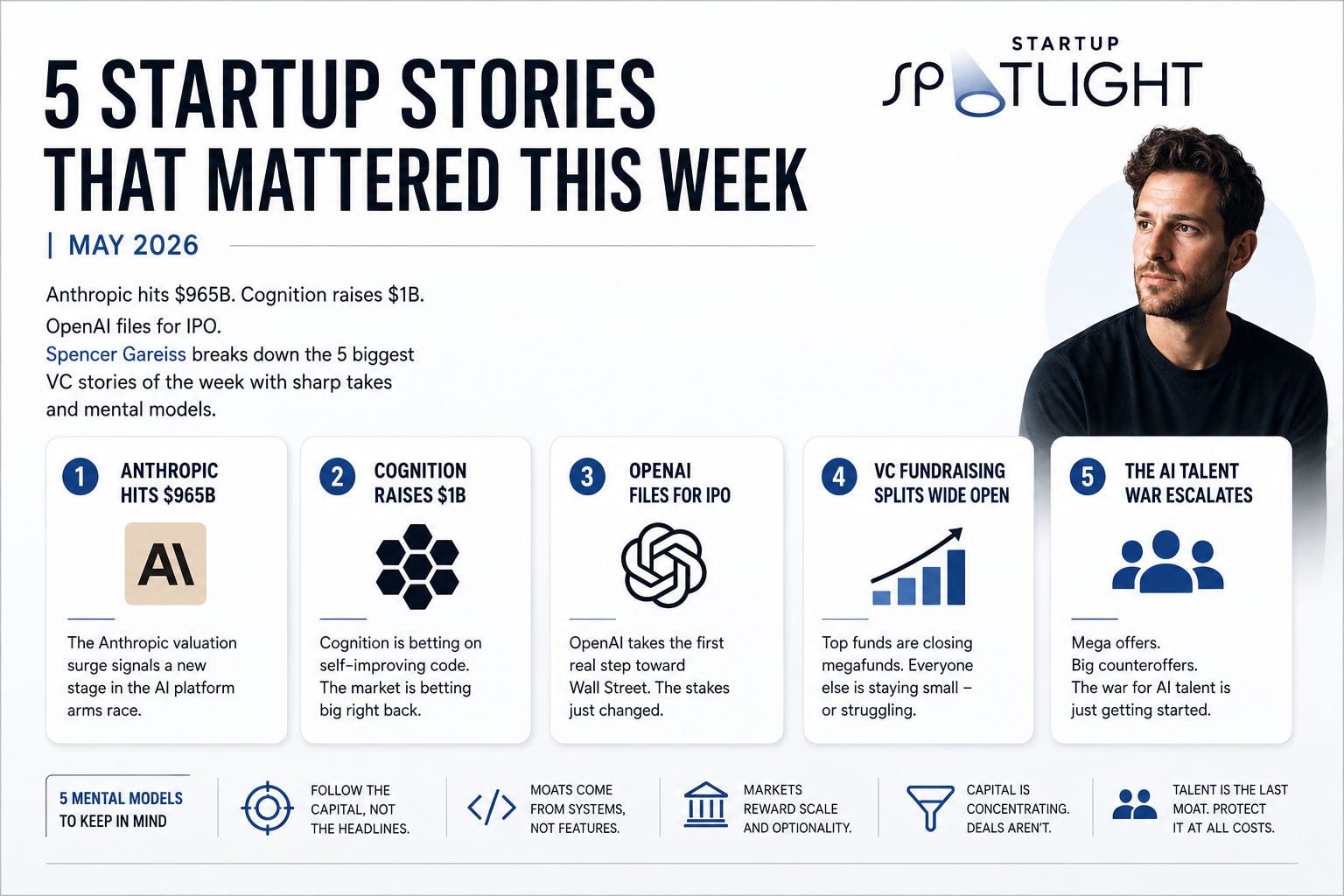
It was a week where “unicorn” felt quaint. A $965B private company. A $26B coding agent. A $1.3B model router that barely existed two years ago. Meanwhile, defense tech doubled down and the world’s most valuable startup filed for its IPO. Let’s get into it.
Story #1: Anthropic Raises $65B at a $965B Valuation — And Laps OpenAI
The headline: Anthropic closed a $65B Series H on May 28, led by Altimeter, Sequoia, Greenoaks, and Dragoneer, at a $965B post-money valuation. That’s the largest private fundraise in history, and it puts Anthropic above OpenAI’s $852B mark. The company’s run-rate revenue crossed $47B this month — up from $10B just a year ago. The round is widely expected to be Anthropic’s last before an IPO targeting fall 2026.
Spencer’s take: When a safety-first AI lab spins faster than every traditional software company in history, you have to ask what “moving carefully” actually means at this scale. The $47B run-rate isn’t just a vanity number — it means the enterprise is actually buying, not just piloting.
Mental Model Deep-Dive: Second-Order Thinking
Most people look at Anthropic’s $965B valuation and react to the number. That’s first-order thinking. The second-order question is: what does it mean that a company with a genuine constitutional commitment to safety is now the most valuable private company on Earth?
It means safety is no longer a soft differentiator — it’s becoming a procurement requirement. Enterprises buying AI at scale need auditability, predictability, and trust. Anthropic built a product that enterprise legal and compliance teams could actually approve. That’s not a coincidence; it’s a strategy.
And third-order: if safety is now a competitive moat, what does that mean for every other AI company that skipped it? The market just priced in an answer.
(Full disclosure: I build on Claude at /mkt. I’m not a disinterested observer here — but the numbers speak for themselves.)
Story #2: Cognition Raises $1B at $26B — Devin Is Writing 89% of Their Own Code
The headline: Cognition, the maker of AI software engineer Devin, raised over $1B at a $26B post-money valuation on May 27, led by Lux Capital, General Catalyst, and 8VC. That’s a 2.5x jump from its $10.2B valuation in September 2025. The buried stat: 89% of all production code committed at Cognition is now written by Devin itself. ARR is running at $492M, growing 50% month-over-month for six consecutive months. Enterprise customers include Goldman Sachs, Citi, Mercedes-Benz, and the U.S. military.
Spencer’s take: When the product is eating its own dog food at 89%, that’s not a demo stat, that’s a proof-of-concept for the whole thesis. Every engineering org watching this round should be running the numbers on their own headcount assumptions.
Story #3: OpenRouter Hits Unicorn Status — $113M at $1.3B, Processing 100 Trillion Tokens a Month
The headline: OpenRouter raised a $113M Series B on May 26, led by Alphabet’s CapitalG, at a $1.3B valuation more than double its $547M valuation from just a year ago. The platform routes requests across 400+ AI models through a single API and now processes 25 trillion tokens per week (100 trillion monthly), a 5x increase in six months. Strategic investors include NVIDIA Ventures, Databricks Ventures, Snowflake Ventures, and ServiceNow.
Spencer’s take: Nobody’s talking about this enough. OpenRouter is the exchange layer for AI inference. When every enterprise wants multi-model flexibility and vendor lock-in avoidance, the traffic router becomes critical infrastructure. Alphabet investing in the layer that routes to its competitors is a tell they’d rather own the toll road than lose the car.
Story #4: OpenAI Files Confidential IPO, Targets $1 Trillion Valuation by Fall
The headline: OpenAI confidentially filed its S-1 with the SEC on May 22, working with Goldman Sachs and Morgan Stanley toward a public debut as early as September 2026. The company is targeting a valuation above $1 trillion. Current private market valuation sits around $852B. One complication getting glossed over: the company reportedly lost $1.22 for every $1 of revenue in Q1 2026.
Spencer’s take: The IPO will be the most scrutinized S-1 since Facebook. Public investors don’t do vibes, they do multiples. When those unit economics become public, the narrative gets a lot harder to control. Watch for how they frame the compute cost trajectory.
Story #5: Anduril Doubles Valuation to $61B After $5B Raise — Defense Tech Becomes a Real Asset Class
The headline: On May 13, Anduril closed a $5B Series H led by Thrive Capital and a16z, doubling its valuation to $61B from $30.5B less than a year ago. Revenue more than doubled to $2.2B in 2025. The company is building autonomous aircraft, drones, missile systems, and AI-powered command-and-control platforms and now has a maritime operation building autonomous naval vessels in Seattle.
Spencer’s take: Palmer Luckey built Oculus and sold to Facebook for $2B. Then he built a defense company that’s worth $61B private and accelerating. The lesson isn’t “pivot to defense.” It’s that founder-led companies with genuine technical differentiation, patience, and a long-time-horizon customer (the government) can build something that traditional primes can’t match on speed. This is what it looks like when venture capital meets the actual defense industrial base.
The Pattern This Week
Capital isn’t spreading thin across every AI startup, it’s concentrating in companies with real revenue, enterprise traction, and defensible infrastructure positions. OpenRouter owns the routing layer. Cognition owns the autonomous engineer. Anthropic owns enterprise trust. The hype cycle ended. The scaling cycle started.
For builders in regulated markets, fintech, defense, healthcare this is the right environment. Compliance friction isn’t a moat until it’s priced in. Then it’s everything. At /mkt, we’ve lived this: Reg A+ isn’t the easy path to athlete tokenization, it’s the credible one.
Next Week on Startup Spotlight
We’re going deep on one question: Is the OpenAI IPO the moment public markets finally have to price AI unit economics honestly? I’ll break down what’s in the S-1 when it drops, what to watch in the roadshow, and the one number that will tell you everything. Don’t miss it.