


Venture funding just hit a record $510 billion. If your fundraise still feels like pulling teeth, you’re not imagining it. You’re just not one of two companies.
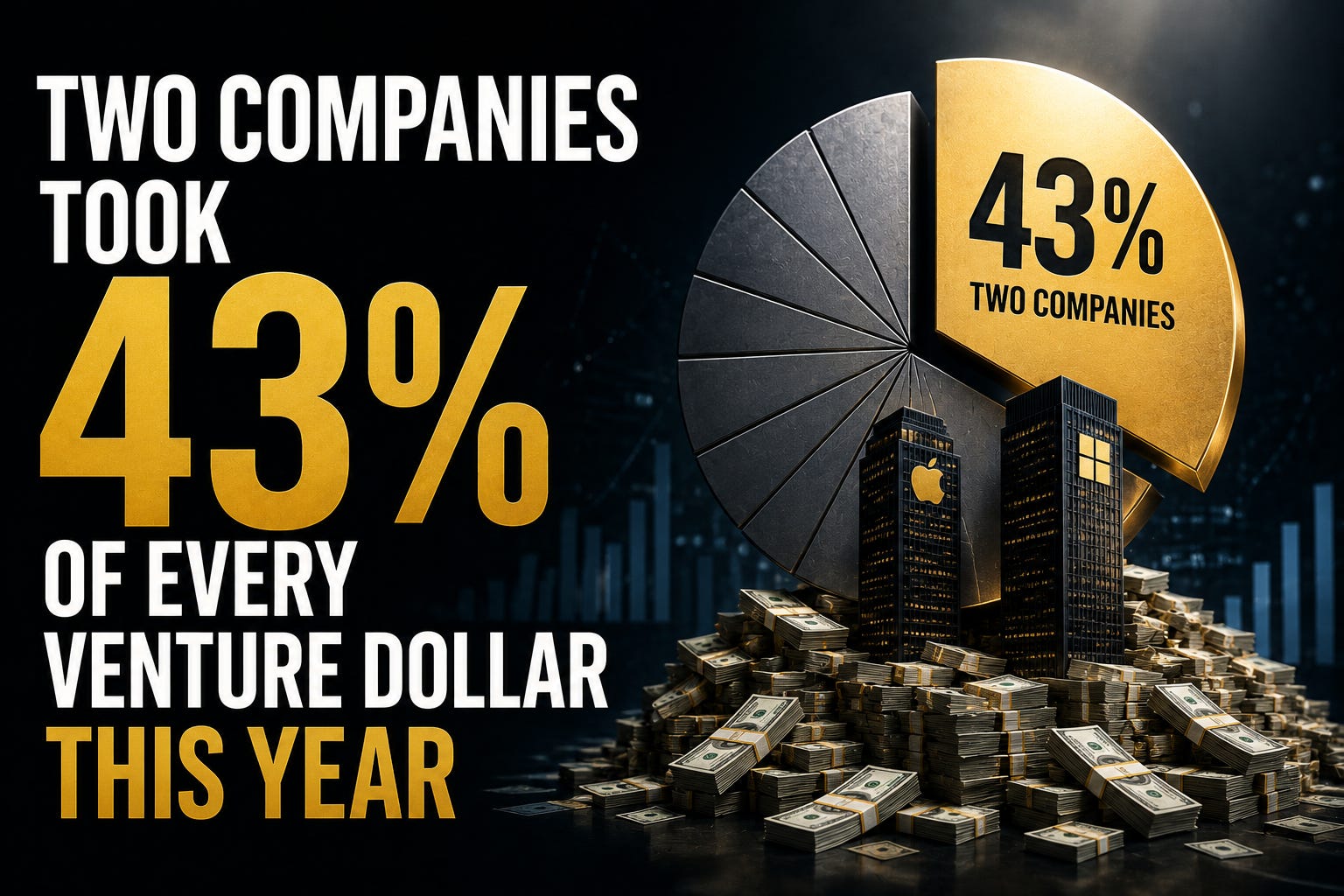
Per Crunchbase, global venture funding reached a record $510 billion in the first half of 2026, more than all of 2025 combined. Sounds like the good times are back. Then look closer. OpenAI and Anthropic alone pulled in $217 billion, roughly 43% of every venture dollar raised on Earth this year. Anthropic raised $65 billion in a single quarter and became the most valuable private company on the Crunchbase board. Sixteen companies raised billion-dollar rounds in Q2, and those 16 soaked up 53% of the entire quarter’s funding. More than 70% of Q2 capital went to AI, and nearly 88% of that AI money went to US companies.
The mental model: Power Law.
In venture, returns have always followed a power law. A tiny number of investments return the whole fund while most return close to nothing. What’s new in 2026 is that the funding itself has gone power-law. It isn’t spread across thousands of startups. It’s piling into a handful, and the average buries that fact completely.
When you read “$510 billion, record year,” your brain hears “money is everywhere.” The distribution says the opposite. Capital is concentrated in fewer hands than maybe ever, and the headline is the arithmetic mean of a room where two people are billionaires and everyone else is checking their bank balance.
That’s the trap for founders: benchmarking against the aggregate. There is no average dollar to raise. If you’re not on the fat end of the curve, the record number is noise, and treating it as signal will push you to raise wrong, price wrong, and burn wrong.
Power laws aren’t just a venture quirk, either. They run straight through the athlete economies we build markets around at /mkt. A small share of names capture most of the attention and value. Designing anything in that world means building for the curve as it actually is, not the flattering average the headline gives you.
Here’s the take. A record funding year and a punishing fundraising market are both true at the same time, and only the power law explains how. So stop reading the aggregate like a weather report for your own raise. Either build something with a real shot at the fat tail, or build a business that never needs the tail at all: revenue, actual customers, a moat you can point to.
The founders who win the next two years won’t be the ones who believed the $510 billion headline. They’ll be the ones who understood it.
Disclaimer: This post is for informational and educational purposes only. It is not investment, financial, legal, or tax advice, and it’s not a recommendation or solicitation to buy, sell, or trade any security, contract, or instrument, or to participate in any prediction market. Valuations, volumes, and funding figures reflect public reporting and third-party estimates that vary by source and change over time; past performance and private valuations are not indicative of future results. Regulatory status referenced here is described generally and is subject to ongoing litigation and change. /mkt is referenced only to illustrate how regulated-market infrastructure is built, and nothing here is an offer or solicitation with respect to any security.
If you want the mental models behind breakdowns like this, my book, Mental Models: How to Think, Act, and Win, is on Amazon now.


Startup Spotlight is for informational and educational purposes only. It is not investment advice, an offer, or a solicitation to buy or sell any security. Company metrics are self-reported, and funding details are drawn from public reporting and company statements. Figures may change.