

Two months ago, a three-year-old startup pointed a small nuclear reactor at an Nvidia chip and switched it on. On Monday, Sequoia paid a billion dollars to do it at scale.
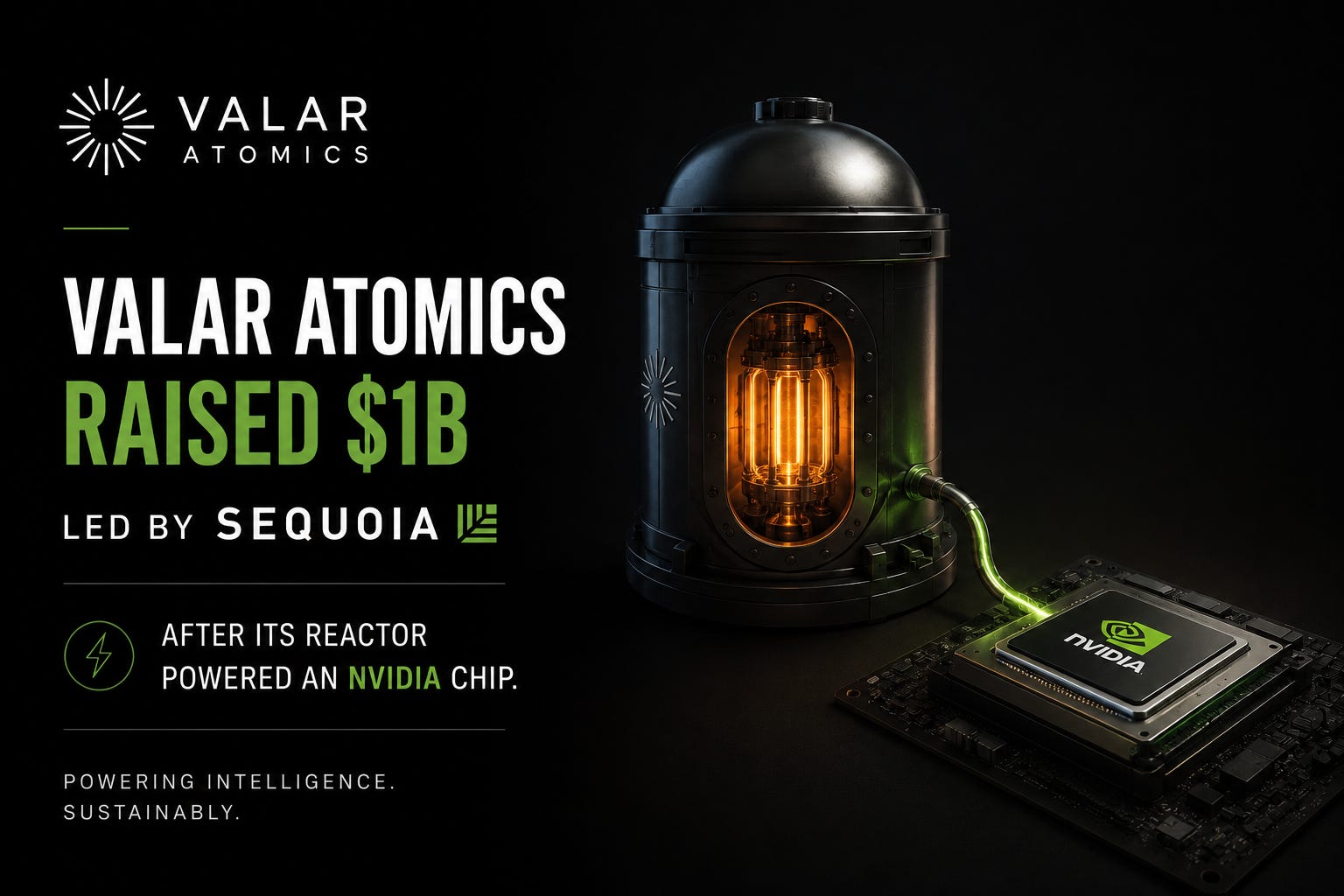
Valar Atomics closed a $1 billion Series B led by Sequoia Capital, with partner Shaun Maguire joining the board, alongside a separate $200 million credit facility (Erebor Bank and J.P. Morgan, per reporting). That’s $1.2 billion in fresh financing for a company that didn’t exist three years ago. Bloomberg reported the round valued Valar at roughly $6 billion; the company didn’t confirm the figure, so treat it as reported, not stated. Even so, it’s about triple the $2 billion valuation Valar carried after its roughly $450 million round back in April.
The trigger was a July milestone. Valar’s Ward 250 reactor became the first in US history to power an Nvidia AI chip directly off a fission reaction, one of only four companies to start a self-sustaining chain reaction this year, per reporting. Valar and Nvidia are now planning a 30-megawatt, waterless, nuclear-powered AI facility in Utah.
So why is a nuclear company suddenly priced like software? One mental model explains the whole thing.
Theory of Constraints. Every system has exactly one binding constraint at a time, and improving anything other than that constraint is wasted motion. For three years, the industry treated compute as the constraint: buy more GPUs, win. But you can’t run a GPU you can’t plug in. S&P Global estimates the industry wants to bring roughly 50 gigawatts of US data centers online over the next three years, and that only about half of that can actually connect to the grid. Interconnection queues run six to ten years. PJM’s capacity prices jumped 833% in a single delivery cycle. The constraint moved. It’s electrons now, and Sequoia’s billion dollars is a bet on who owns the one input everyone else is short on.
Here’s what most people are reading wrong. The headline isn’t “nuclear is back.” It’s that a chipmaker is now underwriting reactors, because the fastest way to sell more chips is to manufacture the power to run them. Silicon and electricity stopped being two separate industries the moment a reactor lit up a Blackwell.
The risk is exactly as real as the thesis. Valar still operates under a Department of Energy pilot authorization and needs a full Nuclear Regulatory Commission license before it can sell a single commercial kilowatt-hour. A $6 billion price assumes it clears a regulatory gap that has humbled better-funded reactor companies. That’s priced-in perfection meeting one of the slowest approval processes in American industry. If you want to track one thing, track the licensing timeline, not the physics.
The physics already worked. The question a billion dollars just asked is whether the paperwork can move at the speed of an AI roadmap.
If this was useful, share it with someone who builds things. And if you want the full toolkit of 50 mental models, you can grab my book, Mental Models: How to Think, Act, and Win, on Amazon right now.
Spence
This post is for informational and educational purposes only and is not investment advice, a recommendation, or a solicitation to buy or sell any security or asset. Funding figures and financing terms are as reported by the company, its investors, or the cited outlets. Valar Atomics’ valuation is attributed to Bloomberg’s reporting and was not confirmed by the company; it is a point-in-time, private-company figure that does not reflect public-market prices or predict future performance. Regulatory status is as reported and subject to change. Always do your own research and consult a licensed professional before making financial decisions.
