



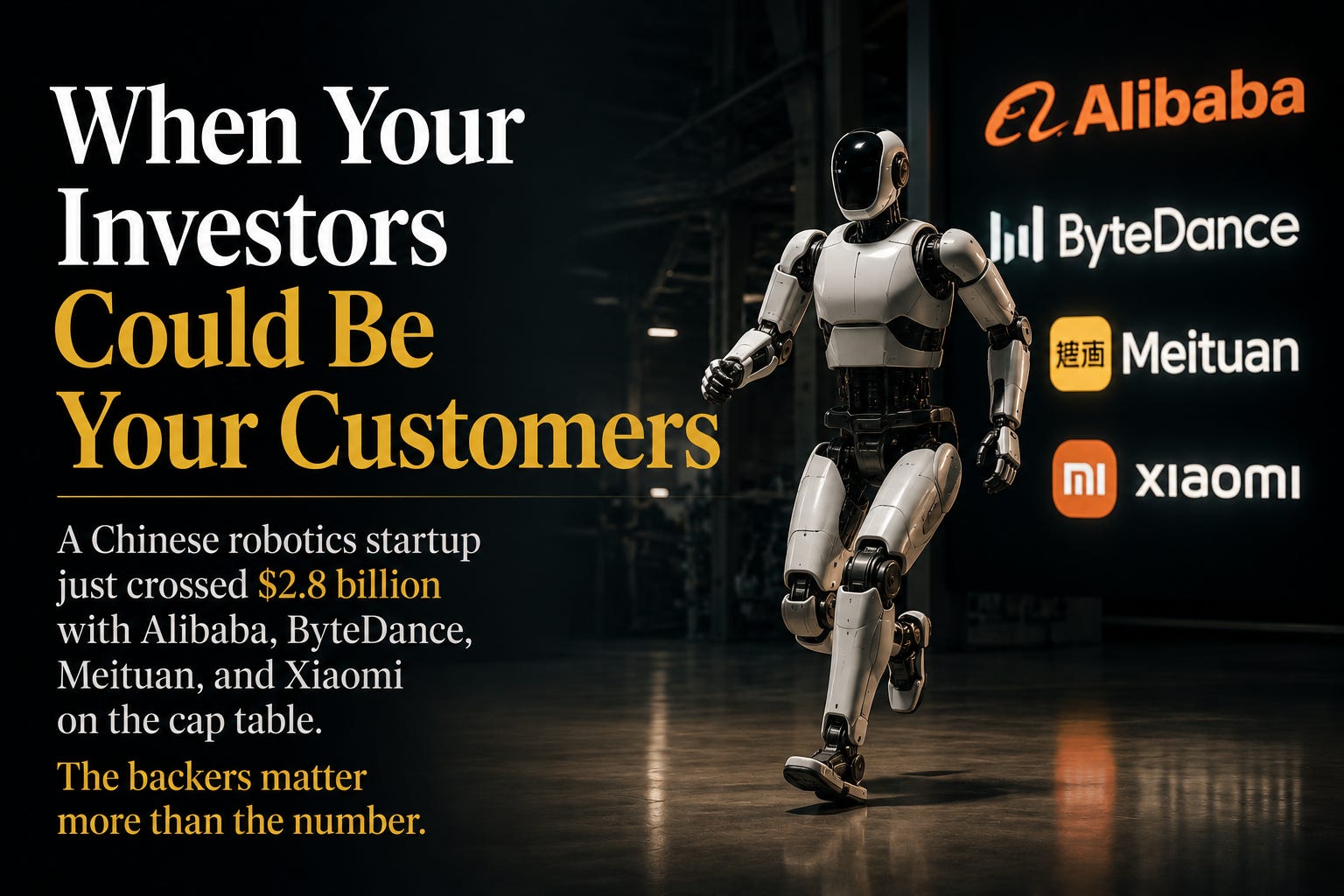
A Chinese robotics company you’ve probably never heard of just crossed a $2.8 billion valuation. X Square Robot closed its Series C this week, its fourth round in quick succession, to build embodied AI foundation models, the software that lets robots act in the physical world. The company didn’t disclose how much it raised. The more interesting disclosure was who wrote the checks.
Across its rounds, X Square has been backed by Meituan, Alibaba, ByteDance, and Xiaomi, four of the largest technology companies in China, with IDG and HongShan in the mix too. That’s not a normal cap table. It’s a who’s-who of companies that run delivery fleets, warehouses, manufacturing lines, and consumer hardware businesses. Once you see that, the valuation stops being the headline.
The mental model: Skin in the Game
Nassim Taleb’s idea is that you learn the most from people who bear the consequences of their own decisions. Talk is cheap. A bet where the bettor eats the downside is information.
Apply it to that cap table. A pure financial VC backing a robotics startup is making one bet: that the equity goes up. But Meituan, Alibaba, and Xiaomi aren’t pure financial bettors here. They’re potential deployers. If embodied AI works, it goes into Meituan’s delivery logistics, Alibaba’s warehouses, Xiaomi’s factories and product lines. They’ve got skin in the game twice over, as investors and as operators who’d have to run the thing. When a company that would have to live with the product puts money in, that’s a louder signal than a term sheet from someone who just wants the markup.
Here’s the catch, because skin in the game cuts both ways. Strategic money carries strategic motives. Some of those checks are conviction. Some are defense, paying to keep a rival from owning the category. And for the founder, four giant backers who also compete with each other is its own problem. Whose strategic interest wins when they diverge? The model doesn’t say “strategic capital is good.” It says read what each backer actually risks and actually gains, then weigh the signal accordingly.
Spence’s take
The lazy read of this round is “$2.8 billion, robots are hot.” The useful read is the cap table. In a frothy market, the valuation is the noisiest number on the page. Who’s funding it, and what they stand to lose if they’re wrong, tells you far more than the headline does.
It’s part of why disclosure-based markets matter. Rules that force stakes into the open turn skin in the game from a guessing game into a fact you can check. That’s the logic /mkt builds on, working in regulated markets on Reg A+ with tZERO’s infrastructure, where who holds what runs through a compliance framework rather than rumor.
So when you size up a deal, a partnership, or a hire, find the skin in the game. The one who eats the downside is the one whose conviction means something. Everyone else is just talking.
If this was useful, share it with someone who builds things. And if you want the full toolkit of 50 mental models, you can grab my book, Mental Models: How to Think, Act, and Win, right now.


Startup Spotlight is for informational and educational purposes only. It is not investment advice, an offer, or a solicitation to buy or sell any security. Company metrics are self-reported, and funding details are drawn from public reporting and company statements. Figures may change.