

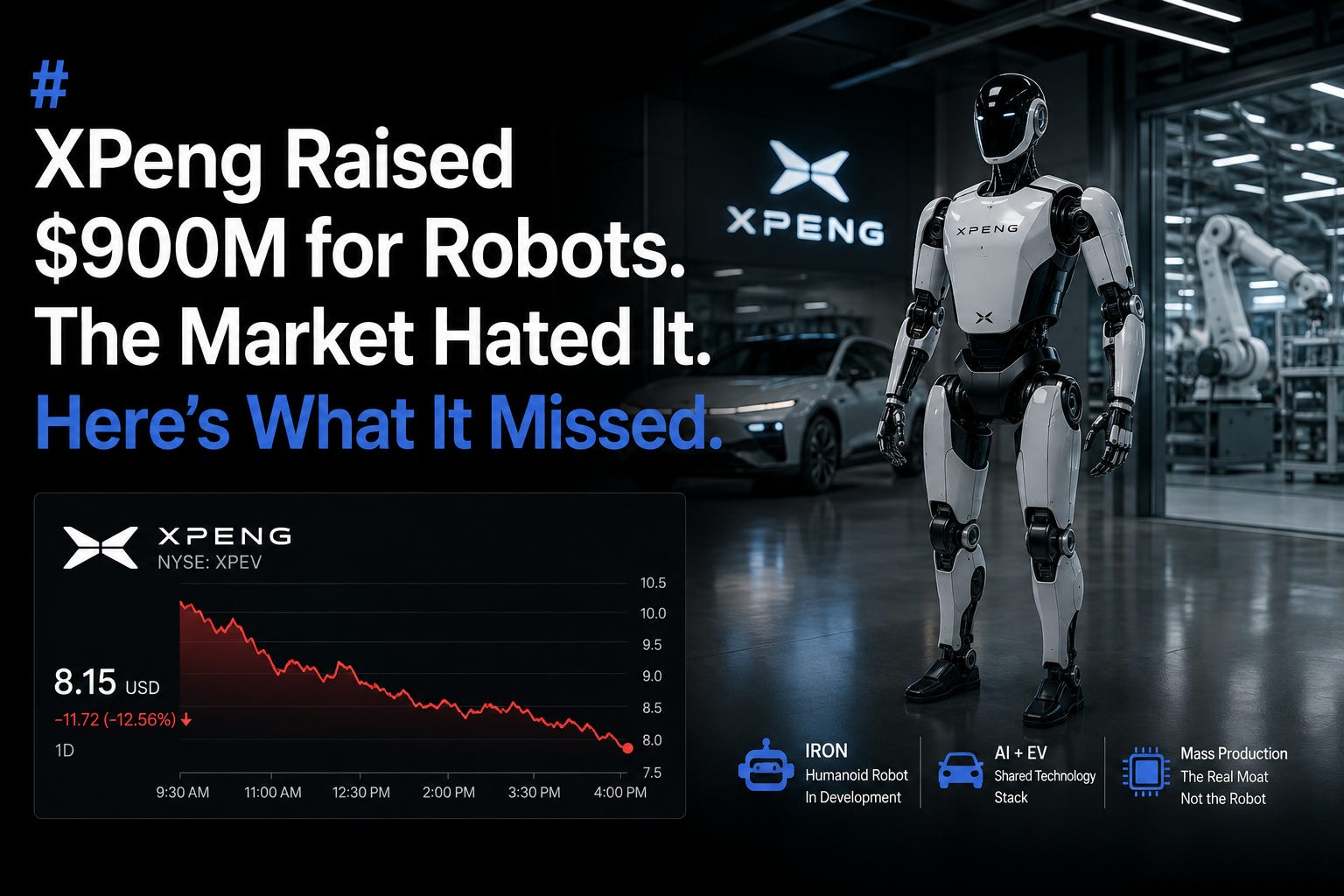
A car company just raised almost a billion dollars for a robot business that hasn’t sold a single robot. The same day, that car company’s stock fell almost 7 percent. If those two facts feel like they cancel each other out, you’re reading it first-order.
Here’s what happened. On August 24, XPeng announced that its robotics unit had signed share-purchase agreements to raise more than $900 million, at a post-money valuation of more than $6.3 billion, roughly 43 billion yuan. XPeng calls it the largest single-round private financing in the history of China’s embodied-AI sector, so treat “largest ever” as the company’s claim. IDG Capital led it. Gaorong Ventures joined, with Tencent and Alibaba as strategic backers. Bloomberg reported the money splits roughly into $200 million from XPeng itself, about $600 million from outside investors, and around $100 million from senior executives writing their own checks.
The robot in question is IRON, XPeng’s humanoid. Mass production is targeted for the end of 2026, first inside XPeng’s own stores and campuses, then a wider launch in 2027. XPeng keeps control of the unit, holding roughly 82 percent and consolidating it on the group’s books. CEO He Xiaopeng is running the robotics business himself.
And the stock? It dropped about 6.8 percent that day, partly because second-quarter results landed at the same time: a wider net loss and light third-quarter guidance. So the market got two messages at once and picked the gloomy one.
Here’s the model I’d use to read this: second-order thinking.
First-order thinking stops at the immediate consequence. Robots don’t ship yet, the parent is losing money, this raise means dilution and distraction, so sell. All true, all shallow.
Second-order thinking asks what happens next, and after that. What XPeng actually did was carve its robotics arm into a separately capitalized entity with its own cap table, its own investors, and a public price tag that didn’t exist 48 hours earlier. It funded a capital-hungry, high-risk bet with mostly outside money, put executive skin in the game of about $100 million, and kept the core EV business from absorbing the burn. The quarter got priced by the market. The decade got priced by the round.
My contrarian take: the move that looks like financial engineering is also a discipline mechanism. A standalone company with its own valuation has to earn its next round on its own results. That’s much harder to bury inside a parent’s income statement than a line item labeled “R&D.” Whether IRON hits its timeline is a real question, and humanoid timelines slip more often than they hold. But “distraction” and “smart structuring” aren’t opposites here. Sometimes the same decision is both, and the stock chart only tells you how the crowd felt for one afternoon.
The lesson for builders isn’t “spin everything out.” It’s this: when you’re funding a long bet, structure decides who carries the risk and who’s forced to prove it. Get that right and a scary line item becomes a priced option. Get it wrong and it’s just burn.
If this was useful, share it with someone who builds things. And if you want the full toolkit of 50 mental models, you can grab my book, Mental Models: How to Think, Act, and Win, on Amazon right now.
Disclaimer: This newsletter is for informational and educational purposes only. It is not investment, financial, legal, or tax advice, and it is not a recommendation or solicitation to buy or sell any security. Funding figures, valuations, and investor details reflect company announcements and third-party reporting (including PRNewswire and Bloomberg) around August 24, 2026, are point-in-time, and may change. XPeng’s description of the round as a record, and the $6.3 billion valuation, are company-reported. Do your own research and consult a licensed professional before making any financial decision.
If you want the mental models behind breakdowns like this, my book, Mental Models: How to Think, Act, and Win, is on Amazon now.


This post is for informational and educational purposes only. It is not investment advice, a recommendation, or a solicitation to buy or sell any security. Funding figures, revenue, and valuation are as reported by the company, regulatory filings, and named outlets; the ~$470M valuation is a reported, time-sensitive snapshot and not independently verified. Dhoni's individual investment amount was not disclosed. The /mkt reference is a structural illustration of building in regulated markets and is not an offer or solicitation. Past performance and third-party investment decisions do not indicate future results.