


While the funding headlines this month belong to billion-dollar AI and defense rounds, one of the sharpest strategic stories is a $40 million check into stablecoin plumbing for emerging markets. It's worth your attention: it's a clinic in how you build a moat in a regulated business, and a warning about how fast that moat erodes.
Company Overview
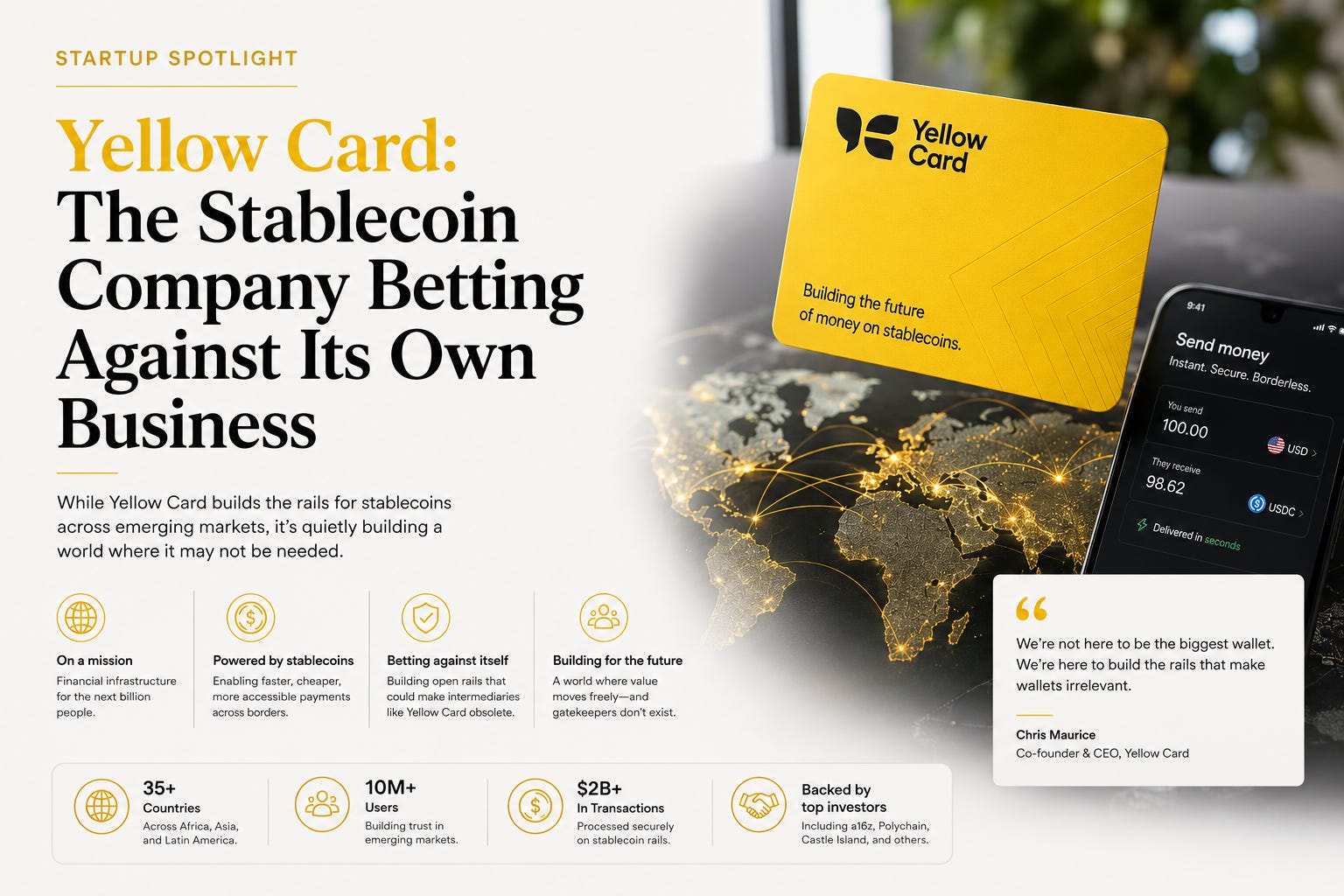
In plain English, Yellow Card lets a business hold US dollars, swap between stablecoins, and pay or collect money across borders without waiting three to five days for a wire or bleeding margin to correspondent banks. Its flagship product, Global USD Accounts, gives a company a dollar account that can hold and move stablecoins, manage treasury, and make and collect payments in more than 50 currencies across more than 50 countries. Think of it as the rails that move dollars into and out of markets where dollars are hard to get and slow to move.
On August 4, 2026, Yellow Card closed a $40 million strategic funding round led by SC Ventures, the innovation and investment arm of Standard Chartered, with participation from Sony Innovation Fund, Polychain Capital, and Blockchain Capital. That brings total equity financing past $120 million. The prior rounds were a $40 million Series B in 2022 and a $33 million Series C in October 2024. This is a company that has raised deliberately, not explosively.
The founding team matters here. CEO Chris Maurice and CTO Justin Poiroux started Yellow Card in 2016 and launched commercially in Nigeria in 2019 as a retail crypto exchange built to simplify cross-border payments across Africa. By 2022 they’d reached 16 African countries and claimed more than one million customers. Then, in late 2025, they did the hard thing: they walked away from the retail app that made their name and pivoted entirely to B2B infrastructure. Today the company reports licenses, authorizations, and registrations to operate in more than 20 jurisdictions across North America, Europe, and Africa, and network volume that has passed $10 billion, up from roughly $6 billion earlier in 2026. Named users of its infrastructure reportedly include large payment and financial-services players.
The Market
Start with the size of the problem. The global cross-border payments market processed roughly $190 trillion in transaction value in 2023, per industry data cited by Alphapoint. B2B flows, supplier payments, invoicing, payroll, and wholesale trade, account for around $10 trillion of that annually and are widely projected to become the largest cross-border category by 2030.
Now the friction. Most of that money still rides infrastructure designed in the 1970s. Swift wires often take three to five business days. Correspondent bank fees and FX markups can eat 2% to 7% of a transfer. In markets like Nigeria, Kenya, or across Latin America, dollar scarcity and volatility turn those inefficiencies into a daily operational tax.
Stablecoins are the technical fix, and adoption is real but early. McKinsey and Artemis Analytics pegged genuine stablecoin payment activity, stripping out trading and automated transfers, at about $390 billion in 2025, more than double 2024. B2B payments made up roughly $226 billion of that and grew 733% year over year. Total stablecoin supply crossed $300 billion, up from under $30 billion in 2020, and the US Treasury Secretary has publicly floated supply reaching $3 trillion by 2030.
Here’s the number that keeps me honest, and that you should hold onto: despite all of that, stablecoins remain roughly 1% of global payment flows, the same share reported in 2023 and 2024. Both stories are true at once: explosive absolute growth, and a tiny slice of the total. That’s not a contradiction. It’s the definition of early.
The timing case rests on regulation, not technology. The US GENIUS Act, the EU’s MiCA framework, and Hong Kong’s regime all moved stablecoins from legal gray zone to licensed activity across 2025 and 2026. That’s what turns a Standard Chartered venture arm from a spectator into a lead investor. And the geographic case is specific: in Latin America, an estimated 71% of stablecoin activity is already tied to cross-border payments, the highest share in the world. Yellow Card built its muscles in exactly this kind of market. Now it’s pointing them at LatAm and Asia Pacific.
Business Model and Moat
Yellow Card makes money the way infrastructure companies do: fees and spread on the flows it moves, plus account and treasury services layered on Global USD Accounts. The details of its take rate aren’t public, and I won’t guess at them. What I can tell you is where the durable advantage sits, and it isn’t the blockchain.
The blockchain part is commodity. Anyone can move USDC on a public network. The hard, slow, expensive part is the last mile: licenses to operate legally in each country, and local fiat rails to actually convert stablecoins into naira, or pesos, or rand, and back, at scale, without breaking a rule. Yellow Card’s stack of authorizations across more than 20 jurisdictions, paired with deep local payment rails, is the real barrier. A rival with better code still has to spend years assembling the same license map. That’s the moat.
The competition is stacked and getting stronger. On one side you’ve got crypto-native infrastructure players and stablecoin issuers. On another, big processors and banks are building their own rails. And on a third, Swift itself is upgrading. Yellow Card’s answer is to be the neutral, licensed, regulatory-first layer that any of them can plug into rather than rebuild. Standard Chartered’s venture arm leading this round is a signal that at least one global bank would rather partner than build the emerging-market license stack from scratch.
Spence’s Take
Two mental models from the book do the heavy lifting here.
The first is Disruption Theory, specifically new-market disruption. Clayton Christensen’s insight was that the most dangerous competitors don’t attack incumbents head-on. They start where the incumbent doesn’t care to serve, get good there, then move up. Yellow Card is a near-textbook case. It didn’t launch in New York trying to out-Swift Swift. It launched in Nigeria, in corridors the big banks treat as afterthoughts, solved a painful problem for people the incumbents ignored, and built licensing and rails as it went. Now it’s carrying that capability up-market toward LatAm, APAC, and, eventually, connecting banks directly. Incumbents rarely see this coming because the early market looks too small to bother with. That’s the trap, and it’s the bull case.
The second model is Commoditize Your Complement. The strategic move here is to make the thing next to you cheap so demand for your thing goes up. Yellow Card is commoditizing the correspondent-banking layer, driving the cost and delay of moving dollars toward zero. Great, unless you follow the logic all the way down. Because if moving dollars becomes free and instant, the value of being a middleman in that flow also trends toward zero. And Maurice said the quiet part out loud: he expects a near future where payments flow directly between banks on-chain, “without B2B payments companies or other payment service companies in the flow at all.” Read that twice. The CEO just described the endgame where his own category gets disintermediated. That’s not a gaffe. It’s clear-eyed. But it tells you exactly where the risk lives.
This is where building in regulated markets becomes the whole game, and it’s a pattern I see up close. At /mkt, where I’m CPO, the athlete-tokenization products run on a Reg A+ framework with tZERO as the trading infrastructure. The regulatory and licensing scaffolding is the slow, unglamorous, expensive part, and that’s precisely why it’s defensible. Same logic as Yellow Card: in regulated finance, the paperwork nobody wants to do is often the moat. Code gets copied in a weekend. A license map takes years.
So the bull case: Yellow Card becomes the licensed, neutral rails that banks and fintechs rent instead of build, the picks-and-shovels play for the emerging-market stablecoin era, validated by a strategic backer with skin in the game. The bear case: banks internalize the capability, stablecoin transfers commoditize the margin away, a key market reverses its regulatory stance, or a better-capitalized rival buys the license map faster. All of those are live. The disintermediation clock started the day the round closed.
Why It Matters
For investors and VCs. This is a deal worth watching, not for the round size but for the investor composition. A global bank’s venture arm and a Japanese conglomerate’s fund carry different mandates than the crypto-native money that backed every prior Yellow Card round. That shift is the signal. If you’re tracking the company, watch network volume (it’s moved from about $6 billion to past $10 billion this year), the count and caliber of bank partnerships, license additions in LatAm and APAC, and, most of all, whether take rate holds as volume scales. None of this is a recommendation. It’s a scorecard.
For potential customers. If you’re a CFO, treasurer, importer, exporter, fintech, or bank operating in or into emerging markets, the product coming your way is a dollar account that settles in minutes instead of days, holds and swaps stablecoins, and pays out in local currency across 50-plus countries. The problem it targets is concrete: dollar scarcity, multi-day settlement, and 2% to 7% FX and correspondent friction. If those are line items on your P&L, this is a category to pilot carefully, with your compliance team in the room.
For competitors and builders. The lesson is uncomfortable if you’re a pure technologist: regulatory licensing and local fiat rails beat clever code. Yellow Card’s edge is the boring, hard, regulated layer, not the chain. If you’re building in payments, go get the licenses and the last-mile rails while everyone else demos throughput. And heed Maurice’s own warning: own the customer relationship, not just the pipe, because the pipe is what gets commoditized. The builders who survive disintermediation become a system of record, not just a router.
The Bottom Line
Yellow Card is a disciplined, regulatory-first infrastructure company attacking a massive and genuinely broken market from the edge inward, with a moat made of licenses rather than code. The bull case is that it becomes the neutral rails everyone rents; the bear case is the one its own CEO named, a future where banks route around the middle. Watch whether the moat compounds faster than the disintermediation clock ticks.
This is Startup Spotlight. Every week I break down a company worth watching. Subscribe for $7.99/mo to get the full analysis.
This post is for informational and educational purposes only and is not investment advice, a recommendation, or a solicitation to buy or sell any security or asset. Funding figures, valuations, revenue projections, and company metrics are as reported by the company, its investors, or the cited outlets; private-company valuations are point-in-time snapshots that do not reflect public-market prices or predict future performance. Company performance claims and forward-looking projections are attributed to the company and are not independently verified. Strategic-investor participation does not imply any product, adoption, or supply agreement. Always do your own research and consult a licensed professional before making financial decisions.
